11% of Greeks recognise the Protected Designation of Origin logo, against 20% across the EU, and 16% recognise the Protected Geographical Indication logo, against 25%, according to Special Eurobarometer 577 on Europeans, agriculture and the CAP, published by the European Commission on 22 September. 46% of Greeks recognise none of the five quality logos they were shown, the highest share among the 27 member states, followed by Spain at 44% and Cyprus at 37%, while in the Netherlands the figure is just 2%.
The finding concerns a country with a large number of PDO and PGI products and consumers who, in the same survey, place far more weight on the quality and origin of their food than the average European. 59% of Greeks say it is very important that a food product carries a specific label guaranteeing its quality, against 41% in the EU, yet the logo that exists for exactly that purpose remains largely unknown.
The survey was based on 26,456 interviews across the EU between 26 May and 24 June 2026, including 1,007 in Greece. Respondents were shown the logos for organic farming, Fairtrade, PDO, PGI and Traditional Speciality Guaranteed and asked which they were aware of.
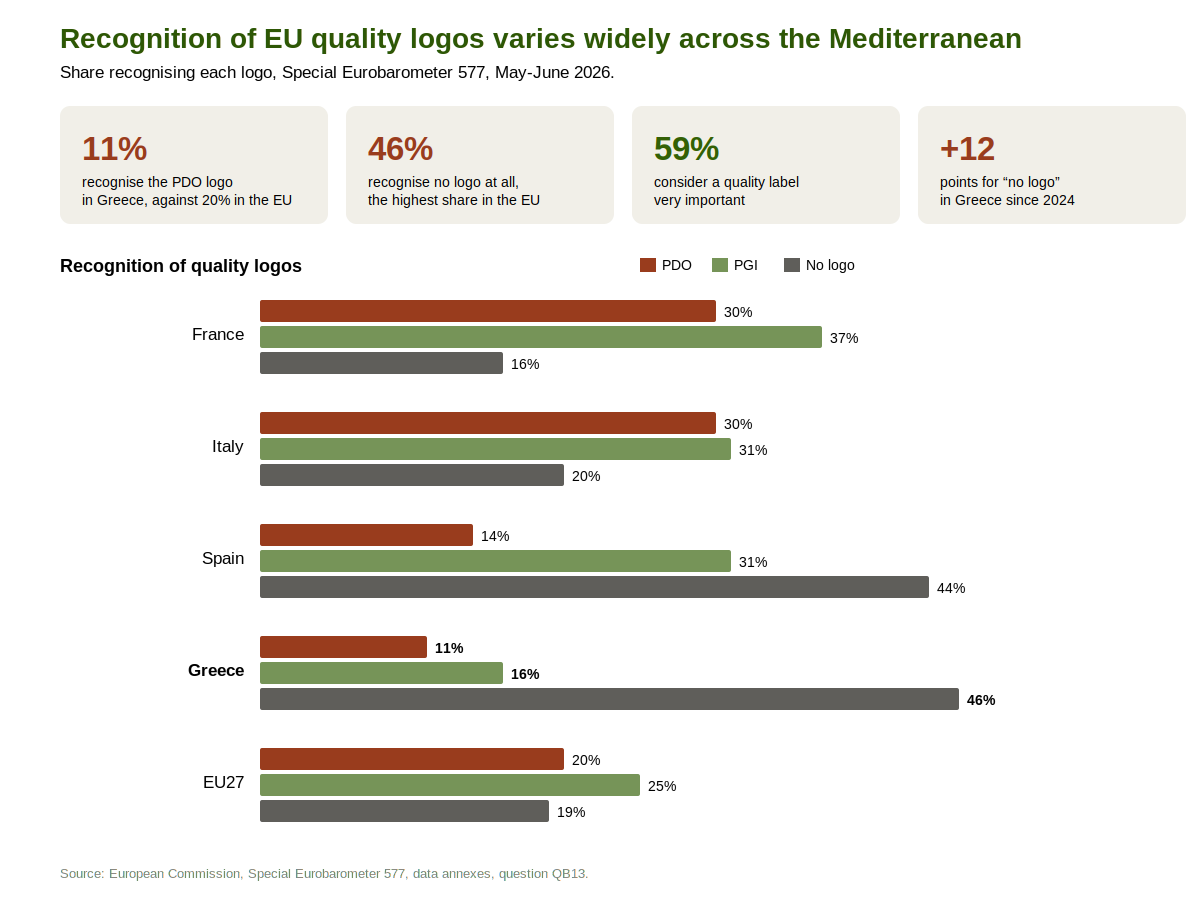
Recognition of quality logos in the four large Mediterranean producers. In France and Italy 30% know the PDO logo, while in Spain and Greece close to half recognise no logo at all. Source: European Commission, Special Eurobarometer 577.
Europeans are steadily getting to know the quality logos
At EU level, awareness of all five logos has risen steadily since 2013. The organic farming logo, the best known, is now recognised by 58% of Europeans, against 25% in 2013, though still below its 2022 peak of 61%. The PGI logo rose from 14% to 25%, Fairtrade from 37% to 47%, the PDO logo from 13% to 20% and the Traditional Speciality Guaranteed logo from 12% to 18%.
The differences between countries are large. The PDO logo is best known in Slovakia, at 38%, followed by France and Italy at 30%, while the PGI logo is most widely recognised in Slovakia at 38%, France at 37% and Austria at 34%. The lowest PDO awareness is found in countries with few such products, such as Denmark and Latvia at 5%.
The four large Mediterranean producers differ sharply
France, Italy, Spain and Greece all have many PDO and PGI products, but their consumers know the logos to very different degrees. In France and Italy, 30% recognise the PDO logo and only 16% and 20% respectively recognise none. In Spain, 14% know the PDO logo and 44% recognise none, and in Greece the figures are 11% and 46%, which leaves Greece with the lowest PDO and PGI awareness of the four.
The Greek picture has worsened since 2024. The share recognising no logo rose by 12 points, and awareness fell for every logo, by 13 points for organic farming, the second largest fall in the EU after Cyprus, by 8 points for Fairtrade and PGI, by 6 points for Traditional Speciality Guaranteed and by 4 points for PDO. The fall for Fairtrade is the largest in the EU, and the fall for Traditional Speciality Guaranteed the joint largest with Poland. In Spain the share recognising no logo also rose by 10 points, while in France and Italy it fell.
Greeks value origin more than the other Mediterranean consumers
The gap widens when set against what consumers look for when buying food. Of the four countries, Greeks place the most weight on every characteristic that PDO and PGI logos certify. A specific label guaranteeing quality is very important for 59% of Greeks, 56% of Italians, 49% of Spaniards and 37% of French respondents. Coming from a geographical area they know is very important for 59% of Greeks, against 46% of Spaniards, 45% of Italians and 39% of the French, and respect for local tradition and know-how for 62% of Greeks, against 48% to 49% in the other three.
France shows the opposite pattern. French respondents give a quality label the least importance of the four, at 37%, and recognise the logos more than any of the other three. Recognising a logo, in other words, does not automatically follow from how much consumers care about what it guarantees, and Greece is the clearest example.
Awareness depends on education and age
Across the EU, the report records large differences between social groups. Respondents who finished full-time education at 15 or earlier are far more likely to recognise no logo than those who studied to 20 or beyond, at 43% against 12%. Those aged 55 and over show the lowest awareness of every logo and those aged 25 to 39 the highest, with a gap of five to ten points. Respondents who see themselves as working class are more likely to say they know none of the logos, at 28%.
PDO and PGI producers sell to consumers who look for origin
For Greek producers of PDO and PGI products, the survey shows two things at once. Greek consumers already want what the PDO and PGI schemes certify, a known origin, tradition and guaranteed quality, more strongly than the average European. At the same time, the logo meant to signal those characteristics on the shelf remains unknown to most of them, and its recognition is falling rather than rising.
The survey measures recognition of the logos, not knowledge of the products themselves. A consumer can know that feta or a local olive oil is a PDO product without recognising the European logo when shown it on its own. The finding still matters for anyone investing in certification, because the logo is the tool meant to carry the value of origin to products consumers do not already know, particularly at a time when the United States is challenging European geographical indications in trade negotiations.
Sources
- European Commission. (2026). Special Eurobarometer 577, Europeans, agriculture and the CAP. Report, section V.2, data annexes and country factsheets for Greece, Spain, France and Italy, 22 September 2026.
- European Commission. Geographical indications food and drink. Directorate-General for Agriculture and Rural Development.