The U.S. government took a controversial stance in the latest 2025 Special 301 Report, published on April 29th, 2025. The government claims that Geographical Indications (GIs), such as Protected Designation of Origin (PDO) and Protected Geographical Indication (PGI) used by EU producers, harm trade and restrict U.S. exporters' rights to use "common food names". This is seen as part of a bigger effort by the U.S. to put pressure on third countries, including the EU, through tariffs, in order to increase demand for American-made products over imported ones.
For many stakeholders in the agrifood sector, this sounds like a technical trade dispute. But the truth is that what's being debated here and the ongoing conflict between the U.S. and the EU could change how farmers and producers label, market, and protect their local products. The recent registration of the European Commission marked more than 3,500 GI-recognized products, highlighting the scale of this system.
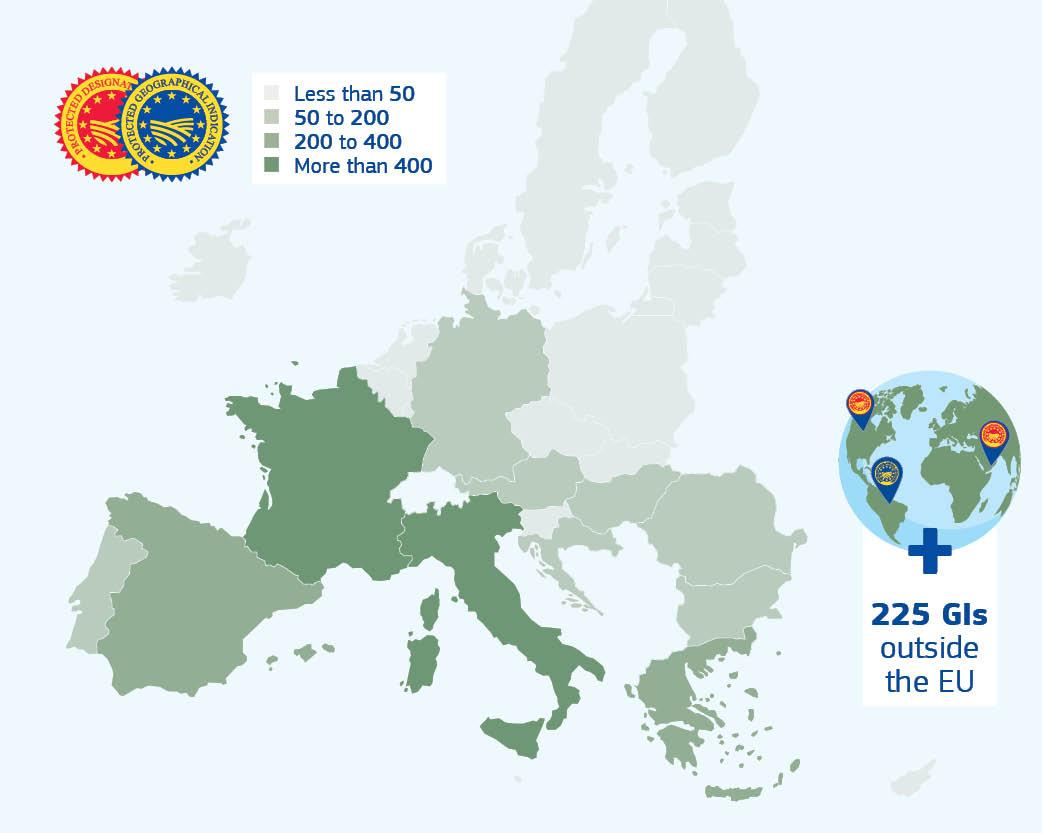
Source: European Commission
What Is the Special 301 Report?
Every year, the United States Trade Representative (USTR) publishes the Special 301 Report, which evaluates how other countries are protecting or, according to the US, failing to protect American intellectual property (IP) rights. In the 2025 edition, the U.S. continues to express strong concern over the European Union's approach to Geographical Indications on food products like:
- Parmigiano Reggiano from Italy
- Roquefort cheese from France
- Kalamata olives from Greece
Here's a breakdown of the Special 301 Report regarding the U.S. position:
- The U.S. believes that the EU uses GIs to restrict fair market access, particularly when negotiating free trade agreements (FTAs).
- According to the report, GI protections in third countries (secured through EU agreements) "deny U.S. producers the ability to use common names like feta or parmesan".
- The report suggests that these practices are "opaque, discriminatory, and harmful" to U.S. exporters, especially small and medium-sized food producers.
A Closer Look: The GI Debate and Global Trade Implications
In the U.S., trademarks are important for food branding and intellectual property. These are typically owned by individual companies and emphasize brand recognition and corporate identity. By contrast, the EU's GI system is based on collective rights tied to geography, tradition, and production methods. A name like Roquefort or Prosciutto di Parma is not simply a label, but a seal of origin that connects the product to its specific cultural and environmental context.
The U.S. asserts that the EU's system functions as a non-tariff barrier, creating an uneven trading map. American producers exporting to countries that have signed FTAs with the EU may find themselves locked out from using well-known product names, even when those terms, like "feta" or "parmesan", are considered generic in the U.S. domestic market. According to the 2025 Special 301 Report, this leads to a kind of forced rebranding, where producers must label their products as "feta-style" or "parmesan-like" cheese. This adds marketing and packaging costs and can also undermine consumer confidence and how they perceive the product's quality and authenticity.
At the same time, it's important to recognize the original purpose of GIs, which is to safeguard local products, rural economies, and traditional know-how. For many producers within the EU and beyond, GIs offer a powerful tool to prevent imitation, maintain product quality, and add value through regional branding.
In the report, the U.S. mentions a trade imbalance that is associated with what they describe as excessive use of GIs. In the dairy sector, for instance, the EU exported over $1.4 billion in cheese to the United States, while the U.S. managed only $6.3 million in cheese exports to the EU. The U.S. believes that its producers are operating under asymmetric rules, with the EU enjoying full access to the American market under existing trademark protections. At the same time, reciprocity is denied to American exporters under the EU's GI regime.
Compounding these concerns are recent EU policy changes. The expansion of the GI system to non-agricultural goods, such as textiles, ceramics, and glassware, raises fears in Washington that even more sectors may face restrictive labeling and market access rules. The new Common Agricultural Policy (CAP), will decentralize GI registration review and reduce timelines for certification, and has drawn a lot of criticism for weakening procedural transparency and limiting opportunities to challenge new GIs.
Expert's Responses: GIs Aren't Barriers, They're Identity
In a strongly worded submission to the USTR, oriGIn (Organization for an International Geographical Indications Network) rebuts these claims, calling them inaccurate, biased, and misleading.
Not All Terms Are Generic
Experts emphasize that terms like "cheddar" or "mozzarella" are not protected under GIs. But names like Parmigiano Reggiano or Greek Feta Cheese in the EU are not generic but deeply tied to specific traditions, geographies, and production methods. The EU is not trying to block competition; the purpose of GIs is to preserve cultural heritage and ensure truth in labeling.
Consumers Need Clarity
Allowing anyone to label cheese "Parmesan" regardless of origin misleads consumers and devalues authentic products. GIs help consumers know what they're buying and foster competition based on quality and origin. When a consumer buys "Prosciutto di Parma," they expect it to come from Parma, Italy. Without GIs, any producer anywhere could use the name, confusing buyers and undercutting authentic producers who follow strict standards.
GIs Are Legally Backed
The TRIPS Agreement recognizes GIs as a legitimate form of intellectual property under WTO and WIPO standards. The EU, therefore, is not misusing GI indications and follows global norms and builds trade frameworks accordingly.
Final Thoughts: Why Should EU Farmers Care?
For farmers and agrifood stakeholders, this debate isn't just about international trade policy. It's about protecting identity, ensuring fair income, and securing the future of rural economies. Geographical Indications (GIs) give traditional products value and uniqueness. Producers can achieve higher prices, guard against unfair competition, and support local jobs and biodiversity with proper GI protection. At stake is not just a name, but the integrity of food traditions and the livelihoods behind them.