


In October 2026 the price of one tonne of urea bought 14.7 MMBtu of natural gas in Europe, the lowest ratio since December 2022, as the natural gas price rose 12.1% during the month and the urea price only 3.1%, according to a Wikifarmer analysis of the monthly commodity prices the World Bank published in early November. The comparison matters to nitrogen buyers because natural gas is the main feedstock for ammonia and urea, and because in the northern hemisphere nitrogen top-dressing of winter cereals takes place mainly from late winter into spring.
European natural gas reached its highest price since December 2022
The European natural gas price reached $28.50 per MMBtu in October 2026, 12.1% above the $25.42 of September and 2.6 times its October 2025 level of $10.89 (World Bank). It is the highest monthly price since December 2022, when gas cost $36.04, and the price has risen every month since June, so the increase from that month's $15.17 comes to 87.9%. Over the last three months alone, from July, the price rose 57.8%, which means the sharp rise that began in September is still under way on the definition used in Wikifarmer's analysis of urea and natural gas prices, a rise of 50% or more within three months.
The urea price rose for a second month in a row
The f.o.b. Middle East urea price was $420 per tonne in October, 3.1% above the $407.5 of September, after $390 in August, the lowest price of 2026 so far. Compared with October 2025 the price is 6.5% higher, while in September it was 11.6% lower than a year earlier. The switch comes mostly from the base of comparison, since last year the urea price fell from $461.1 in September to $394.4 in October, a drop of 14.5% in one month. The October price is still 51.0% below the $856.9 of April, the highest price of 2026, recorded at a time when the crisis in the Middle East was disrupting shipping through the Strait of Hormuz.
The urea to gas ratio has fallen every month since April
The ratio of the urea price to the natural gas price shows how many MMBtu of gas match the price of one tonne of urea. In April 2026 it stood at 55.6, the highest of all months since March 2022, the period in which the World Bank urea price refers to the Middle East, and it has fallen every month since, to 47.6 in May, 29.9 in June, 22.1 in July, 18.5 in August, 16.0 in September and 14.7 in October. A year earlier, in October 2025, the ratio was 36.2, and its median from March 2022 to September 2026 is 29.0, so it now stands at about half the usual level of those years.
In the months since March 2022 in which the World Bank urea series refers to the Middle East, the ratio was lower in only four, all during the energy crisis of 2022: July (11.7), August (8.4), September (11.5) and December (14.4). The ratio compares two international prices and does not show the production cost or the margin of any fertiliser plant.
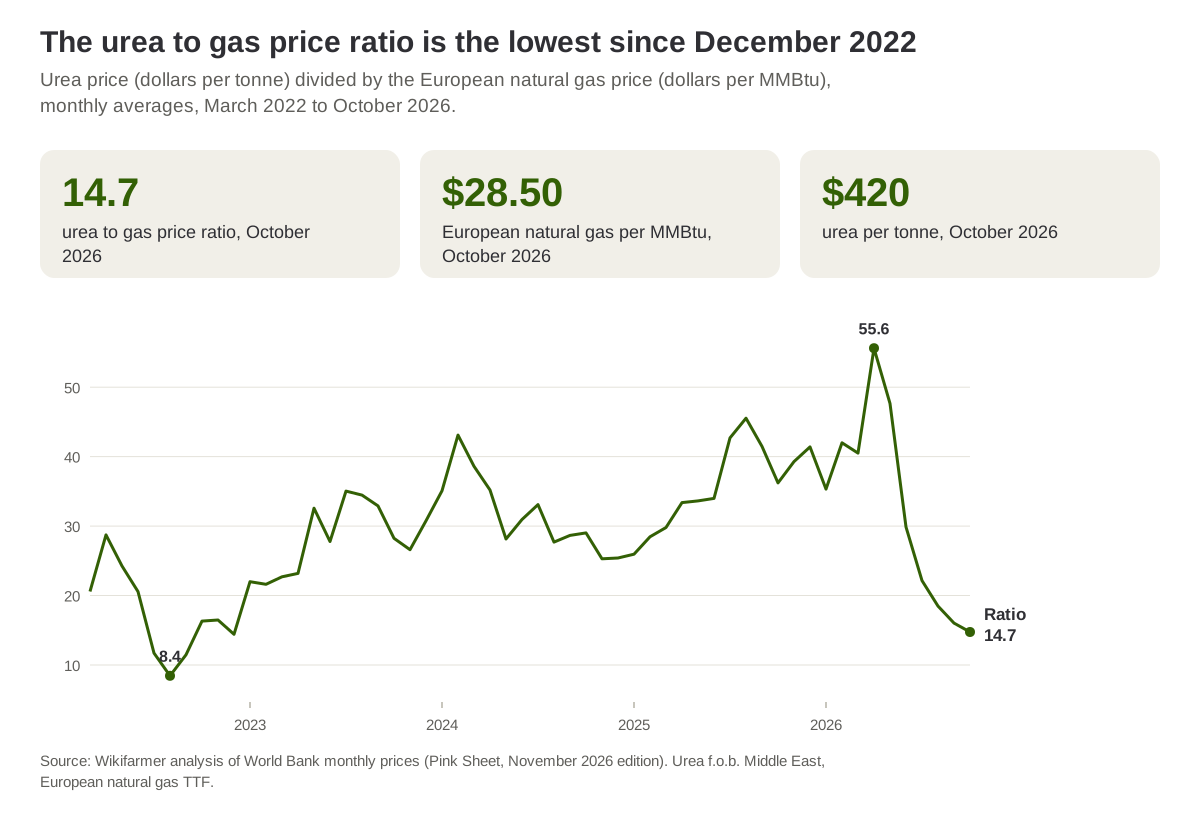
Source: Wikifarmer analysis of World Bank monthly prices (Pink Sheet, November 2026 edition).
The DAP price reached its highest level since May 2022
Among phosphate fertilisers, the price of diammonium phosphate (DAP) was $803.1 per tonne in October, almost unchanged from September with a rise of 0.3%, but the highest since May 2022 and 6.5% above a year earlier. Already in September a tonne of DAP cost as much as 2.31 tonnes of wheat, a ratio exceeded in only 34 of the 717 months since 1967. The price of potassium chloride, by contrast, fell 2.7% in October to $357.5 per tonne.
Since June the gas price rose 87.9% and the urea price fell 7.3%
For farmers, cooperatives and traders planning nitrogen purchases for late-winter and spring applications in the northern hemisphere, the urea price has so far not followed the rise in natural gas, since the gas price rose 87.9% from June while the urea price fell 7.3%, from $453.1 to $420 per tonne. In the five earlier sharp rises in gas prices since 1985, the urea price was higher three months later in only two, so the current gap does not on its own show what the next move will be.
Buyers comparing nitrogen forms weigh the fact that the price per kilogram of nitrogen is one of the criteria for choosing between urea and ammonium nitrate, along with losses in the field and the timing of application. On the revenue side, EU milling wheat prices in October were above a year earlier in all 25 markets with complete data, a comparison that matters to anyone weighing the cost of fertiliser against the price of the crop.
The figures describe what prices did and are not a forecast. November prices will appear in the World Bank's next monthly edition, and the first complete three-month period after the September rise will close with the December prices, in the January 2027 edition.
The analysis uses World Bank monthly prices (Pink Sheet, November 2026 edition with data to October, retrieved on 4 November 2026), as monthly averages in current dollars, not the prices farmers pay in each country. Urea is f.o.b. Middle East from March 2022 and f.o.b. Black Sea before that, so comparisons of the ratio start in March 2022, and the European natural gas price is the TTF price from April 2015. DAP is f.o.b. US Gulf and potassium chloride is CFR Brazil. The urea to gas ratio is a simple quotient of two prices in different units and is not an estimate of production costs. The IMF urea series had not been published for October at the time of the analysis. All figures were recomputed independently from the original file.
Sources
- World Bank. (2026). Commodity Markets, Pink Sheet monthly historical prices (November 2026 edition). World Bank Group.