
One of the most frequent decisions a grower faces each spring is whether to top-dress with urea or with ammonium nitrate. The two look interchangeable, yet they behave very differently in the soil, and the right choice depends on the season, soil type, and method of application.
The first difference is concentration. Urea carries 46% nitrogen and ammonium nitrate 34.5%, so ten kilos of nitrogen require about 22 kg of urea or 29 kg of ammonium nitrate. Per unit of nitrogen, urea is cheaper. What decides the final result is how much of that nitrogen actually reaches the root before it is lost, the subject of our guide on nitrogen use efficiency.
Urea and its nitrogen losses
Urea is not directly taken up by the roots. It first has to be converted in the soil, with the help of the enzyme urease, into ammonium, which is then converted into nitrate nitrogen. While that conversion occurs at the soil surface, some of the nitrogen escapes into the air as ammonia gas and is lost forever.
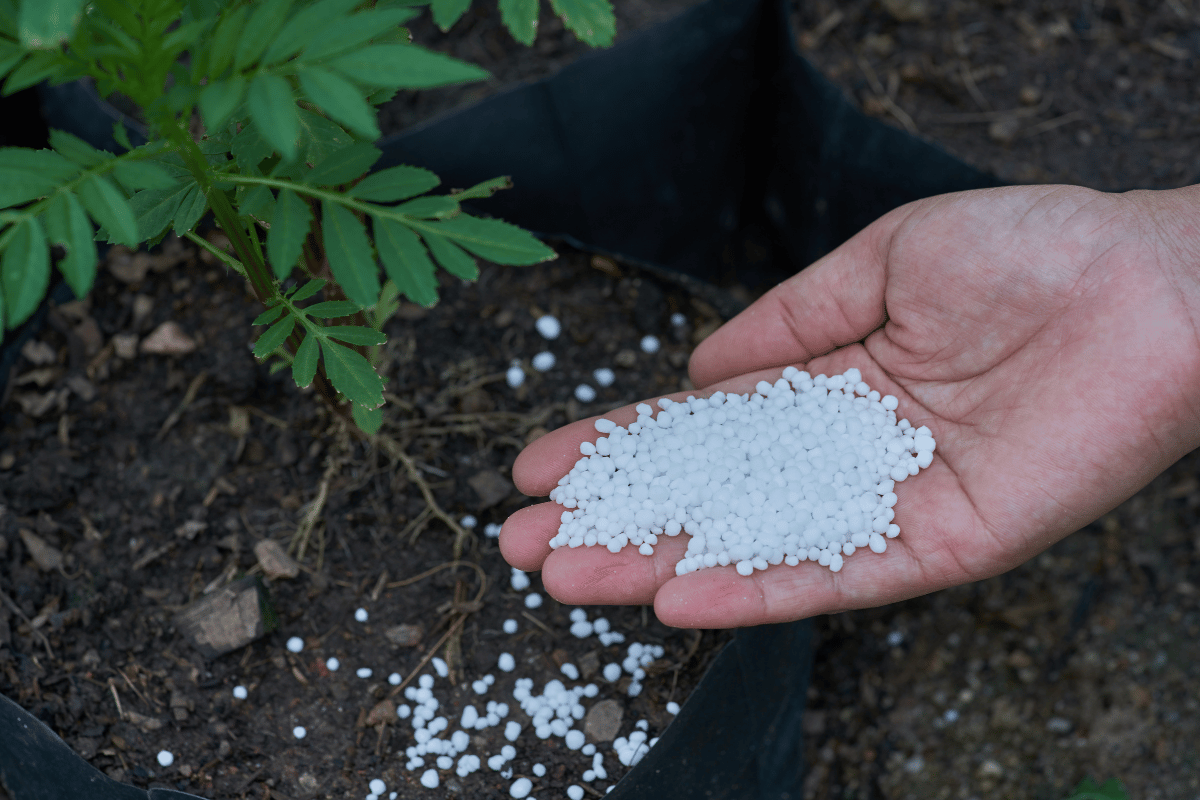
These losses grow under the conditions common across much of Greece, on warm, dry, calcareous soils, where they can run from 15% to as much as 60% of the nitrogen, with field trials averaging around 20%. To limit them, urea needs to be incorporated into the soil, or followed by irrigation or about 12 mm of rain within a few hours of application. In very cold soils, the opposite happens: conversion slows, and the nitrogen takes longer to become available.
Stabilized forms address this. Urea treated with a urease inhibitor (NBPT) slows the conversion for a few days, long enough for irrigation or rain to move the nitrogen into the soil, and noticeably reduces the losses.
Urea in fertigation and foliar sprays
Urea is fully water-soluble, making it easy to apply. Beyond surface spreading, it is used in fertigation and foliar sprays when the crop needs a rapid nitrogen supply. For foliar use, though, biuret matters. Biuret is a by-product of urea manufacture, and common granular urea usually carries 0.5% to 1.5% of it, harmless in the soil but above the 0.25% threshold considered safe for leaves. On sensitive crops such as citrus, stone fruit, and potato, biuret builds up in the tissue and causes leaf burn and chlorosis, so foliar applications call for a specialty low-biuret urea.
Ammonium nitrate and its fast action
Ammonium nitrate delivers half of its nitrogen directly as nitrate, which the roots take up immediately, with no conversion needed in the soil. It works quickly even in cold soil and suits early-spring top-dressing, when the crop needs nitrogen straight away. Volatilization losses stay minimal compared with urea.
Nitrate nitrogen, for its part, leaches easily. Heavy rain and light, sandy soils carry it down past the root zone. This weighs heavily in areas designated as nitrate vulnerable zones, such as the plain of Thessaly and Kopaida, where nitrogen fertilization is restricted. Storage also requires care, as ammonium nitrate draws moisture from the air and cakes if not stored properly. Because in its pure form it is treated as an explosive precursor and is regulated, it is often sold as calcium ammonium nitrate, at around 27% nitrogen.
Choosing by season and soil
In warm periods, when the fertilizer can be incorporated or watered in straight away, urea delivers the same nitrogen at a lower cost. In early spring or in cold soils, when the crop needs nitrogen immediately, and there is no time to incorporate, ammonium nitrate or its calcium form is the safer choice. On calcareous, alkaline soils with surface application, either ammonium nitrate or stabilized urea keeps the nitrogen from escaping into the air.
Cotton, which requires heavy nitrogen applications throughout the season, clearly shows that the combination of form and timing determines the final yield. More on the crop's needs in our guide to cotton fertilization.
On Farmclick you can compare prices for urea 46-0-0 and ammonium nitrate from suppliers across Greece and see the real cost per unit of nitrogen before you order.
Browse fertilizer raw materials on Farmclick, along with granular compound fertilizers and the full fertilizers category.
Sources
Khan, M., et al. (2024). Optimizing nitrogen sources in top dressing for wheat, a field study on growth, yield, and ammonia volatilization. Applied and Environmental Soil Science.
Mississippi State University Extension. (2021). Urea-based fertilizers in forage production.
Li, G., et al. (2020). Agronomic evaluation of polymer-coated urea and urease and nitrification inhibitors for cotton production under drip-fertigation. Scientific Reports.
Geisseler, D. (UC Davis). Citrus production in California, nitrogen. University of California, Davis.
Zekri, M. (UF/IFAS). Foliar fertilization of citrus, low-biuret urea. University of Florida.