
From 1 November to midday on Tuesday 3 November 2026, National Observatory of Athens stations recorded 287.8 mm of rain on Thasos, 165.0 mm on Samos, 115.8 mm in Xanthi, 109.6 mm in Kalamata and 105.0 mm on Corfu. The rain on Monday and Tuesday came with storm Agneta, for which the Hellenic National Meteorological Service (HNMS) kept a red warning in force until Tuesday afternoon for eastern Macedonia, Thrace and the north-east Aegean islands, while Sunday's rain fell the day after a weather deterioration bulletin that HNMS had issued on Saturday 31 October. In olive groves, the autumn plant protection bulletins link rain with peacock spot and anthracnose infections. In Drama the cotton harvest was still under way on 27 October, and according to the European Commission's Joint Research Centre, winter cereal sowing had not started on a large scale by 26 October. The Patras plant protection centre advises growers in its area to assess whether a curative fungicide is needed straight after rain in unprotected olive groves, the cotton bulletins advise stalk shredding and ploughing as soon as harvest is over, and crop losses from excessive or untimely rainfall are insured by the Hellenic Agricultural Insurance Organisation (ELGA).
HNMS kept the red warning in the north-east until Tuesday afternoon
Emergency Bulletin of Dangerous Weather Phenomena 9/2026, issued by HNMS at 13:00 on Monday 2 November and valid until 20:00 on Tuesday, upgraded the Emergency Weather Deterioration Bulletin 16/2026 of Saturday. For the storm, named Agneta by the Italian meteorological service, HNMS forecast heavy rain and thunderstorms, possibly with local hail and frequent lightning. On Monday the red warning applied from the evening to Corfu, Paxi and Epirus, mainly the coast, and at times into the night for the eastern Aegean islands from Chios southwards and the Dodecanese. For Tuesday, the bulletin and its update at 00:00 that day gave a red warning from the early morning, first in western and then in central and eastern Macedonia, including Thasos and Samothraki, Thrace, Limnos, Agios Efstratios and Lesvos.
In its update at 12:00 on Tuesday, valid until 17:00, HNMS wrote that there were no substantial changes from the previous bulletin and kept the red warning until the afternoon only for eastern Macedonia, Thrace and the north-east Aegean islands. It gave an orange warning until the afternoon for Epirus, western Central Greece, the western and southern Peloponnese, the remaining eastern Aegean islands from Chios southwards and the Dodecanese. In the HNMS warnings on Meteoalarm, as they stood at 11:04 Greek time on Tuesday, the expected rain for Central and East Macedonia and Thrace was 30 to 60 mm in 12 hours, and Thessaly had a yellow warning for moderate rain. Thessaly is not named in the HNMS emergency bulletin or in either of its updates.
Thasos recorded the most rain with 287.8 mm
On Thasos, 194.0 of the 287.8 mm fell on Sunday 1 November, before the emergency bulletin for Agneta, while on Samos 133.2 of the 165.0 mm fell on Monday, the day of the red warning for the eastern Aegean. On Tuesday up to midday, Thasos recorded another 58.4 mm, Kilkis 47.0 mm, Drama 39.0 mm and Xanthi 37.2 mm. Over the three days the Larissa station recorded 19.8 mm and Mytilene 24.4 mm, far less than Thasos and Xanthi.
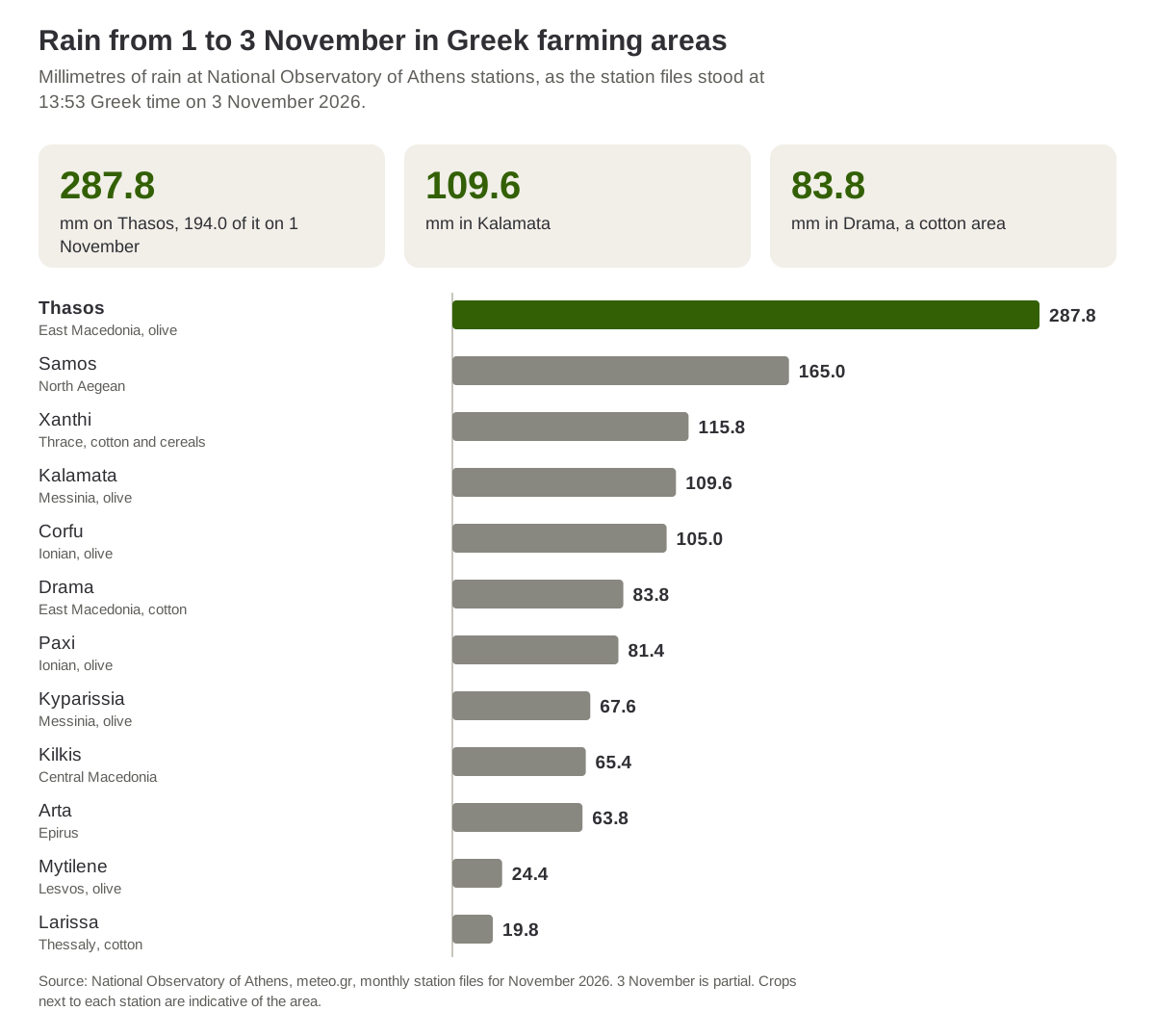
Source: Wikifarmer analysis of the monthly station files of the National Observatory of Athens (meteo.gr), as they stood at 13:53 Greek time on 3 November. 3 November is partial.
In some areas the rain fell on soils that had already taken a lot of water. In NASA POWER data, rainfall over the 30 days to 31 October was 115.1 mm at a point in Pieria, 229% of the 1991 to 2020 average for the same period, 106.3 mm near Larissa, 203%, and 121.8 mm on Lesvos, 253%. In Messinia, by contrast, it was 84% of the average, and on the Xanthi and Rhodope plain 92%. In its MARS bulletin of 26 October, the Joint Research Centre (JRC) wrote that abundant rain in mid-October had replenished soil moisture in Greece ahead of winter crop sowing.
Rainfall passed 100 mm in Kalamata and Corfu
In Messinia, the Kalamata station recorded 109.6 mm, 53.2 mm of it on Monday, Kyparissia 67.6 mm, Filiatra 65.0 mm and Pylos 30.2 mm, while in Laconia Molaoi had 58.0 mm and Sparta 44.6 mm. In the Ionian Islands, Corfu recorded 105.0 mm, Paxi 81.4 mm and Zakynthos 55.4 mm. In Epirus, Arta had 63.8 mm, Igoumenitsa 63.4 mm, Preveza 54.2 mm and Ioannina 51.2 mm, and in Aetolia-Acarnania Agrinio had 47.4 mm, 35.0 mm of it on Tuesday. For Ilia, the Pyrgos and Amaliada stations had no November data in the files we retrieved, and neither did the Kefalonia station.
The Regional Centre for Plant Protection in Patras, in its olive bulletin of 16 September covering Aetolia-Acarnania, Achaia, Ilia, Messinia, Kefalonia, Zakynthos and Ithaca, writes that secondary infections of peacock spot and anthracnose begin with the autumn rains. According to the Ioannina centre's bulletin of 30 September, peacock spot infections are favoured by mild temperatures of 10 to 20 °C and by rain or very high humidity, and growers should take particular care with the susceptible Kalamon variety and with groves in humid areas. Over the three days of rain, with Tuesday counted to midday, the mean daily temperature was 16.6 to 18.0 °C in Kalamata, 15.0 to 16.4 °C on Corfu and 14.9 to 15.6 °C in Arta, within the range the bulletin gives.
The Thessaly plain had less rain than Thrace and Thasos
Stations on the Thessaly plain recorded from 19.8 mm in Larissa to 41.8 mm in Trikala, with 21.4 mm in Karditsa and 20.4 mm in Farsala, while Volos had 31.8 mm. In Magnesia, according to the third and last cotton bulletin of 30 October, harvesting began in the last ten days of September and was completed by mid-October, with higher production thanks to favourable conditions in summer and in the days before harvest. The Larissa bulletin of 29 October gives no harvest percentage and advises growers, as soon as harvest is over, to shred the stalks and then plough with a mouldboard plough to a depth of 20 to 25 cm, whatever crop follows. According to the bulletin, this destroys a large part of the cotton bollworm pupae that overwinter in the soil and is the most effective way to control pink bollworm, which overwinters in the remaining bolls, seeds and stalks.
Cotton around Giannitsa was almost all harvested by 21 October
In central Macedonia, Kilkis recorded 65.4 mm, Polygyros 37.2 mm, Serres 36.6 mm, Thessaloniki 36.0 mm and Giannitsa 34.2 mm, with most of the rain falling on Tuesday in Kilkis, Thessaloniki and Polygyros, while in western Macedonia Florina had 51.2 mm and Kozani 40.8 mm. In the area of the Giannitsa Department of Agricultural Economy, according to the Pella bulletin of 21 October, 90 to 100% of the cotton had been harvested, in a relatively early season, about 10 to 17 days ahead of past years, with relatively high yields. We found no official bulletin this year giving the harvest stage of kiwifruit in Pieria, and we got no November data for the Katerini, Veria and Edessa stations, so the only measurement we have for the area is the wet October at the Pieria point. We also found no official bulletin on the stage of the olive crop in Chalkidiki.
Cotton harvesting in Drama was still under way on 27 October
Apart from Thasos, in eastern Macedonia and Thrace the Xanthi station recorded 115.8 mm and Drama 83.8 mm. In the Drama cotton bulletin of 27 October, harvesting was still under way. After harvest, the Drama and Evros bulletins advise shredding the stalks and crop residues with a flail mulcher and ploughing with soil inversion to a depth of 20 to 25 cm in every cotton field, to reduce cotton bollworm overwintering in the soil, and the Drama bulletin adds pink bollworm, which overwinters in bolls and stalks. On heavy clay soils, the same bulletin advises 2 to 3 units of nitrogen (in Greek usage, kg of N per stremma, that is 20 to 30 kg N per hectare) as ammonium or urea fertiliser before ploughing, so that the residues break down better.
For the olives of Thasos, where the most rain fell, we found no autumn bulletin giving the stage of the crop. The JRC reported on 26 October that the potato harvest was continuing in northern Greece, with yields varying with the weather and water constraints.
Winter cereal sowing had not started on a large scale by 26 October
In the same MARS bulletin, the JRC writes that Greek farmers were preparing fields for sowing winter cereals, that sowing had not started on a significant scale, and that it was expected to begin in late October or early November, depending on soil moisture. Agneta arrived in the days when the JRC expected sowing to begin, with 37.2 mm in Xanthi, 39.0 mm in Drama and 47.0 mm in Kilkis on Tuesday up to midday alone.
On Lesvos the rain followed a wet October
In the eastern Aegean, Samos recorded 165.0 mm, Kos 63.6 mm and Chios 51.4 mm, while on Lesvos, which was under the red warning on Tuesday, the Mytilene station had 24.4 mm from Sunday to midday on Tuesday, 11.4 mm of it on Tuesday. At the Lesvos point, rainfall over the 30 days to 31 October was 253% of the average in NASA POWER data. We found no autumn olive bulletin for the north-east Aegean. On Crete, where October rain fell before the olive harvest, the Heraklion and Chania stations recorded 17.0 mm and 13.0 mm.
The Patras centre advises assessing the need for a spray straight after rain in unprotected olive groves
The olive bulletins of the Regional Centres for Plant Protection were issued in September and October, before the storm, and each one covers the area of the centre that issued it, so applying them to a given grove is a decision to take with an agronomist.
- After rain: in unprotected olive groves, the Patras centre advises assessing whether a curative fungicide is needed straight after rain, and the Ioannina centre notes that sprays can also be applied after rainfall.
- Severe peacock spot: the Ioannina centre advises repeating the spray in the first ten days of November.
- Ripening fruit: for olive anthracnose, which according to the Ioannina centre causes a significant loss of production and lowers olive oil quality, the same centre writes that a second spray is needed about 25 days after the first if the weather favours the fungus, and that mummified fruit, on the ground and on the tree, must be collected and destroyed.
- Hail and frost: the Volos centre, in its bulletin of 1 October, advises a copper spray straight after hail or frost and, in groves where olive knot has spread, one application after wet and windy weather.
- Harvest: to limit olive knot, which starts from wounds left by pole beating, pruning, frost and hail, the Ioannina centre advises against harvesting by beating and in wet weather.
- Residues: the Patras centre asks growers to take into account the ripening stage of the fruit and the interval between application and harvest, so that residues stay within the permitted limits.
Messinia extra virgin olive oil was at 3.40 euros per kg before Agneta
In European Commission price data, extra virgin olive oil in Messinia was at 3.70 euros per kg in the week from 21 September, 3.50 euros in each of the following two weeks and 3.40 euros in the week from 12 to 18 October, the most recent week available on 3 November. In the same week the national average was 3.45 euros for extra virgin, 3.00 euros for virgin and 2.00 euros for lampante. No price has yet been published for the days after the storm, and we found no official record of how olive mills and cotton gins operated after the rain.
ELGA insures crops against excessive or untimely rainfall
The Hellenic Agricultural Insurance Organisation (ELGA) insures and compensates crop production for losses from hail, frost, windstorm, flood, heatwave, excessive or untimely rainfall, snow and seawater, and runs state aid programmes under approved regulations for natural risks it does not cover. Its home page points growers to its online services, its regional offices and the 1540 information line. At 14:00 on 3 November, the ELGA home page carried no announcement about storm Agneta.
ECMWF forecasts little rain for the north until 10 November
The forecast of the European Centre for Medium-Range Weather Forecasts (ECMWF) issued at 00:00 UTC on 3 November gives, for 4 to 10 November at the nearest grid point, 3.3 mm for Thasos, 2.7 mm for Xanthi, 7.0 mm for Drama, 6.5 mm for Giannitsa, 4.5 mm for Larissa and Samos and 6.2 mm for Mytilene. In the west the forecast gives more rain, with 25.1 mm for Arta, 22.7 mm for Filiatra, 19.3 mm for Corfu and 13.5 mm for Kalamata. This is a single model run and can change with each new forecast.
Frequently asked questions
Where did the most rain fall?
At National Observatory of Athens stations, from 1 November to midday on 3 November, Thasos recorded 287.8 mm, Samos 165.0 mm, Xanthi 115.8 mm, Kalamata 109.6 mm and Corfu 105.0 mm.
Should I spray my olive grove after Agneta?
For unprotected groves in Aetolia-Acarnania, Achaia, Ilia, Messinia, Kefalonia, Zakynthos and Ithaca, the Patras plant protection centre advises assessing whether a curative fungicide is needed straight after rain. The Ioannina centre advises repeating the peacock spot spray in the first ten days of November where infection is severe. The decision, the product and the dose are decided with an agronomist, using approved products and keeping to the interval before harvest.
What should I do in a cotton field after harvest?
The Larissa, Drama, Evros and Pella bulletins advise shredding the stalks and crop residues and then ploughing with soil inversion to a depth of 20 to 25 cm, whatever crop follows.
When will wheat sowing start?
On 26 October the JRC expected winter cereal sowing in Greece to begin in late October or early November, depending on soil moisture.
Which losses does ELGA insure?
ELGA insures crop production against losses from excessive or untimely rainfall, flood, hail, windstorm and other natural risks. For information, its home page points to its online services, its regional offices and the 1540 line.
Important notes
Rainfall figures are from National Observatory of Athens stations (meteo.gr), as the monthly station files stood at 13:53 Greek time on 3 November, so Tuesday's figures do not include the afternoon rain. The Kefalonia, Pyrgos, Amaliada, Veria, Katerini, Edessa and Rhodes stations had no November data in the files we retrieved. The warnings are from HNMS Emergency Bulletin of Dangerous Weather Phenomena 9/2026 and its updates at 00:00 and 12:00 on 3 November; we do not have the text of Saturday's deterioration bulletin 16/2026. The plant protection bulletins were issued between 16 September and 30 October, before the storm, and describe the crops as they were then. We found no official bulletin giving this season's stage for Pieria kiwifruit or for olives on Thasos, in Chalkidiki or on Lesvos. October rainfall is from NASA POWER, on a 0.5° by 0.625° grid, for the 30 days from 2 to 31 October, compared with the average for the same period in 1991 to 2020, at 40.2° N 22.4° E for Pieria, 39.6° N 22.4° E for Larissa, 39.2° N 26.3° E for Lesvos, 37.1° N 22.0° E for Messinia and 41.1° N 25.4° E for the Xanthi and Rhodope plain. The forecast is ECMWF's run of 00:00 UTC on 3 November, with totals from 00:00 UTC on 4 November to 00:00 UTC on 11 November at the grid point nearest each town. Olive oil prices are the weekly prices published by the European Commission, the most recent being the week of 12 to 18 October. The article was written in the early afternoon of 3 November, before the warning expired, and does not include a damage assessment.
Sources
- Hellenic National Meteorological Service (HNMS). (2026, 2 November). Emergency Bulletin of Dangerous Weather Phenomena 9/2026 (in Greek), with updates of 3 November 2026 at 00:00 and 12:00.
- Meteoalarm. Warnings for Greece, issued by HNMS, accessed 3 November 2026 at 11:04 Greek time.
- National Observatory of Athens, meteo.gr. (2026). Monthly climatological station data, November 2026, for example Thasos, Kalamata and Drama, accessed 3 November 2026.
- Ministry of Rural Development and Food of Greece. (2026). Agricultural warnings (in Greek), olive bulletins of the Regional Centres for Plant Protection in Patras (3/16-09-2026), Ioannina (4/30-09-2026) and Volos (8/01-10-2026).
- Regions of Thessaly, Central Macedonia, and East Macedonia and Thrace. (2026). Cotton plant protection bulletins (in Greek): Larissa (7th, 29-10-2026), Magnesia (3rd, 30-10-2026), Pella (21-10-2026), Drama (7th, 27-10-2026), Evros (5th, 19-10-2026).
- European Commission, Joint Research Centre. (2026, 26 October). JRC MARS Bulletin, Crop monitoring in Europe, Vol. 34 No. 9.
- NASA Langley Research Center. POWER Project, daily precipitation 1991 to 2026, accessed 3 November 2026.
- European Centre for Medium-Range Weather Forecasts. Open data, IFS 0.25°, run of 3 November 2026, 00:00 UTC.
- European Commission, DG AGRI. Agri-food data portal, olive oil prices, Greece, accessed 3 November 2026.
- Hellenic Agricultural Insurance Organisation (ELGA). Home page (in Greek), accessed 3 November 2026.