

The weather station at Peza, inland from Heraklion, recorded 223.6 mm of rain between 21 September and 20 October 2026, and 124.4 mm of it fell in the first three days of October, according to a Wikifarmer analysis of daily data from the station network of the National Observatory of Athens (meteo.gr). The rain came just before the autumn olive harvest on an island that, together with the Peloponnese, produces most of Greece's olive oil. In its forecast of 26 October, the European Centre for Medium-Range Weather Forecasts (ECMWF) expects weaker rain this week over most of the island than its forecast of 23 October showed.
Peza recorded 223.6 mm of rain in 30 days
Most of the rain at Peza, at 305 m above sea level, came with the storm of 1 to 3 October. The observatory's station in Chania recorded 127.0 mm over the same 30 days, with the wettest day on 14 October at 30.0 mm, while the station of the Hellenic Mediterranean University in Heraklion, on the coast, recorded 97.8 mm. For 1 to 20 October alone the totals were 175.2 mm at Peza, 79.8 mm in Chania and 59.4 mm in Heraklion, so rain fell very unevenly across the island.
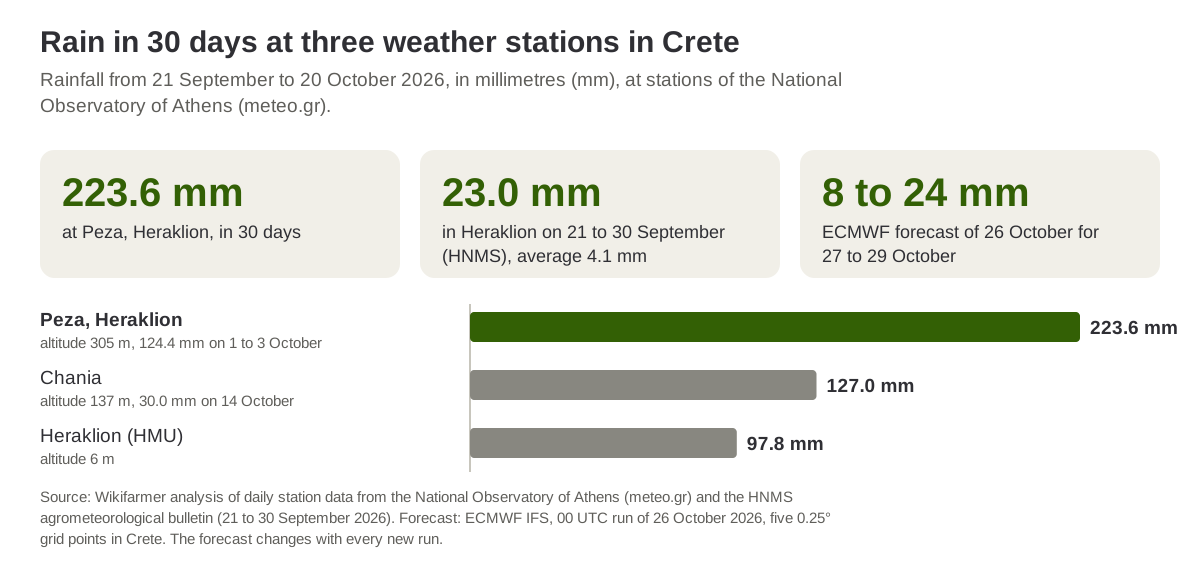
Source: Wikifarmer analysis of daily station data from the National Observatory of Athens (meteo.gr), the agrometeorological bulletin of the Hellenic National Meteorological Service for 21 to 30 September 2026, and the ECMWF IFS forecast of 26 October 2026 (00 UTC).
Seven stations in Crete passed 500 mm in 18 days
In an analysis published on 18 October, meteo.gr counted one station in Greece with more than 1,000 mm of rain between 1 and 18 October, four with more than 600 mm and seven with more than 500 mm, all seven in Crete. The highest total, 1,011 mm, was recorded at Xyloskalo in the Samaria gorge, Chania, followed by the gorge station itself with 764 mm, Anogeia in Rethymno with 693 mm, Askyfou in Chania with 631 mm, Sembronas in Chania with 538 mm, Potamoi in Lasithi with 503 mm and Tzermiado in Lasithi with 502 mm. These stations lie in Samaria and Sfakia, on Mount Psiloritis and in Lasithi, so their totals do not describe the olive groves of the lowlands, although they show how intense the storms were. Over the same period 97 of the 580 stations in the analysis, about 17%, recorded more than 100 mm.
Heraklion had more than five times its average rain in late September
The Hellenic National Meteorological Service (HNMS) reports in its agrometeorological bulletin 23.0 mm of rain at its Heraklion station for 21 to 30 September 2026, against an average of 4.1 mm for the same ten days in previous years and 0.6 mm in the same period of 2025. That rain fell on four days, so the storm of early October reached the Heraklion area after an already wet spell.
Chania recorded 11.0 mm of rain from 27 to 29 October
The National Observatory of Athens stations recorded 11.0 mm of rain in Chania from 27 to 29 October, 5.4 mm at Peza and 4.8 mm at Heraklion west, according to a Wikifarmer analysis of daily station data (meteo.gr), with 29 October counted only up to the time of the analysis. ECMWF's forecast of 26 October (00 UTC run) had given 8.1 to 23.8 mm for the same three days, with the highest value at the central Crete grid point, and the run of 23 October had given 84.0 mm at the central Crete point and 119.1 mm at the Chania point. At Peza, in central Crete, the rain that fell was less than a quarter of the 23.8 mm in the latest forecast.
The HNMS emergency weather bulletin 15/2026, issued on 25 October at orange level and valid until midnight between 28 and 29 October, forecast locally heavy rain and thunderstorms mainly in eastern Central Greece, Attica, Magnesia, Larissa, the Sporades, Evia, the Dodecanese and the eastern Aegean islands, and did not include Crete. No HNMS warning was in force on 29 October.
Autumn rain favours peacock spot and olive knot
In its bulletin of 28 September 2026 on autumn and winter olive protection, the Regional Centre for Plant Protection and Quality Control of Heraklion, part of Greece's Ministry of Rural Development and Food, notes that falling temperatures and rainy weather favour peacock spot (Spilocaea oleagina), a disease that attacks more strongly in autumn than in spring. The bulletin lists Throumbolia, Tsounati, Amfissis and Kalamon as particularly susceptible varieties, while Koroneiki is infected only in humid areas. For susceptible varieties it recommends a preventive spray with copper or other approved fungicides before the next rainy period, keeping to the pre-harvest interval on the label, and for copper products it asks growers to wait at least 21 days before harvest because of the effects on the oil.
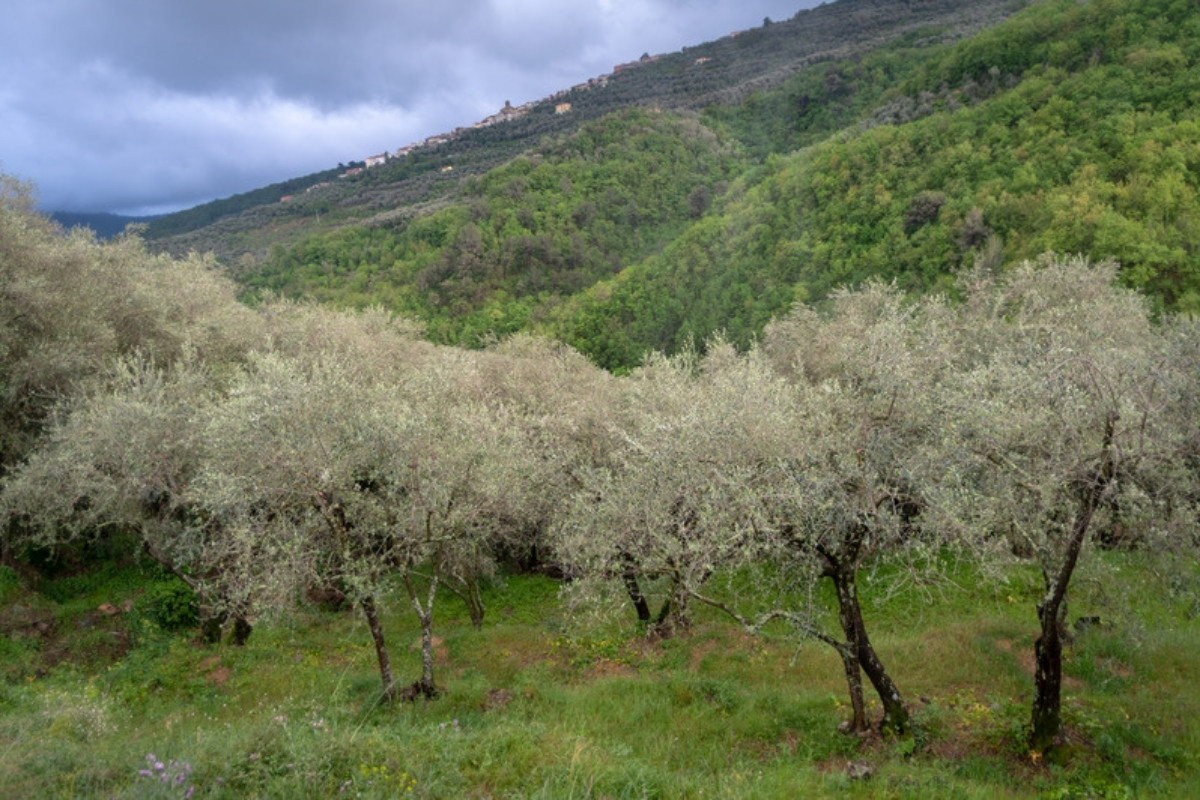
Olive knot (Pseudomonas savastanoi) spreads with water and enters through wounds and cracks, so the same bulletin advises against beating, pruning or cleaning trees in wet weather and asks growers to protect trees when they harvest by beating in a rainy period, since Koroneiki is very susceptible to the bacterium. The soft fruit rot caused by Camarosporium dalmaticum, which appears in autumn on half-ripe and ripe fruit, develops only on fruit attacked by the olive fruit fly, so how far it spreads depends on how well the fly was controlled in each grove. Every rain also decides when to pick after rain, since wet fruit weighs more without giving more oil.
No official estimate of crop damage has been published yet
The official sources Wikifarmer checked up to 26 October contain no estimate of whether the October rain changed the quantity or quality of Crete's 2026/27 olive oil. For growers, the station data show that the harvest starts after a very wet 30 days and that this week's rain, according to ECMWF's forecast, will be spread over several days, which matters for planning picking and spraying, while Greece's plant-protection bulletins for olives from the Heraklion regional centre give the advice for each area. For buyers of Cretan olive oil, the effect of the October rain can be measured once the harvest advances and the first figures from mills and the authorities are published.
Frequently asked questions
How much rain fell in Crete in October 2026?
From 1 to 20 October the Peza station in Heraklion recorded 175.2 mm, Chania 79.8 mm and Heraklion 59.4 mm, while Xyloskalo in the Samaria gorge reached 1,011 mm from 1 to 18 October. Adding the last ten days of September, Peza reached 223.6 mm in 30 days.
How much rain fell in Crete from 27 to 29 October?
The National Observatory of Athens stations recorded 11.0 mm in Chania, 5.4 mm at Peza and 4.8 mm at Heraklion west, with 29 October counted only in part, against 8.1 to 23.8 mm in ECMWF's forecast of 26 October. Forecasts change with every new run, so field work in the coming days needs the latest HNMS forecast.
Which olive diseases does autumn rain favour?
According to the bulletin of the Heraklion plant protection centre, rainy weather with falling temperatures favours peacock spot, while olive knot spreads with water through wounds such as those left by beating. The soft fruit rot caused by Camarosporium dalmaticum appears on fruit attacked by the olive fruit fly.
Does the rain affect the quantity or quality of Cretan olive oil?
The official sources checked up to 26 October give no estimate of quantity or quality. The picture will become clear when mills and the authorities publish figures during the harvest.
Why does rainfall differ so much from one station to another?
The highest totals were recorded at stations in Samaria, Sfakia, Anogeia and Lasithi, while totals at coastal stations such as Heraklion were much lower. Thunderstorms drop large amounts of rain over small areas, so two stations a few kilometres apart can record very different totals.
Important notes
Wikifarmer analysed daily data from the automatic stations of the National Observatory of Athens (meteo.gr), the HNMS agrometeorological bulletin and the ECMWF IFS numerical forecast. Station data are point measurements and do not describe every olive grove. The HNMS average is the average of previous years as given in the bulletin. The forecast is the deterministic 00 UTC run of 26 October 2026 on a 0.25 degree grid, about 25 km, at 35.25° N 25.00° E (central Crete), 35.25° N 25.25° E (Heraklion), 35.50° N 24.00° E (Chania), 35.00° N 24.75° E (Messara) and 35.00° N 25.75° E (Ierapetra), and it changes with every new run. The article does not estimate damage and does not give spraying advice. Every treatment follows the official plant-protection bulletins, the product label and the advice of an agronomist.
Sources
- National Observatory of Athens, meteo.gr. (2026, October 18). October 2026, very high rainfall in Crete in the first 18 days of the month (in Greek).
- National Observatory of Athens, meteo.gr. (2026). Monthly climate data for the stations of Peza (October, September), Chania (October, September) and Heraklion, Hellenic Mediterranean University (October, September), retrieved 23 October 2026. The files are updated every month.
- Hellenic National Meteorological Service. (2026). Agrometeorological bulletin, 21 to 30 September 2026 (in Greek).
- Hellenic National Meteorological Service. (2026, October 25). Emergency weather bulletin 15/2026 (in Greek).
- European Centre for Medium-Range Weather Forecasts. (2026). ECMWF open data, IFS forecast, 00 UTC run of 26 October 2026.
- Ministry of Rural Development and Food, Regional Centre for Plant Protection and Quality Control of Heraklion. (2026, September 28). Agricultural warnings, olive protection for autumn and winter (in Greek).