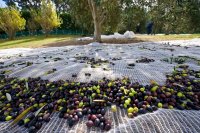

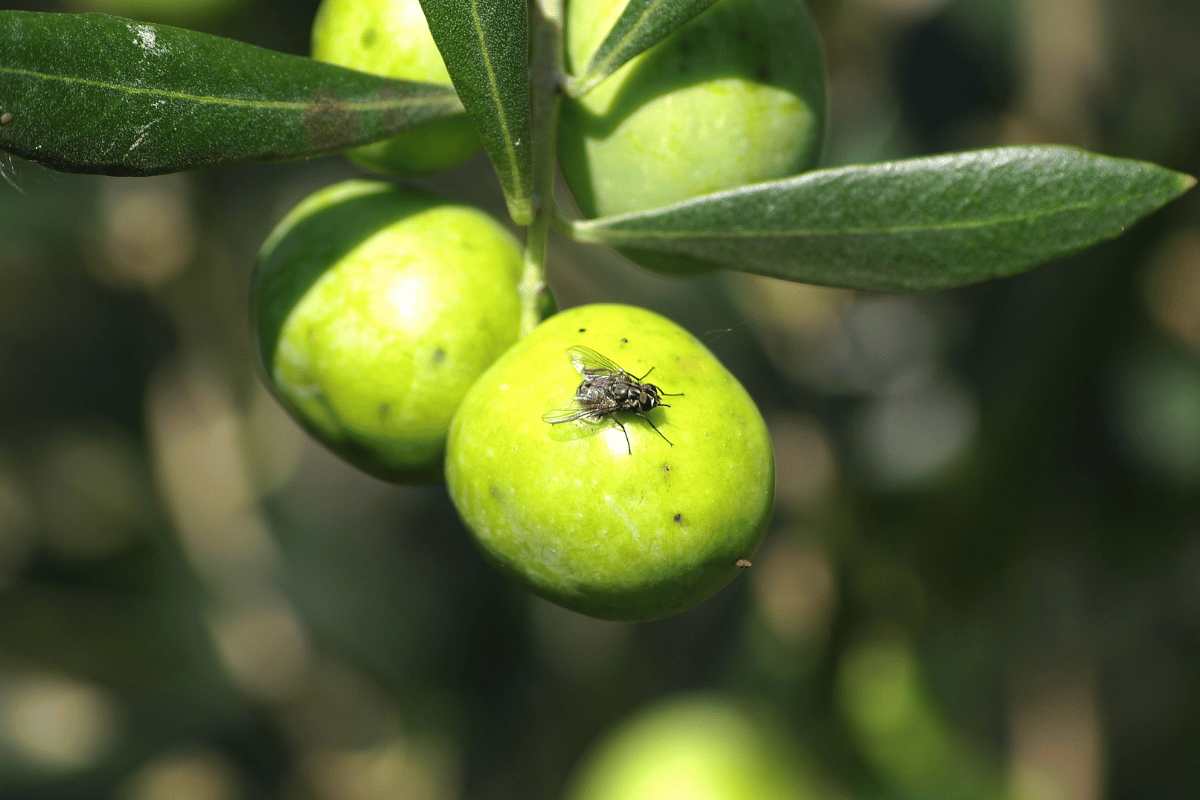
Across most of Greece's olive-growing regions, fruit set is complete, and the young olives have already reached the size of a wheat grain. This is when the carpophagous, or fruit-feeding, generation of the olive moth begins, the most damaging of the year, and the plant-protection bulletins issued by the Greek Ministry of Rural Development and Food for Crete, Eastern Macedonia and Thrace, and Central Greece all agree that June decides a large share of the crop.
Below, we bring together what each region's bulletin shows and when treatment is advised. The dates are indicative, and every grove needs to be treated as a separate case, based on its own pheromone traps and the most recent local bulletin.
Why the olive moth's fruit generation is the most dangerous
The olive moth closes its annual cycle with the fruit-feeding generation, whose larvae develop exclusively inside the olive stone. The female lays its eggs on the calyx of the small fruit, and as soon as the larva hatches, it bores straight inside. The damage comes in two waves. Some of the infested fruit blackens and drops early in summer, the so-called "pepper" drop, while the rest fall in September, when the mature larva leaves the fruit and severs the stalk, the "kalogri" drop.
In this generation, there is no tolerance for damage, because every fruit lost is an irreplaceable loss of yield. Timing is everything. The larva does not wander on the fruit surface but enters immediately, so the insecticide has to be on the fruit at the moment of hatching. That is why the spray targets young larvae right after they hatch, before they can bore into the fruit.
When treatment is applied, changes from region to region, depending on how far the flight has progressed and the size of the fruit.
| Region | Crop status | Indicative spray window |
|---|---|---|
| Crete (Heraklion), mid-early zone Bulletin 2 June |
Egg-laying on small fruit, hatching underway | 3-6 June, combined with the olive fruit weevil |
| Eastern Macedonia and Thrace (Kavala) Bulletin 5 June |
Fruit set in early areas, end of flowering in late areas | 1-2 days in early areas, about 4 in late areas, from 5 June. In table-olive varieties, repeat in 10-12 days |
| Central Greece (Volos) Bulletin 2 June |
Catches underway with large differences between groves, high in Fthiotida and Thessaly | When the fruit reaches 4-5 mm and stays below 8-9 mm, based on the traps |
These dates are indicative and change quickly. Every grove is a separate case, so please keep an eye on the catches in your own pheromone traps, follow the most recent local bulletin, and, where needed, consult your agronomist. Guidance for the late regions will follow in upcoming bulletins.
Olive fruit weevil and otiorhynchus on the young fruit
Alongside the olive moth, the Crete bulletin notes increased activity of the olive fruit weevil (Rhynchites cribripennis). This is a small reddish-brown beetle that opens characteristic crater-shaped holes on the fruit and causes locally significant early fruit drop. Scouting is done early in the morning by shaking thin branches over a white surface. When more than three or four adults fall, immediate treatment is needed, and it can be combined with the olive moth treatment.
The same areas also see Otiorhynchus cribricollis, a night-active beetle that hides in the soil and climbs the trees at dusk. It leaves sawtooth notches along the leaf edges and drops fruit together with the stalk. Where it appeared the previous year, the spray is directed at the neck and trunk and can be applied alongside the olive moth treatment.
When to treat scale insects
During the same period, the young, crawling nymphs of scale insects move to settle on branches, leaves, and fruit, and this is the stage at which they are most vulnerable. The bulletins mention three species in particular:
- Olive scale (Pollinia pollini): settles on the buds and severely weakens the trees.
- Oleander scale (Aspidiotus nerii) and olive parlatoria (Parlatoria oleae): armored scales that attack foliage and fruit.
Control rests first on cultural practices. With pruning, summer cleaning, and good nutrition, the trees cope better and spread is held back. Where chemical treatment is needed, it targets the vulnerable nymphal stages. Paraffin oils are applied only when the temperature stays below 30°C for the next two days, on trees that are well watered and in good condition, never on trees suffering from stress or water shortage. For parlatoria in particular, control is advised only in groves with a severe problem the previous year, in combination with the olive moth spray.
Mites in table-olive varieties
In Eastern Macedonia and Thrace, the bulletin adds mites, with emphasis on table-olive varieties. From fruit set onward, as the fruit grows, controlling it becomes important. Where the problem was serious, and no earlier treatment has been made, a spray with a suitable acaricide is advised straight away.
How to choose and apply the products
For every treatment, we use only products approved for olive and for the specific pest. The full list of approved products by crop and pest is available in the official database of the Greek Ministry of Rural Development and Food. Read the label carefully for dosage, tank-mix compatibility, and the pre-harvest interval, and avoid spraying bee-toxic products during flowering. Where possible, prefer low-impact options, such as Bacillus thuringiensis formulations for young olive moth larvae.
On Farmclick you can find approved plant-protection products for olive from suppliers across Greece.
| Olive plant protection on Farmclick Browse approved insecticides and acaricides from suppliers across Greece. |
The dates and recommendations above come from each region's bulletin and hold as a general trend. Conditions vary from grove to grove, depending on microclimate, exposure, tree age and crop load, so final decisions should rest on your own pheromone traps and the most recent local bulletin.
For serious or uncertain infestations, consult an agronomist. Where possible, favor cultural measures and low-impact solutions, and use only approved products, following the label instructions and the operator-safety measures.
Sources
All figures come from the plant-protection bulletins of the Greek Ministry of Rural Development and Food:
- Regional Plant Protection Centre of Heraklion, olive bulletin No7 (2 June 2026).
- Regional Plant Protection Centre of Kavala, DAOK of Eastern Macedonia and Thrace, olive bulletin No20 (5 June 2026).
- Regional Plant Protection Centre of Volos, Central Greece, olive bulletin No5 (2 June 2026).