
After rain, harvesting waits until the trees and fruit have dried, which in practice usually means two or three days of dry weather. There are four reasons, each backed by research or official advice. The fruit gains weight from water without gaining oil; wet paste makes extraction harder at the mill; harvesting wounds on wet trees open the way to olive knot; and wet fruit spoils faster before milling. Waiting has a limit, though, because in a rainy autumn, a long delay leaves ripe fruit exposed to anthracnose.
Rain adds water to the fruit and leaves the oil unchanged
Fruit oil content is usually measured on a fresh weight basis, so any change in the fruit's water content shifts the percentage even when the amount of oil in the fruit stays practically the same. In ripening studies, autumn rains reduced relative oil content due to rapid changes in fruit and flesh water content. In contrast, oil accumulation had already levelled off by the end of ripening.
In practice, if 100 kg of olives gave 20 kg of oil before the rain, the same trees afterwards give more kilograms of fruit with the same amount of oil, and therefore a lower yield per kilogram. When milling is charged per kilogram of fruit, the grower is also paying for water.
After a prolonged drought, a good rain of around 20 mm helps the trees recover, as Greek researcher Kostas Chartzoulakis explains, but the oil in the fruit is not fully restored. Shrivelled fruit that plumps up after rain has mostly taken on water.
Wet fruit makes a difficult paste at the mill
The best extraction is achieved when fruit moisture is between 50 and 56%. Above 56%, the paste forms emulsions, gel-like mixtures of oil and water that do not break easily during malaxation, and oil becomes harder to extract, while below 50%, the paste turns dry and also causes problems at the mill.
In a mill study, oil losses in by-products rose from under 10% to 14% of dry matter as fruit moisture rose from 40 to 67%. In another study, fruit moisture of around 50% gave the highest extraction and the most phenolic compounds, and the researchers noted that fruit moisture depends heavily on rainfall just before harvest. In irrigated groves, managing irrigation before harvest keeps moisture from climbing further.
Knocking wet trees opens the way to olive knot
The olive knot bacterium spreads easily with water and infects trees only through fresh wounds, such as those left by leaf fall, harvesting injuries, pruning and frost cracks. Plant protection bulletins from the Greek Ministry of Rural Development and Food advise against pruning or cleaning trees in rainy weather and recommend a gentle harvester setting; in infected groves, a protective copper spray after any wounding, such as harvesting, is recommended, especially when rain follows.
The same bulletin describes Koroneiki as susceptible to the disease, with serious problems across its area of responsibility, from Aetolia-Acarnania to Messinia and the Ionian Islands.
Autumn rains trigger anthracnose
The onset of autumn rain marks the onset of secondary anthracnose infections, which mainly attack olives during ripening and sharply reduce oil yield and quality in epidemic years. Infected fruit rots, drops or mummifies, and its oil is reddish with high acidity.
Because unripe fruit resists the pathogen, harvesting before full ripening is one of the most effective measures in susceptible cultivars when the weather is wet during ripening. In a rainy autumn, therefore, waiting for the grove to dry is measured in days, not weeks. Koroneiki was classed as resistant to anthracnose in an evaluation of 21 cultivars.
Wet fruit spoils faster on the way to the mill
The "musty-humid" sensory defect is linked to storing fruit before milling in high humidity without ventilation, conditions that allow microbes to grow and fruit to rot, and Penicillium and Aspergillus moulds have been found in olives stored for several days in humid conditions. Any defect detected in sensory assessment rules an oil out of the extra virgin category.
Fruit harvested damply therefore needs an even shorter route to the mill, in perforated crates rather than sacks, kept in a shaded, ventilated place. Fruit picked up from muddy ground is best milled separately, because olives crushed with soil or mud give musty oil.
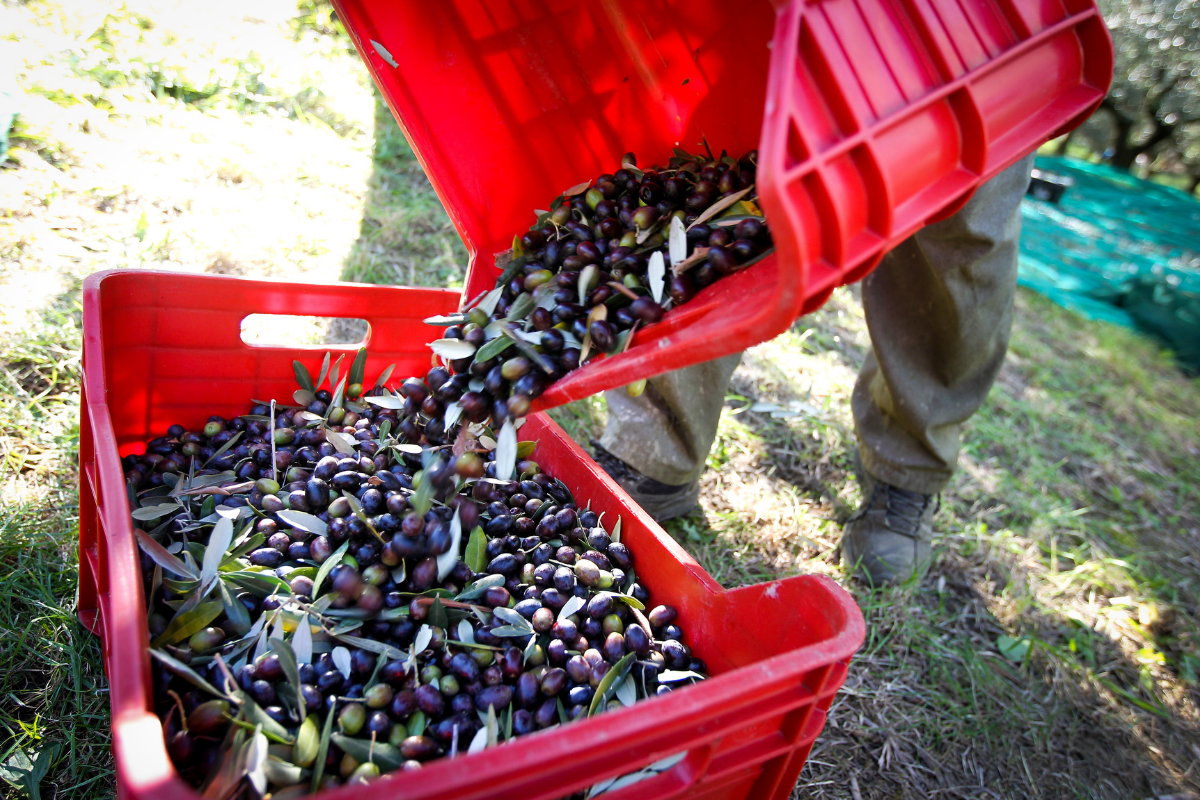
Damp fruit needs a short route to the mill, in crates that let air through rather than in sacks.
How long to wait after rain
There is no research-based number of days, and the advice comes from experience. Experienced growers usually wait two or three dry days, and how producers organise the harvest region by region can be read in the interviews with growers across Greece. Criteria are more useful than days. The canopy and fruit should be dry; the ground should be free of nets and footsteps, and the forecast should not show new rain straight after harvesting, so that a protective spray can go on.
Waiting costs most when the fruit is ripe, and the cultivar is susceptible to anthracnose, when there is a late olive fruit fly attack, or when the wind is knocking fruit down. In those cases, harvesting resumes as soon as the grove has dried, with no further delay.
| What rain changes | Consequence | What to do |
| More water in the fruit | Lower yield per kilogram | Wait two to three dry days |
| Fruit moisture above 56% | Emulsions, extraction losses | Tell the mill so it can adjust settings |
| Wet branches | Olive knot infection through wounds | Harvest dry trees, copper, afterwards |
| Wet autumn with ripe fruit | Anthracnose, high acidity | No delay beyond drying time |
| Wet fruit in storage | Mould, oil defects | Crates, ventilation, prompt milling |
Sources: Greek Ministry of Rural Development and Food Plant Protection Bulletins, 2025. UC Davis Food Quality. Studies cited in the text.
Frequently asked questions
How many days should I wait after rain to harvest olives?
Usually two or three dry days, until the canopy, fruit and ground have dried. There is no research-based number of days, and with ripe fruit at risk of anthracnose, the wait should not be stretched.
Do olives lose oil when it rains?
No. The fruit takes up water and gets heavier, so the oil percentage per kilogram decreases, while the amount of oil in the fruit remains practically the same.
Why does the mill give a lower yield after rain?
For two reasons. The fruit carries more water per kilogram, and wet paste forms emulsions that hold some of the oil in the by-products, especially when fruit moisture exceeds 56%.
Can I harvest wet olives?
Better not. Knocking wet trees makes olive knot infection easier, and wet fruit spoils more quickly before milling, increasing the risk of oil defects.
Is a copper spray needed after harvesting?
In groves with olive knot, Greek plant protection bulletins recommend a protective copper spray after any wounding, such as harvesting, especially when rainy weather follows.
Is rain before harvest good for the crop?
After drought, rain helps the tree recover, but does not fully restore the oil in the fruit. Shortly before harvest, it raises fruit moisture and makes extraction harder.
Important notes
Every plant and every environment is unique. Conditions vary considerably with region, exposure, water quality, soil pH and the overall health of the plant. The guidance above is general and a starting point.
If you suspect a serious nutrient deficiency or a disease that basic practices do not resolve, contact an agronomist for an accurate diagnosis.
Plant protection products should be used carefully and responsibly. Always try non-chemical methods first (cultural practices, soft soap, summer oil). When chemical intervention is needed, use only approved products and follow the label instructions.
Sources
- Greek Ministry of Rural Development and Food, Regional Plant Protection Centre of Achaia (2025). Plant protection bulletin, olive, No 1/27-02-2025, olive knot (in Greek).
- Greek Ministry of Rural Development and Food, Regional Plant Protection Centre of Achaia (2025). Plant protection bulletin, olive, No 5/02-10-2025, peacock spot and anthracnose (in Greek).
- Agrotypos (2025). Olive irrigation, when and how much to water, with K. Chartzoulakis (in Greek).
- olivenews.gr (2025). Rain and the harvest (in Greek).
- UC Davis Food Quality. Olive oil processing.
- Frontiers in Plant Science (2024). Exploring the relevance of the type of horizontal separator to optimize the extraction efficacy for the Arbequina variety.
- Agricultural Water Management (2021). Effects of pre-harvest deficit irrigation during the oil accumulation period on fruit characteristics, oil yield extraction, and oil quality in olive cv. Genovesa.
- Singh et al. (2016). Harvesting time influences fruit removal force, moisture, oil content in olive. Australian Journal of Crop Science.
- Effects of harvesting time on fruit development process and oil content of selected Iranian and foreign olive cultivars under subtropical conditions.
- Moral, J. et al. (2017). Variability in susceptibility to anthracnose in the world collection of olive cultivars of Cordoba. Frontiers in Plant Science.
- Talhinhas, P. et al. (2018). Olive anthracnose, a yield- and oil quality-degrading disease. Molecular Plant Pathology, 19(8), 1797-1807.
- Olive Oil Times. Olive oil defects.
- Changes in the volatile and sensory profile of virgin olive oil as a function of olive fruits mould process.
- Filtration scheduling, quality changes in freshly produced virgin olive oil.