
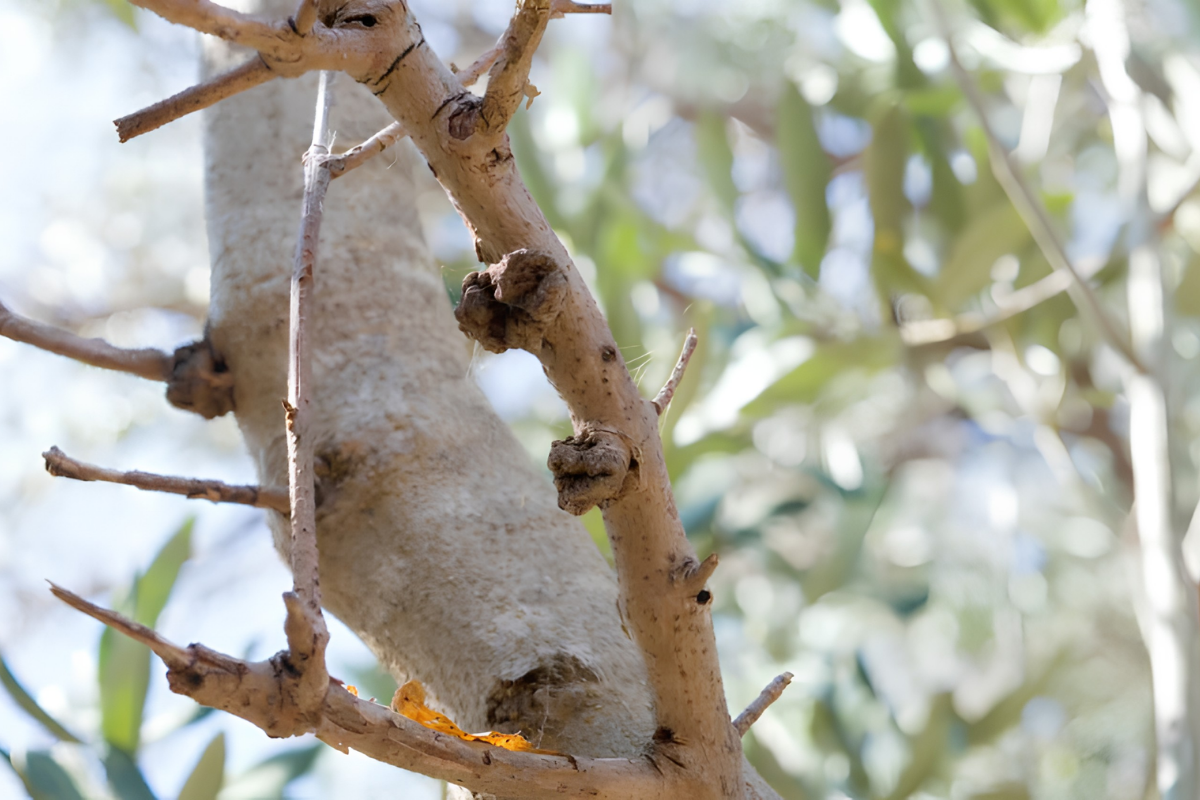
Olive knot is a bacterial disease caused by Pseudomonas savastanoi, recognised by the characteristic galls that form on twigs, branches and trunk. The bacterium has one weakness that shapes the entire control strategy. It cannot penetrate healthy tissue on its own and enters exclusively through fresh wounds, whether from frost, hail, pruning or harvest. That means the disease does not depend on luck but on how and when work is carried out in the grove. This guide covers how to recognise it, which entry points matter, why the first 24 hours after any injury count, and how pruning hygiene is organised.
Symptoms and identification
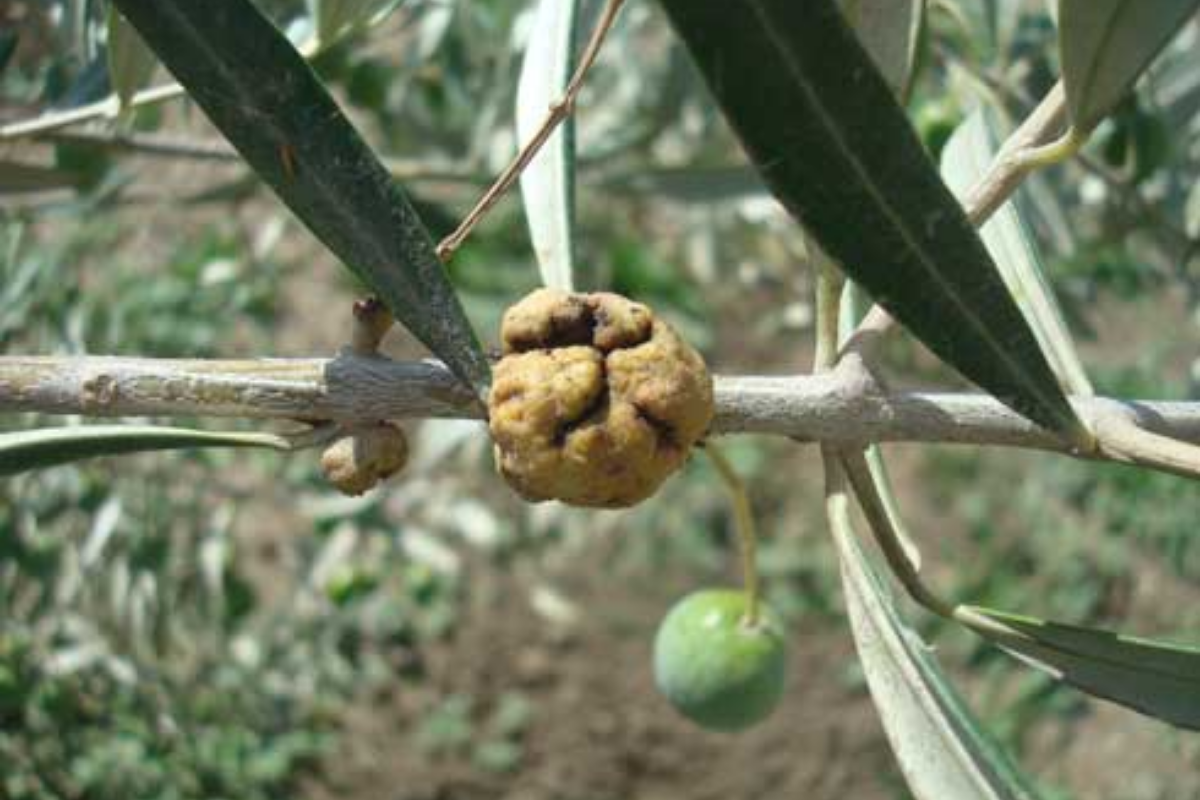
The defining symptom is the formation of hyperplastic galls, also called knots or tumours, on twigs, branches, scaffold limbs, the trunk, and the roots, and, more rarely, on leaves and fruit. The galls start small, soft, and smooth, with a pale green colour, then gradually enlarge, harden, darken, and crack, taking on a rough appearance that makes diagnosis easy even from a distance.
The damage comes not from the gall itself but from what it does. Affected tissue is deformed, and sap flow is restricted, so branches above a gall weaken, produce less growth and eventually die back. In advanced infections, the tree loses vigour and yields drop noticeably.
The bacterium responsible infects only olive. A closely related pathogen, Pseudomonas savastanoi pv. nerii, causes similar galls on oleander and can also infect olive, which means oleanders growing near a grove are not harmless bystanders.
The entry points
| Wound | When it happens | What should follow |
|---|---|---|
| Harvest, especially mechanical | Autumn and early winter | A copper spray immediately after harvest finishes |
| Pruning cuts | Winter and early spring | A spray straight after pruning, and a sealant on the large cuts |
| Frost | Winter | A copper spray, but pruning is postponed until the real damage becomes visible |
| Hail and strong wind | Any season | A copper spray as soon as possible after the event |
| Leaf scars | Naturally, through the year | A preventive autumn spray before the long rains set in |
Spread happens through rain, which washes bacteria from existing galls onto neighbouring tissue and trees, and through equipment. Greenhouse studies have confirmed that cutting tools contaminated by contact with knots can transfer the pathogen to healthy olive tissue, meaning that pruning itself can seed an infection across a grove.
The critical first twenty-four hours
One finding from field research in California offers the most practical rule for olive knot management. Copper applications made within 24 hours of wounding significantly reduce disease, while wounds treated with copper and then inoculated seven days later still showed over 50% less infection, which demonstrates good persistence of the protectant film.
The conclusion for the grove is simple. Spraying is not scheduled by the calendar but by the event. After harvest, after pruning, after hail, after frost, and as soon as possible in each case.
The spray programme
Copper products do not cure existing galls. They reduce the bacterial population on the surface of the tree and protect open wounds, so they work strictly as protectants. In areas with a history of the disease a minimum of two applications a year is needed:
- Immediately after harvest, in late autumn, when the tree is covered in small wounds from picking
- Immediately after pruning, repeated about 25 days later, an application that also covers peacock spot
- As an emergency measure, after frost, hail or strong winds that broke branches
- Preventively in autumn, before prolonged rainfall begins
Research in Spanish groves shows that two regular copper applications per year substantially reduce both bacterial populations and the number of knots per tree, with the clearest difference appearing from the third year of the programme. This is a cumulative strategy rather than a one-season fix.
Pruning hygiene
Pruning is at once the most useful tool and the biggest risk. Five rules govern it:
- Dry weather only: pruning and harvest are strictly avoided in rain or very humid conditions, since water spreads the bacterium onto fresh cuts
- Healthy trees first: work starts on clean trees and leaves infected ones for last
- Tool disinfection: secateurs and saws are disinfected frequently, ideally between trees, with alcohol or a chlorine solution, noting that chlorine solutions are highly corrosive to metal parts
- Cut back into healthy wood: branches carrying many galls are cut several centimetres below the infection, and the prunings are removed from the grove and burned
- Seal the large cuts: big wounds are covered with pruning paste, while galls on the trunk can be carefully scraped back to healthy wood and painted with a thick copper paste
International practice adds one recommendation that is often missing from grower guidance. Removal pruning for galls is best carried out in the dry season, in July and August, when the chance of new infection is at its lowest. The technique itself is covered in the guide to olive tree pruning.
What to do after frost
After a hard frost, the instinct is to cut out the damaged wood straight away. That is a mistake for two reasons. First, the true extent of the damage is not visible until new growth begins, so healthy wood is often removed along with the dead. Second, fresh cuts add to the wounds the frost has already made and multiply the entry points. The correct order is to apply a copper spray immediately, then prune later, once regrowth shows what survived.
Varietal susceptibility and planting material
Varieties are not equally affected. According to UC IPM guidelines, Koroneiki is among the more sensitive varieties to olive knot, along with Manzanillo, and for these two, annual applications are considered the minimum.
For new plantings, buy trees from reputable nurseries and inspect them individually for galls before they go in the ground, because a single infected tree can introduce the disease into clean land and keep it there for decades.
Frequently asked questions
Can olive knot be cured?
Not in the sense of eradication. Existing galls do not regress, and copper products act only preventively, protecting wounds and reducing the bacterial population on the surface of the tree.
When do you spray copper for olive knot?
Immediately after harvest, immediately after pruning, and as an emergency treatment after frost or hail. The closer the spray follows the injury the better the protection, with the first 24 hours the most critical.
Why should you not prune in the rain?
Because water carries bacteria from existing galls into fresh cuts. Pruning and harvest are always done in dry weather.
How do you disinfect pruning tools?
With alcohol or a chlorine solution, ideally between trees. Chlorine solutions are effective but corrosive to tools, so rinse and dry them after use. Quaternary ammonium products registered for equipment sanitation are used commercially as a less corrosive alternative.
Should I cut out branches with galls?
Yes, where infection is extensive. Cut several centimetres below the gall into healthy wood, in dry weather, and burn the prunings. This work is best done during the dry summer period.
Can the olive knot spread from oleander?
The bacterium that causes galls on oleander is closely related and can infect olive as well, so oleanders carrying galls near a grove are worth removing or cleaning up.
Important notes
Disease pressure varies by region, variety and grove history, so build the treatment programme with a local agronomist and follow regional plant protection guidance.
Use only products registered for olive in your country, follow the label and the maximum number of applications per season, and give priority to cultural hygiene measures.
References
- UC Statewide IPM Program, Olive knot.
- UC Statewide IPM Program, Olive knot in home and landscape.
- Quesada J. M. et al., Comparison of chemical treatments for reducing epiphytic Pseudomonas savastanoi pv. savastanoi populations, Crop Protection, 2010.