Peacock spot is the most widespread foliar disease of the olive, and the usual reason a grove goes into spring half bare. It is caused by the fungus Venturia oleaginea, still widely known by the name of its asexual stage Venturia oleaginea, and it is recognised by the circular lesions with concentric rings that give the disease its common name. The damage never shows on the fruit. It shows as premature defoliation that weakens the tree and cuts next year's flowering. This guide covers how to recognise it, how to tell it apart from the diseases it is often mistaken for, how it moves through the year, and exactly when the sprays are applied.
Symptoms and identification
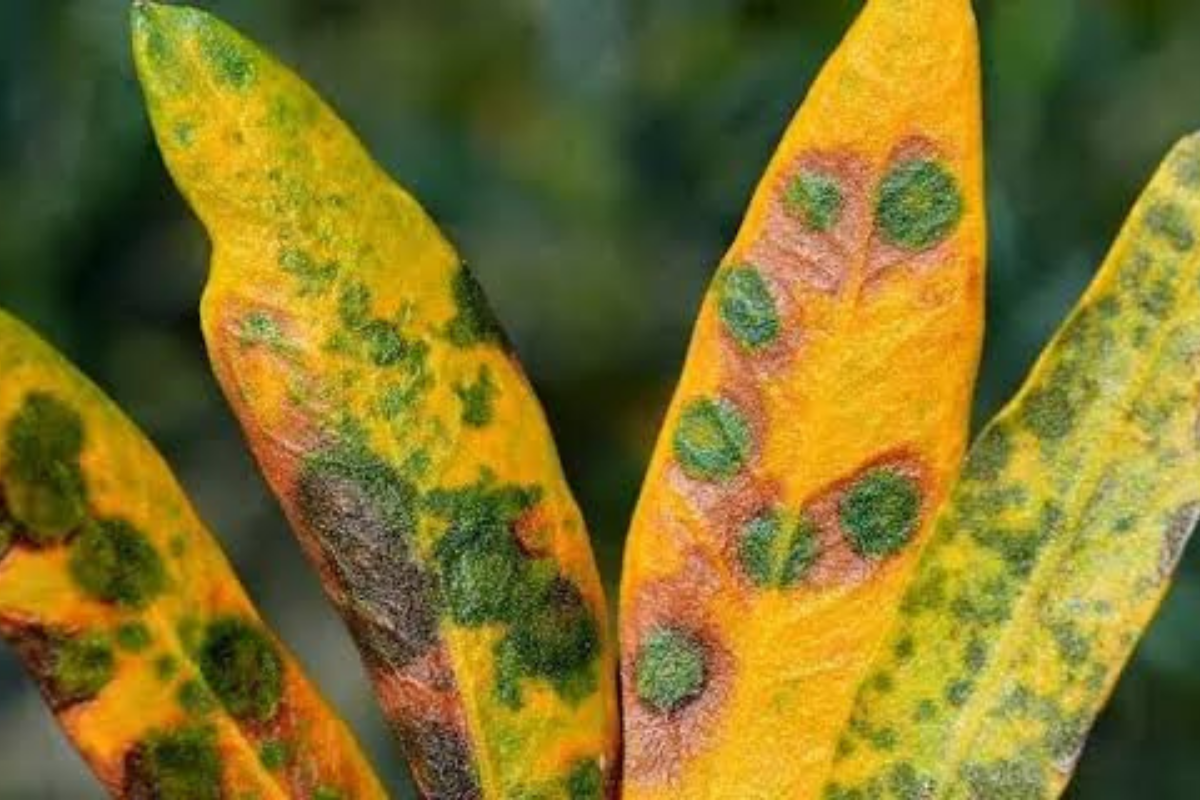
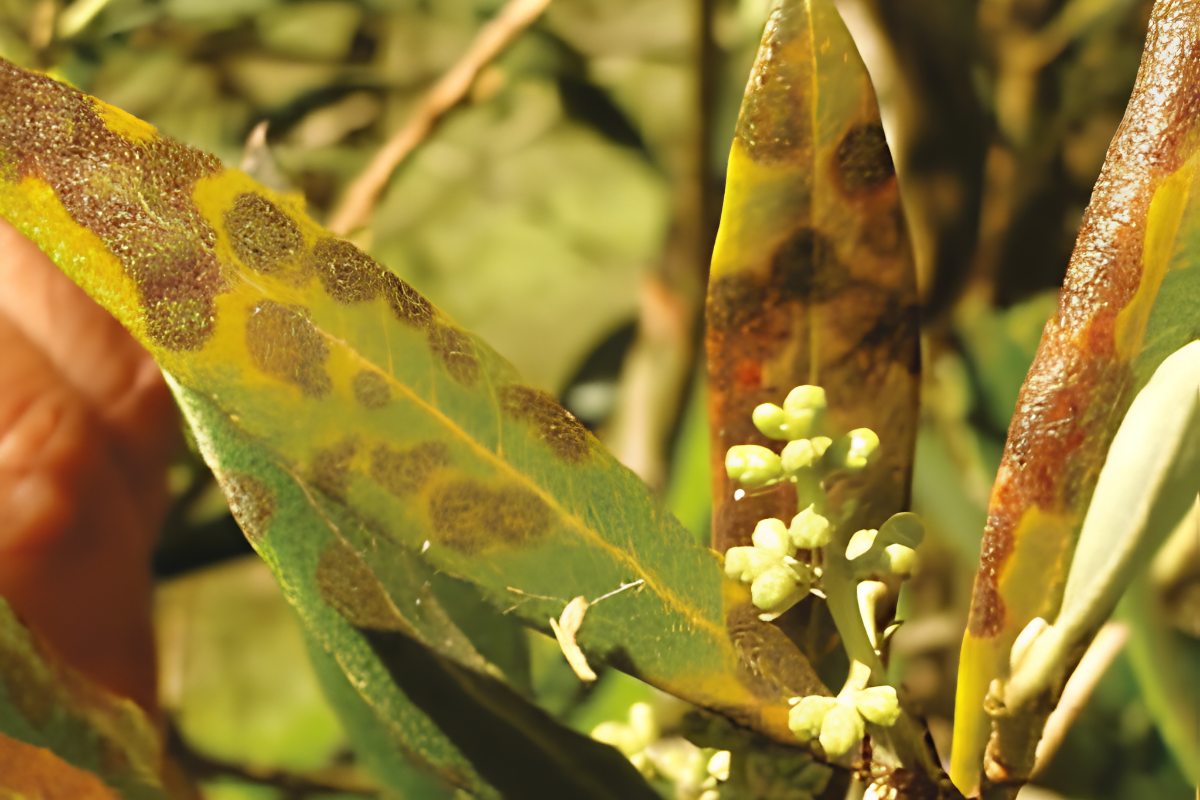
The first lesions appear on the upper surface of the leaves, as sooty blotches that develop into circular, dark green to black spots between 2.5 and 12 mm across. As they expand, concentric rings form in shades of olive green, grey, and dark brown, often ringed by a yellow halo. Affected leaves turn yellow and drop early.
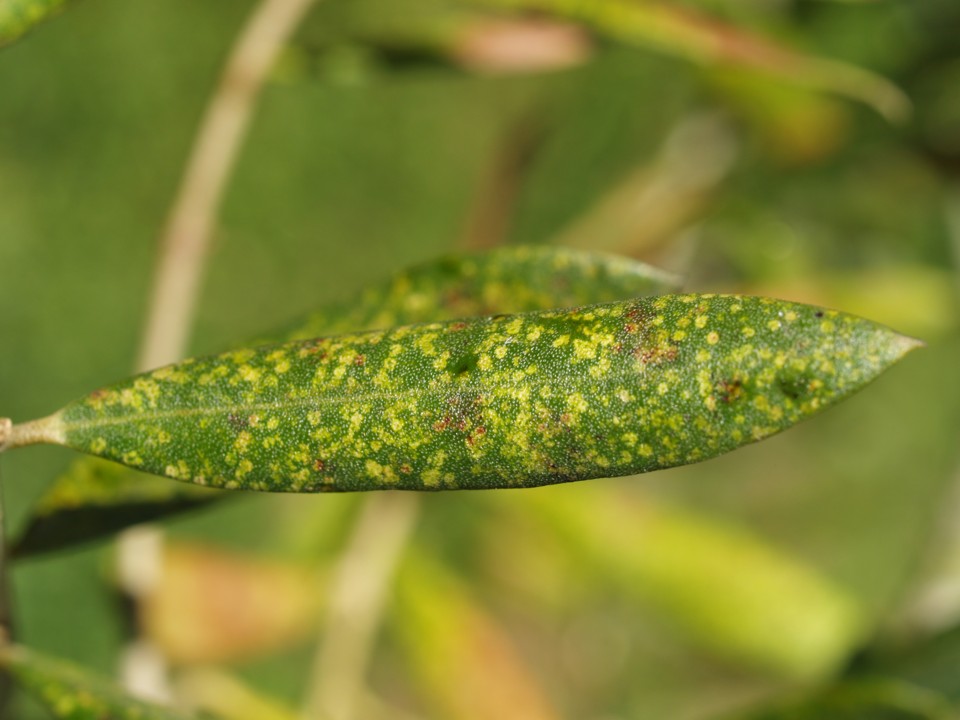
Two details help the diagnosis. First, infections start on the lower, inner leaves of the canopy, where moisture lingers longest. Second, old lesions take on a white, crusty appearance, and it is from the margins of exactly these lesions that the autumn crop of spores develops.
The disease is mainly foliar, but under heavy pressure, it also produces sunken brown lesions on petioles and fruit.
Telling it apart from other leaf spots
| Disease | Where it appears | Distinguishing feature |
|---|---|---|
| Peacock spot | Upper leaf surface, low in the canopy | Circular lesions with concentric rings and a yellow halo |
| Cercospora leaf spot | Both leaf surfaces | Irregular chlorotic blotches above and grey fruiting growth underneath |
| Anthracnose | Mainly on fruit near ripening | Fruit rot and mummification, with twig dieback |
| Sooty mould | On the surface of leaves and fruit | Black film that rubs off, growing on insect honeydew |
Anthracnose is the easiest to separate, since it attacks the fruit. Cercospora is confused far more often, but it responds to the same copper-based programme, so in practice, one spray schedule covers both.
Disease cycle and infection conditions
The fungus overwinters inside infected leaves, mainly those still hanging on the tree and secondarily in fallen litter. Conidia move by water alone, splashed from leaf to leaf by raindrops, rather than blowing about in dry air.
Infection requires sustained wetness on the leaf. According to UC IPM guidelines, roughly 48 hours of free moisture allows germinating spores to cause significant infection, a period that shortens to as little as 14 hours at warmer temperatures. Infection occurs across a broad range of mild temperatures, with the optimum around 15 to 24°C, and summer heat effectively shuts the disease down.
The most deceptive feature is the latent period. Weeks can pass between infection and visible lesions, and under conditions unfavourable to the fungus, whether cold or hot and dry, latency can exceed 120 days. A grove that looks clean in November may already be infected.
Throughout the year, there are two peaks: autumn, as the first rains arrive, and spring, when new growth is soft, and the weather is still wet.
The damage it causes
The damage is indirect but serious. Premature defoliation reduces the photosynthetic surface; branches are left bare, with foliage only at the tips, and the tree weakens. The consequence shows the following year, in reduced flowering and fruit set, and the disease also deepens alternate bearing. Defoliation also creates an illusion of recovery, since the tree appears clean after it has simply shed its infected leaves.
Cultural measures that reduce pressure
- Pruning for airflow: opening the canopy lets air and sun dry the foliage quickly after rain, and it is the single most effective preventive measure, as covered in the guide to olive tree pruning
- Restraint with nitrogen: heavy nitrogen fertilisation produces soft, dense growth that is more readily
- Drainage and spacing: damp, low-lying and closely planted groves carry the heaviest infections
- Removing fallen leaves: in small groves and garden trees, collecting and destroying fallen litter cuts the initial inoculum
When to spray
Peacock spot is managed preventively rather than curatively. The aim is to protect the foliage before the rain arrives, which makes timing more important than product choice.
- Autumn spray: the key one of the year, applied before the rains start, typically from September to October, depending on the region. In humid areas with a history of infection, two applications are used
- Post-harvest spray: a supplementary treatment where heavy winter rain is expected
- Spring spray: protects the new growth, applied when new shoots are 2 to 5 cm long, with one or two applications completed before temperatures climb
- Repeat: in prolonged wet weather, treatment is repeated after 25 to 30 days
Coverage has to be thorough, wetting the whole canopy, and large trees need roughly 150-200 litres of spray solution per 1,000 m². Regional plant protection services publish the exact dates each season through their advisory bulletins.
Which products are used
The backbone of control remains copper-based fungicides, meaning Bordeaux mixture, copper hydroxide and copper oxychloride, which act preventively by forming a protective film on the leaf. Their great advantage is that the same spray also suppresses cercospora, sooty mould and anthracnose. Systemic fungicides with both preventive and curative activity are also registered in many countries, and they are used mainly where infection is already established.
In every case, the maximum number of applications per season is set in each product's registration and must be respected, along with rotation of active ingredients to avoid resistance. It is also worth noting that copper fungicides sit on the European list of candidates for substitution, so research into alternatives, particularly for organic production, is very active.
Frequently asked questions
When should olives be sprayed for peacock spot?
The main spray goes on in autumn, before the first rains (usually September to October), and the second in spring, once new growth reaches 2 to 5 cm. Wet seasons call for a repeat after 25 to 30 days.
Why is it called peacock spot
Because of the lesions, the concentric dark green to black rings with a yellowish halo around them resemble the pattern on a peacock's tail feathers.
How do I tell peacock spot from cercospora
Peacock spot produces circular, ringed lesions on the upper leaf surface, while cercospora gives irregular chlorotic blotches above and grey growth underneath. Both are managed with copper-based sprays.
Does the peacock spot affect the fruit?
Mainly the leaves. Under heavy pressure, it produces sunken brown lesions on petioles and fruit, but the real loss comes from defoliation rather than direct fruit damage.
Why do trees look healthy when they have peacock spots
Because infected leaves drop and the healthy ones remain, giving an impression of recovery. On top of that, the latent period between infection and the onset of visible symptoms can exceed 120 days.
Is copper enough to control it?
In most situations, yes, provided the sprays are applied at the right time with good coverage. Where infection is already established, curative products are used, always in accordance with local plant protection guidance.
Important notes
Conditions differ from grove to grove, and the spray programme is adapted to the region, the variety and the history of infection, so work with a local agronomist and follow regional plant protection bulletins.
Apply cultural preventive measures first, and use only products registered for olive in your country, following the label and the maximum number of applications per season.
References
- UC Statewide IPM Program, Peacock spot in olive.
- Pacific Northwest Pest Management Handbooks, Olive leaf spot.
- Buonaurio R. et al., Olive leaf spot caused by Venturia oleaginea, an updated review, Frontiers in Plant Science, 2023.