

On 29 October a US food and grocery delivery platform reported 993 million orders for the third quarter of 2026, 28% more than a year earlier. In the same release it said it now offers a connection through MCP, the open standard that lets an AI tool work with another company's software, to outside AI agents, the software that people allow to carry out steps such as placing an order on their behalf.
Analysts on the earnings call asked how much ordering already goes through such agents. The chief executive answered that third-party agents had generated "maybe several hundred orders in total" since they started, and that customers still order mainly through the company's own app.
Agent orders are counted in hundreds against a quarterly total of 993 million
Several hundred orders since the agents started is roughly one in a million of the orders the platform handled in the third quarter alone. The company has built tools of its own for ordering through AI: its release says it "recently shipped a series of AI agents", including one that customers reach by text message, and on the call the chief executive described an MCP connection the company gives to other companies for uses such as corporate lunch orders.
The release also says that AI personal agents "are now starting to become more mainstream", and the chief executive said the company would keep working with outside agent makers and expects advertising opportunities even inside some of these agents. The figure covers orders placed by outside agents, not those placed through the company's own tools.
Visits from AI services to US retail sites more than doubled in a year
Data from an analytics company that tracks more than 1 trillion visits to US retail sites show where AI tools do reach shoppers today. Visits that arrived from generative AI services grew 127% year on year in August 2026, and the company expects them to grow 130% in November and December, the US holiday shopping season. In August those visitors converted at a rate 48% higher than other visitors and brought 43% more revenue per visit.
The forecast does not say what share of all visits comes from AI services, and it does not report purchases completed by agents. Its figures describe people who asked an AI tool a question and then went to the retailer's site and bought there themselves, which is a different step from an agent placing the order.
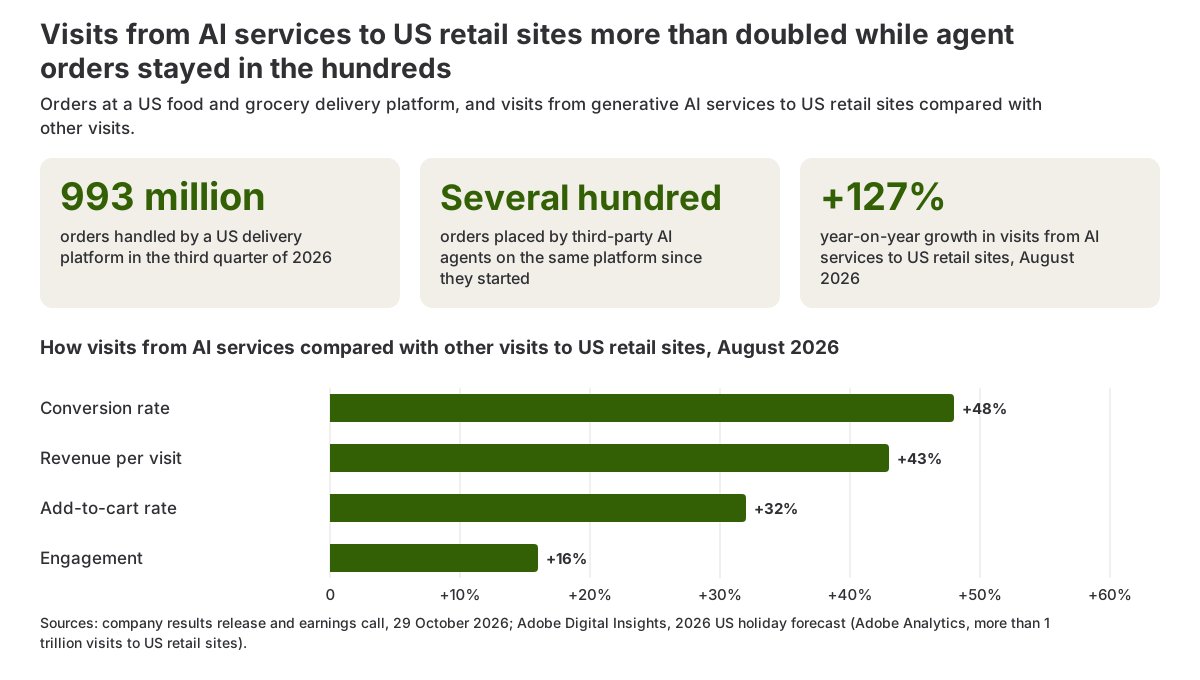
Agent orders at a US delivery platform, and visits from AI services to US retail sites compared with other visits, August 2026. Sources: company results release and earnings call, 29 October 2026; Adobe Digital Insights, 2026 US holiday forecast.
Food sellers are opening access to agents before the orders arrive
The low numbers have not stopped retailers from preparing. In October a large US grocery retailer opened a gateway for shopping agents in beta, with approval of every purchase by default or a spending limit set by the shopper, while another large online retailer blocks shopping agents from its site.
In trade between companies, agents are further away still. Two in three EU food makers took no electronic orders in 2024, and much of what distributors receive comes by email, text message or phone. This is why the first AI tools in this part of the chain read the orders that arrive rather than place them, with a person checking the orders they flag.
Four points a food supplier can check while agent orders stay rare
- Product data: AI tools that send buyers to a shop work from what its pages say, so product names, pack sizes, origin and certifications written out in full are what a tool can repeat to a buyer.
- Prices: a price that an AI tool shows needs its type and date, because a benchmark, an average of completed sales and a seller's offer need not match on the same day.
- Approval: before opening an ordering system to agents, a supplier can decide which orders go through without a person and which wait for approval, the choice the grocery retailer gives its shoppers.
- Order channels: while most food orders between companies still arrive by email and phone, a tool that reads those orders may save more time today than a connection for agents that few buyers use yet.
Sources
- DoorDash. (2026). Q3 2026 earnings press release. DoorDash Investor Relations, 29 October 2026.
- The Motley Fool. (2026). DoorDash (DASH) Q3 2026 earnings call transcript. 29 October 2026.
- TechCrunch. (2026). DoorDash said it's only received several hundred orders from AI agents. 30 October 2026.
- Adobe. (2026). 2026 U.S. holiday forecast. Adobe Digital Insights, September 2026.
- Walmart. (2026). Walmart makes it possible for agents to shop on behalf of customers, while keeping customers in control. Walmart corporate news, 21 October 2026.
- Bloomberg. (2026). Amazon blocks Meta's Muse AI agent from its retail site. Via The Star, 22 September 2026.
- Eurostat. (2026). E-commerce sales of enterprises by NACE Rev. 2 activity (isoc_ec_eseln2). Eurostat data browser.