


In 2024, 34% of EU makers of food, drinks and tobacco products with 10 or more employees received orders through a website, an app, an online marketplace or EDI messages, according to Eurostat's survey on ICT use and e-commerce in enterprises. The other 66% received no orders by any of these routes. Eurostat counts an order as e-commerce when it arrives through a method designed for ordering, even if payment and delivery happen offline, and it excludes orders sent by manually typed email. The survey ran in 2025 and its questions on sales refer to the previous calendar year.
Ten years earlier, in 2014, the share of food makers taking electronic orders was 24%. In 2024 it stood at 41% among wholesalers and at 24% among all enterprises covered by the survey, which leaves out agriculture and the financial sector.
An agent can only order through a channel that software can read
In September and October, two freight forwarders and a transport software company opened freight booking to AI agents through MCP connectors, so that an agent can quote and book a shipment for a customer without anyone filling in a form. In a speech at the Sibos conference on 29 September, Christopher Waller, a member of the US Federal Reserve Board, said that purchases between businesses may suit agents well, because they recur and follow set rules such as approved suppliers and budgets.
An agent acting for a buyer can place an order through a supplier's web shop or portal much as a person would, or through a direct connection between the two companies' systems. EDI, or electronic data interchange, is the older form of that direct connection. Eurostat defines it as the structured transmission of data or documents between enterprises in a format, such as EDI or XML, that allows automatic processing. An agent can also send an email, but at a supplier without software of its own to read it, someone has to type the order in.
EDI orders bring in more than a quarter of food makers' turnover
In 2024, 17% of EU food makers received orders as EDI messages, close to the 16% of 2014. Those orders made up 27% of the sector's turnover, according to Eurostat's figures on the value of e-commerce sales. Web orders from other businesses and public bodies brought in 2.1% of turnover and web orders from consumers 0.9%. All electronic orders together accounted for 30% of food makers' turnover, against 19% for all enterprises.
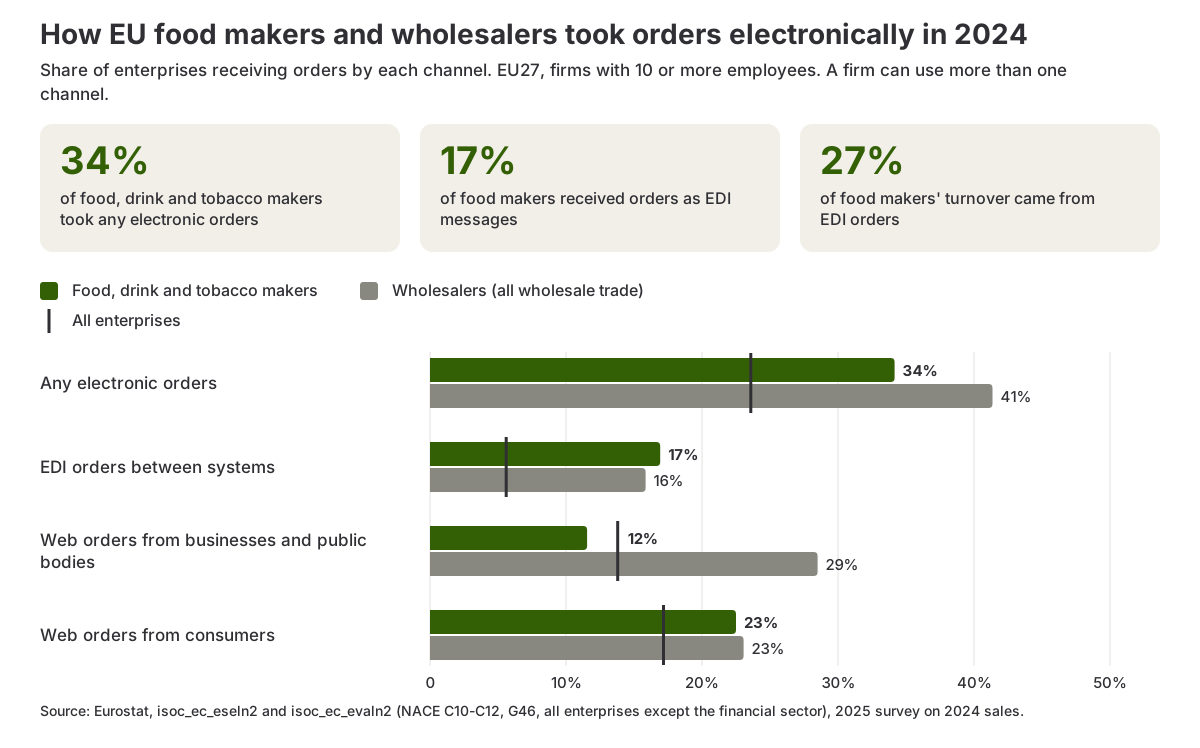
Share of EU food makers, wholesalers and all enterprises receiving orders by each channel in 2024. Source: Eurostat.
In 2024, 28% of EU enterprises with 250 or more employees received EDI orders, against 12% of medium-sized firms and 4% of small ones, across all the sectors in Eurostat's breakdown by firm size. Eurostat does not publish this split for food makers alone, but their figures point the same way. If 17% of firms bring in 27% of the sector's turnover through EDI orders alone, the food makers using EDI are on average larger than the rest.
More food makers take web orders from consumers than from businesses
The share of food makers taking orders through websites, apps or marketplaces doubled between 2014 and 2024, from 12% to 24%. The share taking web orders from consumers rose from 10% to 23%, and the share taking them from other businesses and public bodies from 7% to 12%, with most of that rise between 2020 and 2021. Measured by value, the order is reversed. Web orders from businesses bring food makers more than twice as much turnover as web orders from consumers.
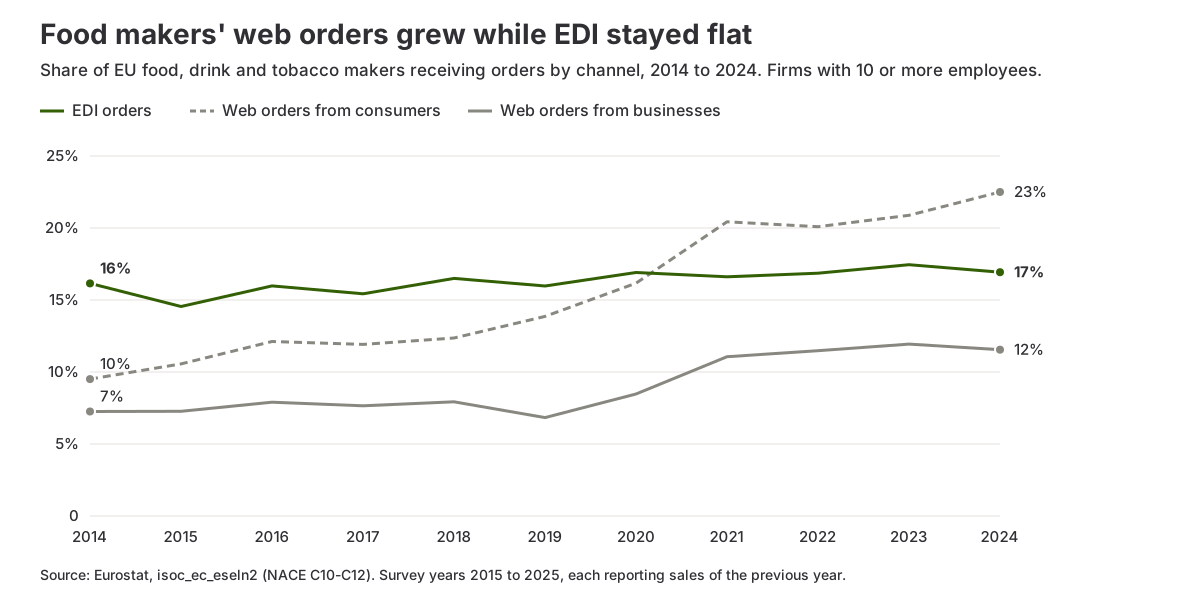
Share of EU food, drink and tobacco makers receiving orders by channel, 2014 to 2024. Source: Eurostat.
Wholesalers take web orders from businesses more often than food makers
In 2024, 29% of EU wholesalers received web orders from other businesses or public bodies, more than twice the share of food makers. EDI orders were at a similar level in both groups, 16% of wholesalers against 17% of food makers. Among wholesalers, EDI orders made up 15.3% of turnover and web orders from businesses and public bodies 7.3%. Eurostat publishes figures for wholesale trade as a whole and does not separate food wholesale.
Greece and Bulgaria have the lowest shares in the EU
Among the 22 member states with published figures, Greece, at 14.5%, and Bulgaria, at 14.8%, had the lowest shares of food makers taking electronic orders in 2024. Only 1.6% of Greek food makers received EDI orders, the lowest share among the member states with published figures. In Spain, 52% of food makers took electronic orders and 27% received EDI orders, behind only the Netherlands (62%), Ireland (61%) and Lithuania (60%) on the first measure. Italy was at 29%, Cyprus at 25% and Croatia at 19%.
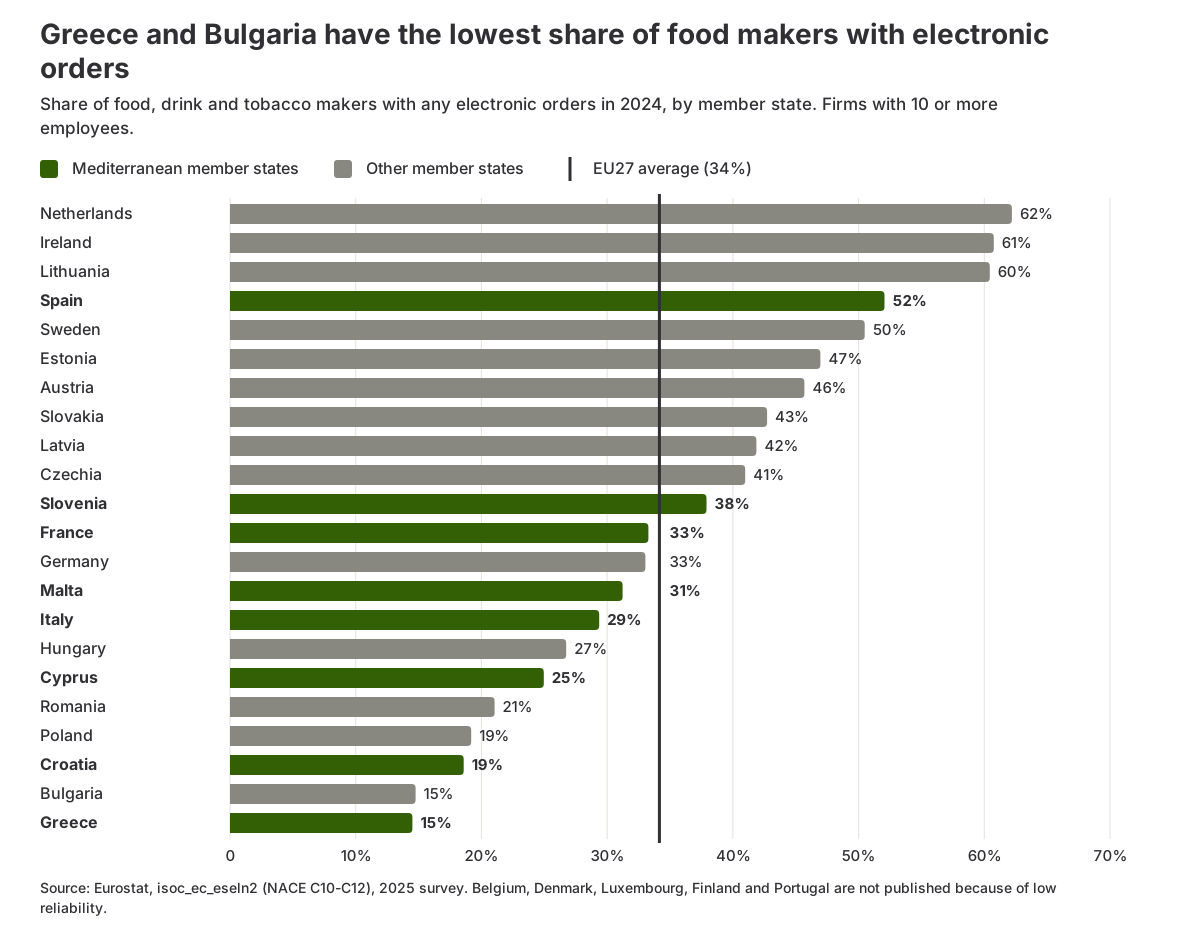
Share of food, drink and tobacco makers with any electronic orders in 2024, by member state. Source: Eurostat.
Eurostat does not publish the total for Portugal because of low reliability, although 17% of Portuguese food makers received EDI orders. Olive oil mills are counted within food manufacturing, and the survey does not publish them separately.
Four things a food maker can check in its own order channels
- Order routes: which orders already arrive by EDI, a web shop or a customer's portal, and which arrive by phone or email and are typed in by staff.
- Product and price data: whether specifications, prices, minimum quantities and lead times are kept in one place that a system can read, and whether the price a buyer's software finds is the current one. The same question comes up from the buyer's side, in what an AI assistant sees when it reads a food price.
- Approval: who confirms an order that arrives without a person writing it, and on what grounds. An order placed by software still raises the question of when an exporter should turn an order down.
- Skills: a connection that takes orders needs someone who maintains it and checks what comes through. In 2025, 69% of EU food makers that considered AI but did not use it named lack of expertise, the barrier they cite most often.
Sources
- Eurostat. (2026). E-commerce sales of enterprises by NACE Rev. 2 activity (isoc_ec_eseln2). Eurostat data browser, last updated 15 June 2026.
- Eurostat. (2026). Value of e-commerce sales by NACE Rev. 2 activity (isoc_ec_evaln2). Eurostat data browser, last updated 27 February 2026.
- Eurostat. (2026). E-commerce sales of enterprises by size class of enterprise (isoc_ec_esels). Eurostat data browser, last updated 15 June 2026.
- Eurostat. (2026). E-commerce statistics. Statistics Explained, data extracted February 2026.
- Eurostat. (n.d.). Glossary: E-commerce. Statistics Explained.
- Eurostat. (n.d.). Glossary: Electronic data interchange (EDI). Statistics Explained.
- Waller, C. J. (2026). Payments in the age of AI agents. Speech at Sibos 2026, Miami, 29 September 2026. Bank for International Settlements.