For most olive growers, autumn marks the start of the harvest, whether the fruit is destined for the table or for oil. For the harvest to succeed and give a product of high quality and satisfactory quantity, each grower has to take a few decisions before starting, above all when to harvest and how, meaning with which method and equipment.
There is plenty of debate about the right moment to harvest olives. In general it depends heavily on the weather, the location of the grove, the olive cultivar, whether the crop is for table olives or oil, and the farming methods. Choosing the right date takes accumulated experience, as the experience of growers across Greece shows, and getting it right gives the grower a competitive edge in yield, sensory characteristics, colour, taste and aroma.
Harvest timing decides quality and quantity
When and how the harvest is done has a direct effect on the quality and quantity of the product, whether that is olive oil or table olives. Early harvesting of fruit for oil, for example, gives less oil, because the fruit has a lower oil content at that stage, but the final product is of higher quality. The usual criteria of olive oil quality are its content of polyphenols, sterols, tocopherols and phospholipids and low acidity, and all of them directly affect the final price.
In every case the grower is looking for the right balance between oil quality and quantity. Micro oil extractions are the grower's ally at this stage. At regular intervals the grower takes a small sample of olives to the mill to measure phenols, sensory characteristics and fruit oil content.
For table olives, harvest timing directly affects fruit size and therefore income. For Kalamon, for example, the price for the 100-fruit-per-kilogram class is almost four times that for 350 fruit per kilogram. The aim is to get as much of the crop as possible into the large, well-paid classes, which may require thinning the crop so that the tree produces fewer but larger fruit. Fruit thinning removes underdeveloped, misshapen or surplus fruit early, so that the tree's resources are shared among fewer olives.
Irrigated groves ripen differently from rain-fed ones
Studies and field observations show that irrigation water has a significant effect both on the rate of ripening, judged by the change in fruit colour, and on polyphenol content. Fruit on irrigated trees normally reaches high oil content later than fruit on rain-fed trees, and the colour change from green to black, the build-up of anthocyanins, is also more gradual.
Oil content as a percentage of fresh fruit weight tends to be higher on rain-fed trees, but irrigation generally produces more and heavier olives overall. In one study, polyphenols were lower in fruit from irrigated groves than from groves that received only rain, falling further as the amount of water increased, and the researchers also found a correlation between the water trees receive and fruit anthocyanins.
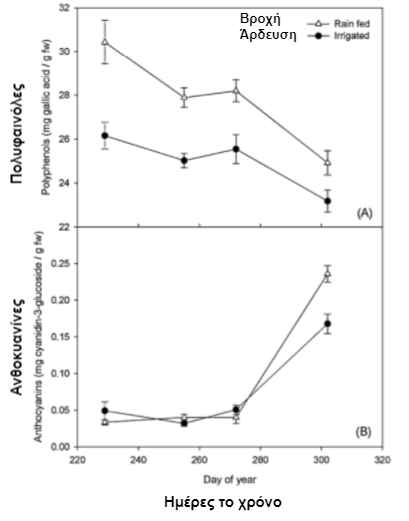
Polyphenols (top) and anthocyanins (bottom) in the fruit of rain-fed and irrigated trees as ripening progresses.
Fruit detachment force falls as the olives ripen
As more and more growers choose to harvest green, at early ripening stages, mechanical harvesting becomes less efficient. The reason is that at these stages the force needed to detach the fruit from the tree is high, and it falls gradually as the fruit ripens. It is measured in newtons (N) with a simple dynamometer.
At the start of ripening, with green fruit, detachment force is 6 N or more, at an intermediate stage it falls to 4 to 4.5 N, and once it reaches 3 N at an advanced stage, natural fruit drop can be expected to begin within 10 days. The rate of decline and the exact values differ between cultivars. According to the handbook of the European Olive4Climate project, harvest should take place when the ratio of detachment force (N) to fruit weight (grams) reaches 2 N/g.
Weather and pests can change the harvest date
Even when a grower pins down the best harvest moment as precisely as possible, the weather may not allow it to be followed to the letter. As autumn goes on, more frequent rain often delays or interrupts the harvest, so the grower checks the forecast before any work and, after rain, waits for the trees and fruit to dry. Beyond its direct effect, the weather can also shift the harvest date indirectly through outbreaks of diseases such as anthracnose and pests, above all the olive fruit fly, which can put the crop at risk even 1 to 2 weeks before harvest.
Anthracnose is a fungal disease that has become much more widespread in Greece in recent years. It rots and mummifies olives, especially in the final stages before harvest, and many growers have reported losing a large part of their crop only a few weeks or even days before harvest, when everything seemed to be going to plan. Although olive fruit fly damage starts much earlier in the season, it becomes obvious, even to non-specialists, around September and October, when favourable temperature and humidity have pushed populations to high levels and the stings are visible on the olives.
In groves on Crete, olive fruit fly attacks followed by anthracnose raised fruit acidity dramatically, so that a crop intended for extra virgin olive oil ended up as an industrial product, and fruit fly damage changes the oil in other ways too. If a grower suspects a problem, harvesting earlier, for example by two weeks, is an option, and there are many reports from across Greece of those two weeks saving the crop from a surge in a pest population or a disease outbreak.
Four common harvest mistakes
Although Greece has a long tradition of olive growing, many growers, mostly part-time but also professional farmers, use harvesting techniques that can damage fruit quality and the health and productivity of the trees in the following year.
Cutting off laden branches exhausts the tree
The first mistake is cutting off branches loaded with olives so that they can be fed straight into a ground machine that separates olives from leaves and broken shoots. This is one of the worst things that can be done to an olive tree. When a tree is wounded or loses part of itself, it immediately starts repairing the damage, and it can be compared to a power plant, where the leaves collect energy from the sun to send to the parts of the plant that need it.
The tree needs the most energy for two functions, producing shoots and producing fruit, and the two compete, so that whatever goes to one is taken from the other. In a heavy crop year the tree has sent all its energy to the fruit and used up valuable resources. Once the fruit is removed, the tree uses its leaves to rebuild energy and produce fruit the next year.
If branches with abundant foliage are removed along with the fruit, the tree loses its energy-collecting machinery and next year's crop is put at risk. On top of that, the little energy produced by the remaining foliage will go into regrowing the shoots that were removed, which in practice means a very small or even negligible crop the following year. Patience is needed to bring fruit down from an overloaded branch, because cutting it off removes valuable plant tissue and causes long-term problems for the tree's physiology.
Olives do not gain more oil the longer they stay on the tree
The second mistake is the belief that the longer fruit stays on the tree, the higher its oil content. Growers often say harvest should be as late as possible, "the later the better," with explanations such as "we are leaving the olives on the tree to draw more oil." Harvesting later than normal does not increase the amount of oil, while it has direct effects on quality. With the lower temperatures and shorter days of autumn and winter, fruit oil content soon reaches a ceiling and stops rising, after which the fruit starts to lose moisture.
The delay reduces key compounds such as aldehydes and phenolic compounds, which are among the quality criteria for the product, with a direct effect on both the sensory characteristics and the nutritional value of the oil. The negative effects also include higher acidity, and finally, leaving fruit on the tree for a long time reduces flowering the following year.
Sacks heat and crush the fruit
The third mistake is collecting olives in plastic or jute sacks, which were and still are the most common way of taking fruit from the field to the mill. Sacks, especially plastic ones, prevent ventilation and raise fruit temperature, while their size and stacking crush the fruit, causing damage and losses, and all of this significantly degrades the product.
To avoid this, ELGO-DIMITRA recommends using crates, which allow better airflow around the fruit, and many growers prefer 20 kg crates. In every case the materials used must meet food safety requirements, such as the phthalate limits of Regulation (EU) 10/2011, and must be cleaned thoroughly before use.
Every day before the mill costs quality
The fourth mistake is leaving too much time between harvest, transport to the mill and extraction. Once the fruit is picked the clock starts, because as time passes microbial fermentation begins, with a risk of mould growth, higher acidity, lower phenols and degraded sensory characteristics. Even in a cultivar that tolerates post-harvest handling fairly well, such as Koroneiki, the higher the temperature and the longer the storage, the more acidity rises and phenols fall. In a study on Koroneiki olives, after 20 days of storage the acidity of oil from fruit kept at 20°C was 177% higher than from fruit kept at 5°C.
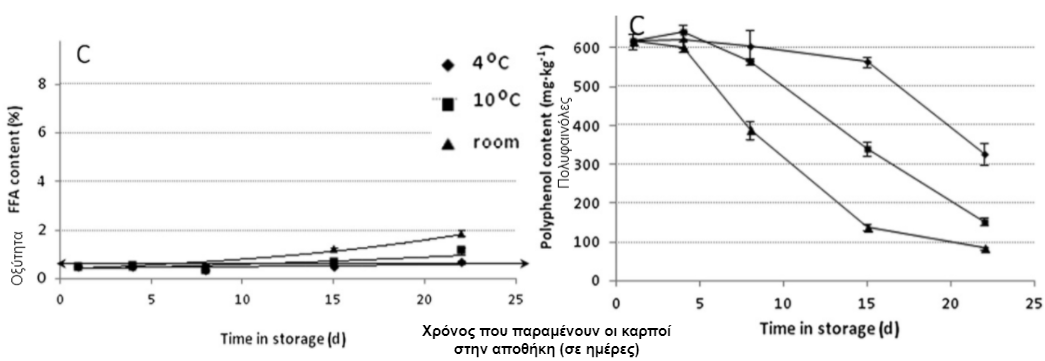
Free acidity (left) and polyphenols (right) of the oil as the fruit waits in storage at 4°C, 10°C and room temperature.
This damage is hard to quantify precisely, for example how much acidity the fruit will gain in a given number of days, because it also depends on other factors. Growers should also remember that at peak times another 1 to 2 days may pass after delivery before the mill starts processing, because of the queue. The grower therefore books a slot with the mill in advance and stores the fruit until milling in a cool, shaded, well-ventilated place.
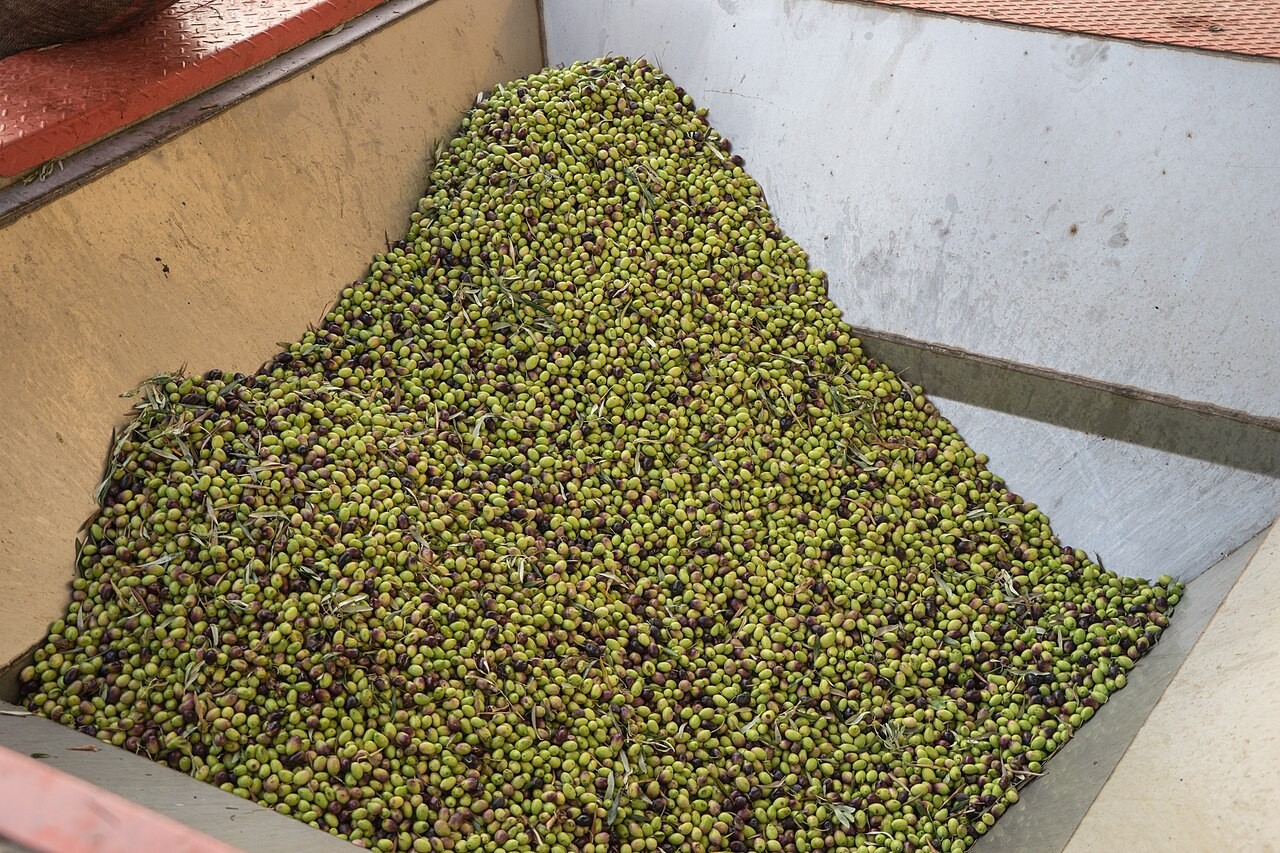
Olives at the mill. Booking a slot in advance keeps the time between harvest and extraction short.
The harvesting method depends on the grove and the product
From ancient times until 20 to 30 years ago, most growers knocked the fruit off the trees with wooden sticks. Modern olive growing now includes new tools that make harvesting easier and faster, improve its efficiency, lower labour costs and reduce injury to the trees. The method each grower chooses depends on:
- the grove, if it is very rocky or steep,
- tree shape, meaning height, canopy size and trunk thickness,
- the purpose of the crop, table olives or oil,
- the grower's budget.
Olives can be harvested in four ways:
- Entirely by hand, picking into a bucket or using hand rakes, a technique widespread for table cultivars so that the fruit is not damaged.
- With hand-held machines, meaning electric or petrol vibrating harvesters and combs, while wooden sticks are not recommended.
- With heavy tractor-mounted vibrating machines, such as trunk shakers with or without a catching umbrella. In this case the grower chooses low-vibration machines or adjusts the intensity so that the trees are not damaged and not too many leaves are lost, and harvests once fruit detachment force has fallen.
- Fully mechanically, with over-the-row harvesters for super-high-density hedgerow plantings (SHD), consisting of a tall tunnel, a moving cab, a full-height catching system and trays where the olives fall. The machine passes over the tree, and inside the tunnel the branches are shaken so that the olives drop onto the trays.
Fully mechanical harvesting is possible only on flat, unobstructed fields where trees are kept low and planted at set spacings so that the machine can pass between them, and it is most widespread in California, Australia and parts of Spain, among other places. Mechanical harvesting of Arbequina also takes place in Greece, in areas such as Xanthi and Komotini, Larissa, Aetolia-Acarnania and Ilia. Across most of the country, however, the terrain, with few large flat areas, rules out super-high-density, fully automated systems.
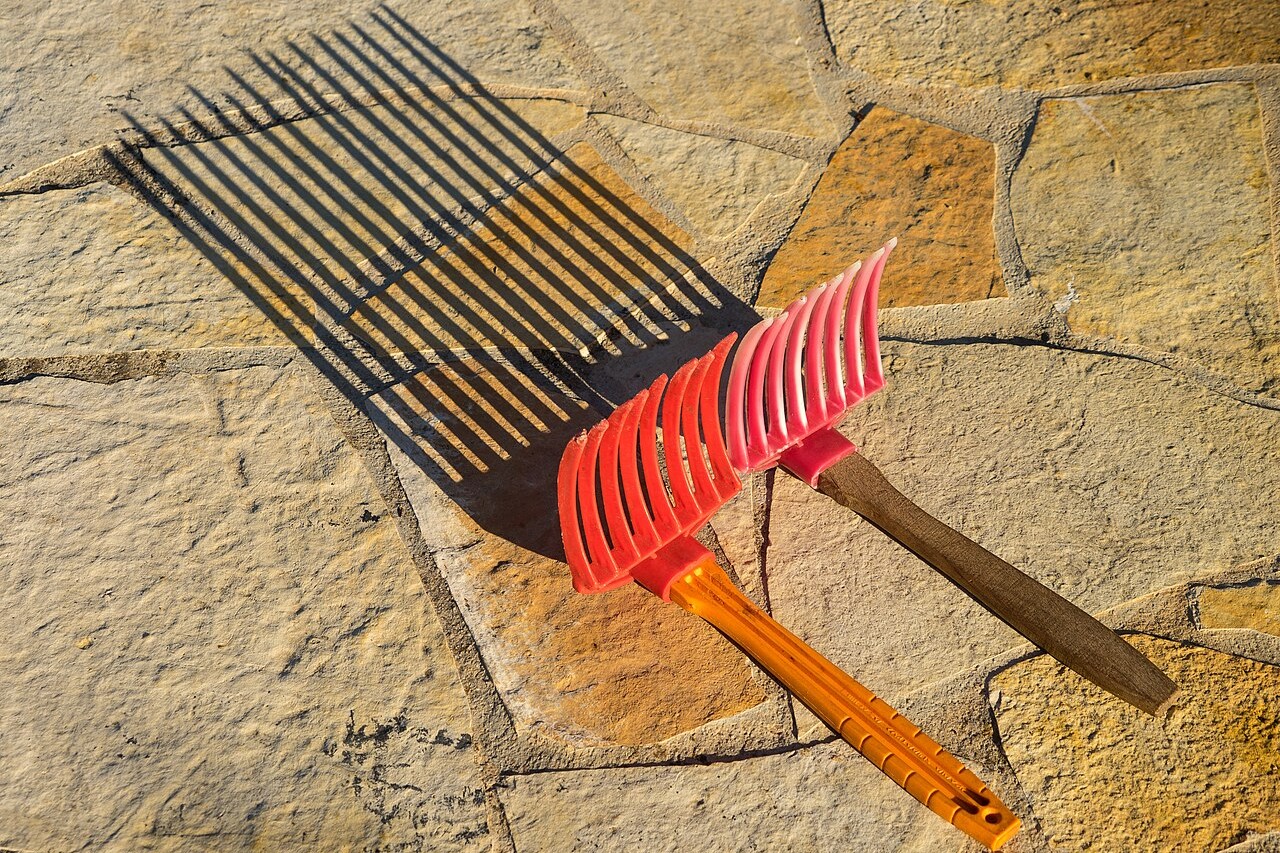
Plastic hand combs are the simplest harvesting tool and are still widely used for table cultivars.
Low-vibration harvesters protect next year's shoots
Among hand-held harvesters, hook heads grip the branch and pass the vibration into it without touching the fruit directly. In a study of an electric hand-held harvester, fruit damage depended on head speed and stick length, and was lowest, at about 6%, with the longer 17 cm sticks. With the vibration intensity set correctly, the fruit falls without damaging the shoot tips that matter for next year's crop. Battery, 12 V and petrol harvesters also differ in the vibration the operator receives, and choosing between olive harvesting tools and machines starts from the intended use of the fruit.
During pruning or harvesting there is also a risk of contaminating the fruit, the soil or a water source through machinery, for example with chain oil. That is why many olive growers prefer vegetable-based lubricants, which break down fully in the soil within a short time and are considered safe for the fruit and the environment, and their use is essential in organic farming.
The grove still needs care after harvest
For many growers the end of the harvest is the end of the season. To keep the trees healthy and productive the next year, however, a few follow-up tasks after harvest are needed, in the order below.
Copper sprays protect harvest wounds
The aim of this treatment is to protect the trees from diseases such as anthracnose, peacock spot and olive knot. It is particularly important in rainy areas or in groves with a history of infection, where the trees were wounded during harvest.
Many growers start copper sprays around mid-September, with one spray roughly every 10 to 20 days until about a week before harvest, 3 to 5 sprays in total, on days without rain or strong wind. Because many growers prune at the same time as they harvest, they spray copper again straight after pruning, while when harvest and pruning are further apart, copper is applied after harvesting and again straight after pruning. Because copper use has been restricted at EU level, the number of sprays is matched to each grove's real risk.
Fertilisation and organic matter prepare the next season
Besides the main fertilisation in the winter months, January and February, 1 or 2 foliar feeds can follow the harvest, or the grove can be enriched with organic fertilisers such as compost or well-rotted manure. In a five-year trial by the Pasias chemical laboratory on Koroneiki, Kalamon, Chalkidiki, Manaki and Amfissis trees, foliar sprays with boron and trace elements from late November to late December raised leaf boron from 25 to 38 ppm by mid-March, while in unsprayed trees it fell to 12 ppm. Formulations containing phosphorus lowered boron instead, so phosphorus is best left out of the post-harvest spray. Whether, and which, fertilisation a grove needs is decided by leaf and soil analysis.
Fallen olives should not be left in the grove
Olives that fell to the ground during or before the harvest, if they are not collected and stay there until the next year, are the ideal vehicle for an early build-up of olive fruit fly. Whatever is left after harvest should be gathered in bags and removed from the field straight away, since fallen olives may contain fly eggs and larvae.
Important notes
Every plant and every environment is unique. Conditions vary considerably with region, exposure, water quality, soil pH and the overall health of the plant. The guidance above is general and a starting point.
If you suspect a serious nutrient deficiency or a disease that basic practices do not resolve, contact an agronomist for an accurate diagnosis.
Plant protection products should be used carefully and responsibly. Always try non-chemical methods first (cultural practices, soft soap, summer oil). When chemical intervention is needed, use only approved products and follow the label instructions.
Sources
- Martinelli, F. et al. Effects of irrigation on fruit ripening behavior and metabolic changes in olive. Scientia Horticulturae.
- Olive4Climate. Olive4Climate Handbook.
- ELGO-DIMITRA. Magazine, issue 23, pp. 14-17 (in Greek).
- Evaluation of changes in the quality of extracted oil from olive fruits stored under different temperatures and time intervals. Scientific Reports, 2019.
- Development of an electrical hand-held olive harvester. Misr Journal of Agricultural Engineering.
- Pasias-Raptopoulou General Chemistry Laboratory. Does post-harvest foliar feeding help olive flowering in spring? (in Greek).