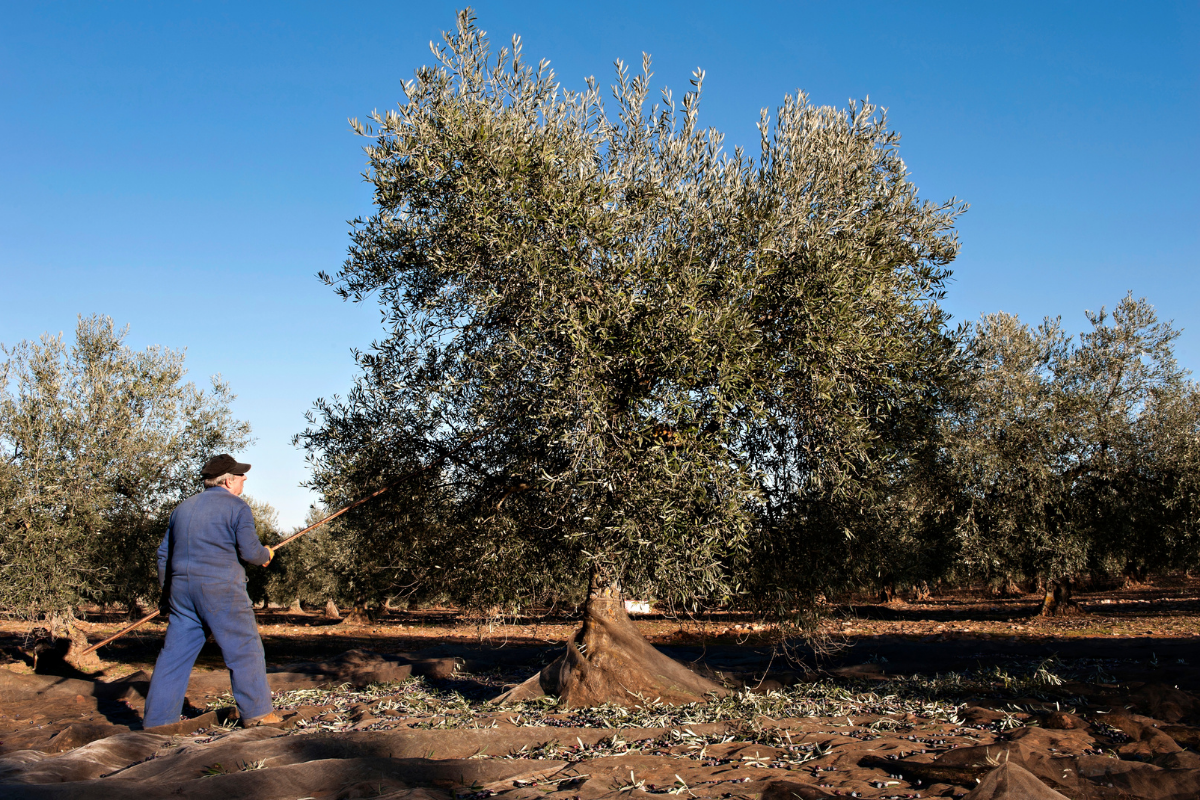
Portable vibrating olive harvesters deliver roughly three times the productivity of hand harvesting, and in sloped groves, old trees, and irregularly spaced groves, they are the main harvesting tool. The right equipment depends on the layout of the grove, tree size, whether the fruit is for oil or the table, and the grower's budget, and it has to cover the whole journey of the fruit, from the hand rake to the crate that reaches the olive mill.
Hand rakes remain the safest option for table olives
Plastic olive rakes, with or without a pole, and hand picking bruise the fruit least, which is why they dominate for table cultivars. In Chalkidiki, green table olives are picked entirely by hand, and pickers wear gloves or tape over their nails to avoid marking the delicate fruit, as growers told Wikifarmer in its interviews with producers across Greece.
Hand rakes cost the least but are also the least productive, so in an oil grove with hundreds of trees, they are usually kept for low branches or for fruit destined for the table.
Olive harvesters are grouped by power source
Battery harvesters are now the most widespread, with batteries ranging from 12 to 48 V and power typically between 400 and 1,000 W across models on the market. Run time depends on battery capacity, so a full day in the grove usually calls for a second battery or a generator system. 12 V harvesters can also run from a wheeled petrol generator that powers one or more tools at once, which solves the charging problem on large holdings.
Petrol harvesters carry the engine on the tool, need no charging and have plenty of power, but they are heavier, noisier and transmit more vibration. Pneumatic combs are driven by a compressor, usually powered by a tractor, and in groves with tractor access, they let several workers run from the same source. In a field comparison, a branch shaker harvested 58 kg of olives per hour, compared with 36 kg per hour with pneumatic combs, yielding productivity two to four times that of hand harvesting.
The harvester head decides on output and fruit damage
Three main head types are on the market. A pulsed double comb has two rows of teeth moving in opposite directions that comb the branch, a finger or sphere head rotates or oscillates inside the canopy, and a vibrating hook grips the branch and shakes it without touching the fruit directly.
In a comparison of three types of hand-held harvesters, the pulsed double-comb head at 1,500 rpm scored best overall, with 88 kg per hour, 98% fruit removal and 6.6% damaged fruit, while in related work, the hook type caused the least fruit damage. For oil, speed and removal come first, whereas for table olives, fruit damage is the criterion that rules out the more aggressive heads.
Early harvesting makes every harvester work harder because unripe fruit holds more tightly to the branch. Fruit detachment force falls as the olives ripen, and when a grower turns up the intensity to shake down green fruit, more leaves are lost, and the shoots that will bear next year's crop are damaged.
Pole and weight decide how many hours a worker can keep going
Poles are fixed or telescopic, with most models between 2 and 3.4 metres long and weighing around 2.3 to 3.3 kg. Carbon-fibre poles are lighter than aluminium ones, and a difference of a few hundred grams is felt after eight hours with arms raised. Telescopic poles reach higher but are usually heavier, so for low, well-pruned trees, a short fixed pole is often the better choice.
Hand-arm vibration is a real risk for the operator
EU Directive 2002/44/EC sets a daily exposure action value of 2.5 m/s² and a limit value of 5 m/s² for hand-arm vibration over an eight-hour day. In measurements on electric hand-held harvesters used for four hours a day, daily exposure for the more exposed hand ranged from 11 to 40 m/s², far above the limit for every model tested. Heads with two arms oscillating in opposite directions cut exposure by 60 to 70%.
In another comparison, an electric comb transmitted about half as much vibration as a petrol hook shaker. In practice, head type, breaks, and rotating workers on the harvester reduce exposure, and safety glasses protect against twigs and leaves thrown from the canopy.
Trunk shakers and tractor machines serve large groves
Trunk shakers are mounted on a tractor, with or without a catching umbrella, and shake the whole tree. They need trunks and tree spacing they can reach, and their efficiency depends on the ratio of fruit detachment force to fruit weight, with harvest recommended once it falls to about 2 N per gram. They have to be set to low vibration so as not to damage the bark or strip too many leaves.
The market also offers self-propelled or remote-controlled carriers with a harvesting head, tractor-hung harvesters and suction machines that pick fruit up from the nets. Fully mechanical harvesting with over-the-row machines is used only in super-high-density hedgerow plantings on flat, unobstructed land.
From the net to the crate, the fruit needs its own equipment
Nets or ground sheets are laid under each tree to catch the fruit, and on large holdings, tractor-mounted net winders save many working days. The fruit then goes through a leaf separator, either a hand screen or a mechanical one, which removes leaves and twigs before transport, and larger farms also use olive cleaning machines.
For transport, plastic or jute sacks restrict airflow, heat the fruit and press it, which is why perforated crates, often of 20 kg, are recommended. Olives are stored somewhere shaded, cool, and well-ventilated until milling, which should happen as soon as possible, because every day of waiting increases acidity and reduces phenolic compounds.
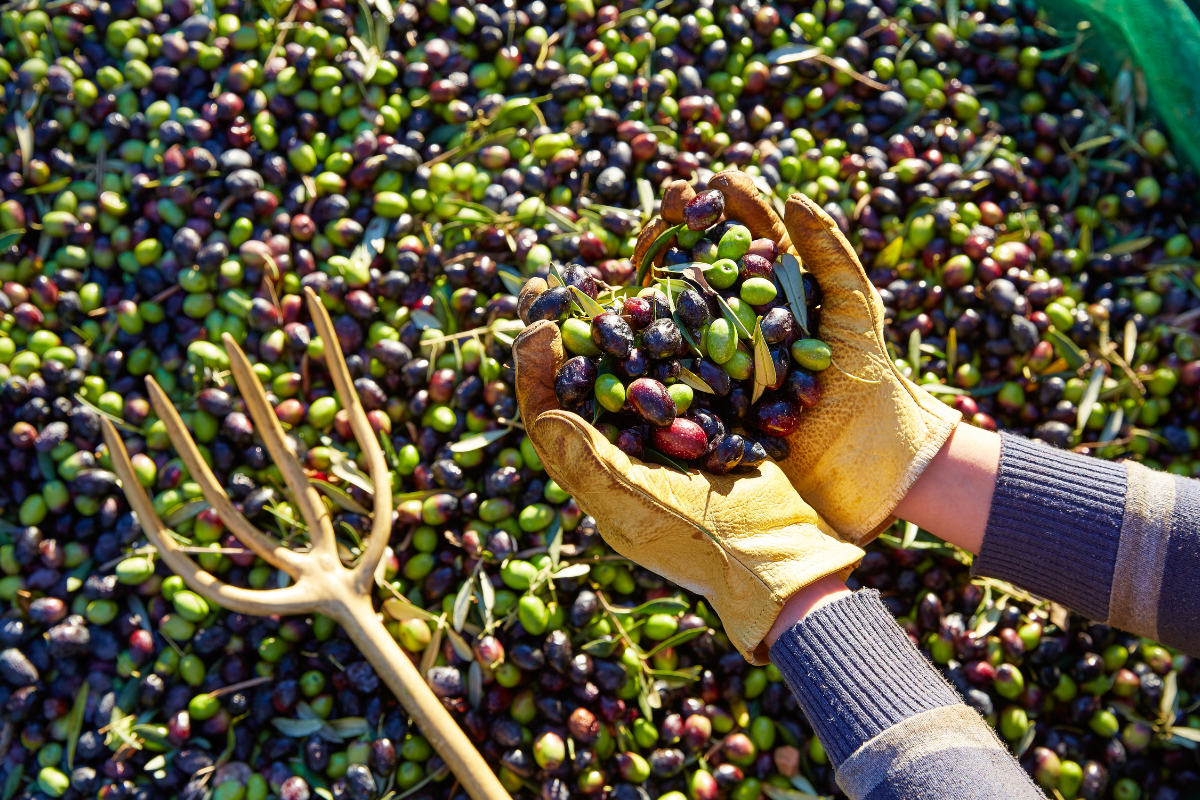
The fruit gathered from the nets still carries leaves and twigs, which the leaf separator removes before transport.
Which tool for which grove
| Tool | Best for | Watch out for |
| Hand rake | Table olives, small groves, low branches | Low productivity |
| Battery harvester | Most groves are grown for oil | Run time, spare battery |
| 12 V harvester with generator | Large groves, several tools at once | Moving the generator around |
| Petrol hook shaker | Thick branches, groves without power | Weight, noise, high vibration |
| Pneumatic combs | Groves with tractor access, work crews | Compressor, hoses |
| Trunk shaker | Large, flat groves with regular spacing | Vibration setting, bark damage |
Sources: Wikifarmer olive harvest articles and the harvester and vibration studies cited in the text.
Frequently asked questions
Battery or petrol olive harvester?
A battery harvester is lighter, quieter and transmits less vibration, with run time as its limitation. A petrol harvester requires no charging and has more power for thick branches, but it is heavier and, in terms of vibration, transmits about twice as much as an electric comb.
Which harvester is best for table olives?
For table olives, the deciding factor is fruit damage. The vibrating hook, which shakes the branch without touching the fruit, caused the least damage in comparative work, while for the most delicate cultivars, hand raking remains the safest option.
What is a finger or sphere head harvester?
It is a harvester whose head carries fingers or spheres that rotate or oscillate inside the canopy and knock the fruit off. It is sold in battery and 12 V generator versions.
What pole length do I need?
For low, pruned trees, a fixed pole of about 2 to 2.5 metres is enough and lighter; for taller trees, telescopic poles reach up to about 3.4 metres and are slightly heavier.
How do I collect olives from the ground?
Nets or ground sheets are laid under the trees, the fruit is gathered from them and passed through a leaf separator to remove leaves. Large groves use net winders and suction machines mounted on tractors.
Is harvester vibration dangerous?
In measurements with four hours of use a day, every electric harvester tested exceeded the EU limit of 5 m/s² several times over. Breaks, rotating operators and heads with opposing arms reduce exposure.
Important notes
Productivity, fruit damage and vibration figures come from specific studies, cultivars and conditions and will differ from grove to grove. Before buying, assess the layout of the grove, tree height and the intended use of the fruit, and always follow the manufacturer's safety instructions for use, personal protective equipment and maintenance.
Sources
- Applied Sciences (2022). Vibration from electric hand-held harvesters for olives. Applied Sciences, 12(4), 1768.
- Development of an electrical hand-held olive harvester.
- Evaluation of the mechanical harvesting efficiency of olive. CIGR Journal.
- Evaluation of the vibrations transmitted to the hand-arm system in the use of portable harvesters for olives.
- Guidelines for occupational exposures to mechanical vibration (2018). PubMed.
- Performance evaluation of hand-held olive harvesters.
- Wikifarmer. How to harvest olives at the right time and in the right way.