As the autumn harvest approaches across Crete and the Peloponnese, Koroneiki is the variety that will produce most of Greece's olive oil. It covers 50 to 60 per cent of the country's olive-growing acreage, dominates plantings in Crete and the Peloponnese, and forms the basis for new orchards almost everywhere.
The most frequently asked question about it concerns yield, and the answer depends on two figures that are frequently confused.
How much oil does it give
Oil content, meaning the proportion of oil in the weight of fresh fruit, runs from 20 to 27 per cent and ranks among the highest of any cultivar worldwide.
In practical terms, that means roughly four to five kilos of olives for one kilo of oil, where harvest happens at the right stage. The figure is not fixed throughout the season, however. It climbs as ripening advances, starting low in early autumn. That increase does not mean better quality, since over-dehydrated fruit yields oil with raised acidity and degraded sensory characteristics.
Kilos per tree
The second figure is fruit production, which varies far more. Depending on planting conditions and spacing, a tree yields from 30 to 100 kilos of fruit.
Combining the two, a tree in good condition yields roughly 6 to 25 kilos of oil, a range that helps explain why the answers in circulation differ so widely. In intensive planting systems, yields are quoted per unit area and reach 2 to 4 tonnes of fruit per hectare under optimum conditions. The tree comes into bearing early, from the third year, a trait that makes it attractive for new plantings.
The fruit and the oil
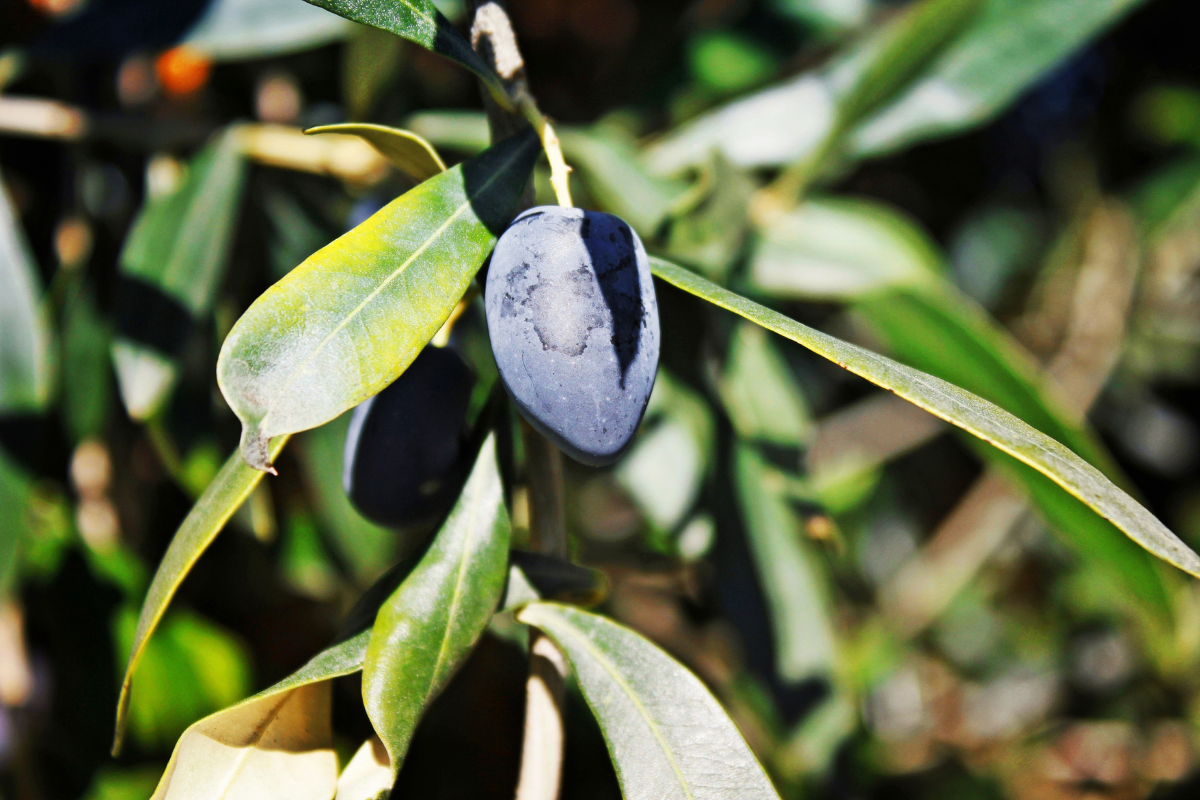
The fruit is very small, 0.5 to 1.4 grams, mastoid in shape and ending in a small teat. The flesh-to-pit ratio reaches 6.6 to 1, which explains how so small a fruit delivers so much oil.
The oil contains very high levels of oleic acid (76 to 80 per cent) and a high stability index. Polyphenols typically range from 300 to 700 milligrams per kilo, with early-harvest oils reaching higher levels. The profile is fruity, with pronounced notes of green apple, almond, and cut grass, and moderate bitterness and pungency.
The tree
This is a tree of moderate vigour, with a spreading habit and a sparse canopy that favours air movement and light penetration. Height usually runs 5 to 7 metres.
Leaves are small and thick, with a blade length of 4.5 to 5.2 cm, and rooting ability is rated medium to high, which is important for propagation from cuttings. Flowering is early, and the tree produces abundant pollen, which is why it serves as a widespread pollinator for numerous other varieties.
The altitude limit
The most significant constraint on this variety, and the reason it is not planted everywhere, is cold. Koroneiki does not tolerate frost.
In practice, above 400 metres of altitude it gives way to other varieties, most commonly Tsounati, which also serves as a pollinator. In Crete some sources place that threshold at 400 to 500 metres.
Attempts to grow it north of its usual zone frequently fail. One recorded case in the Trikala region saw trees come into bearing early, after which a severe frost caused cankers on the trunks and brought growth to almost a halt.
Tolerances and weaknesses
The variety is tolerant of drought and strong winds, which suits it to rainfed cultivation. Restricted irrigation, however, intensifies alternate bearing.
Regarding pests and diseases, susceptibility to the olive fruit fly is consistently reported by Greek sources, while it shows moderate resistance to Verticillium wilt. For olive leaf spot and olive knot, sources disagree: some describe it as resistant, others as susceptible. Field behaviour most likely depends on the local microclimate and disease pressure, so monitoring remains necessary regardless of the variety.
The i-38 clone and high-density planting
Nurseries frequently offer it as Koroneiki i-38, a designation that corresponds to a clonal selection rather than to a different variety.
That selection is intended chiefly for super-high-density hedgerow plantings, a system now applied in Spain, Italy and Australia. In a comparison from 2008 to 2014, the selection produced, on average, around 15 per cent more oil than the corresponding selection of the Spanish variety Arbequina.
Two things are worth knowing for anyone considering that route. Planting distances, harvest equipment and pruning differ radically from the traditional system. And the cold constraint remains unchanged, since this is the same variety.
The naming confusion
In the literature and in the trade, Koroneiki also appears as Psilolia, Koroni, Lianolia or Vatsiki, and the third of those creates a real problem.
Lianolia of Corfu is an entirely different variety, with a tree reaching 15 metres in height, cultivated in the Ionian Islands and Epirus, greater cold tolerance, and higher soil moisture requirements. When buying planting stock or describing production, use "Koroneiki" as the safe name, while the botanical designation is Olea europaea var. microcarpa alba.
Trade names such as "large-fruited Koroneiki" cause similar confusion. Typical Koroneiki fruit weighs around 1 gram, so any offer with a noticeably larger fruit needs clarification on what is actually being sold.
When it is harvested
Ripening is rated early to intermediate, with the fruit turning black at full maturity.
In practice, harvest begins in mid-October and peaks in November, with exact dates shifting according to region, altitude, and season. For early-harvest oil, picking occurs earlier, resulting in lower oil content but higher polyphenol levels.
How growers from Chania to Messinia time the Koroneiki harvest, from around 20 September in Filiatra to the end of October in Lampaina, is told in when and how olives are harvested in Greece, while maturity indices, yield per tree and the route to the mill are covered in the guide to harvesting olives.
Notes
Yield and oil content figures come from international and Greek sources and represent ranges rather than guarantees. Actual performance depends on soil, microclimate, tree age, irrigation, fertilisation and management of alternate bearing. Before establishing a new planting, consult a local agronomist and check how the variety performs in neighbouring groves under comparable conditions.
Sources
- International Olive Council. Koroneiki, World Catalogue of Olive Varieties.
- Tsesmelis Nursery. Koroneiki, variety characteristics.
- Chemical composition of virgin olive oils from Koroneiki cultivar with regard to fruit ripening and irrigation regimes. International Journal of Food Science and Technology.