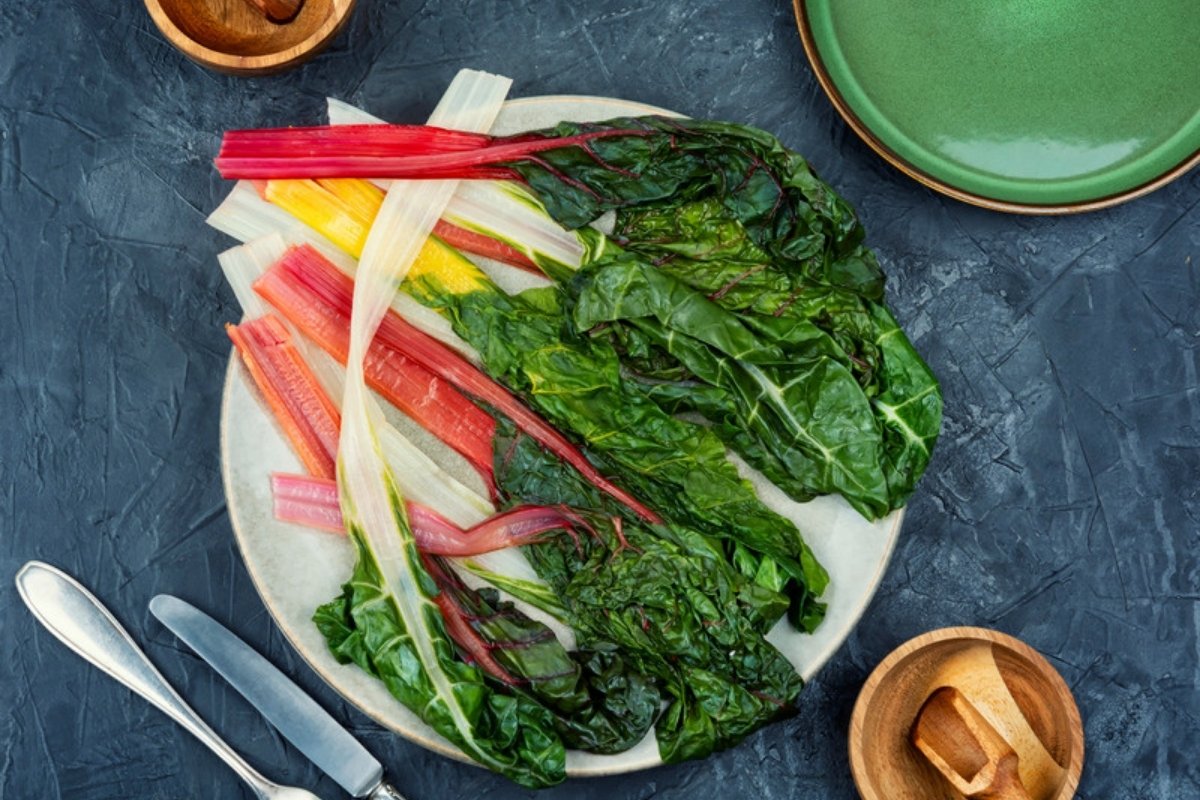
100 grams of raw Swiss chard provide just 19 kcal and almost 93 grams of water, and are one of the richest dietary sources of vitamin K, at 830 µg, or about 11 times the reference value. They also supply significant amounts of vitamin A, vitamin C and magnesium, as well as 11,000 µg of lutein and zeaxanthin. Chard also contains a fair amount of sodium naturally, almost three times as much as spinach. For most people it is a nutritious and safe food, but two groups need care: people taking anticoagulants, because of vitamin K, and people with kidney stones, because of oxalates. This article covers chard's nutrients, what a typical serving provides, what applies to claims in the EU, and which precautions are needed.
Nutrients per 100 grams
Values are for raw Swiss chard, from the USDA FoodData Central database. The percentage refers to the nutrient reference value of EU Regulation 1169/2011, where one is defined.
| Nutrient | Per 100 g | % of reference value |
|---|---|---|
| Energy | 19 kcal | 1% |
| Water | 92.7 g | – |
| Carbohydrate | 3.74 g | 1% |
| Sugars | 1.1 g | 1% |
| Fibre | 1.6 g | – |
| Protein | 1.8 g | 4% |
| Fat | 0.2 g | under 1% |
| Vitamin K | 830 µg | 1,107% |
| Vitamin A | 306 µg | 38% |
| Vitamin C | 30 mg | 38% |
| Vitamin E | 1.89 mg | 16% |
| Magnesium | 81 mg | 22% |
| Potassium | 379 mg | 19% |
| Manganese | 0.37 mg | 18% |
| Copper | 0.18 mg | 18% |
| Iron | 1.8 mg | 13% |
| Calcium | 51 mg | 6% |
| Folate | 14 µg | 7% |
| Sodium | 213 mg | – |
| Lutein and zeaxanthin | 11,000 µg | – |
Lutein and zeaxanthin are carotenoids, like beta-carotene, which in chard reaches about 3,650 µg per 100 grams. As with any vegetable, values vary from sample to sample, depending on variety, season and growing conditions.
What a typical serving provides
A salad with 50 grams of raw chard leaves provides about 415 µg of vitamin K, more than five times the reference value, about 15 mg of vitamin C and 153 µg of vitamin A, around 19% each, for under 10 kcal. In Greek and Mediterranean cooking, though, chard is eaten mostly cooked, boiled, in pies or in stews, and it shrinks a great deal, so a portion of cooked chard corresponds to a much larger quantity of fresh leaves.
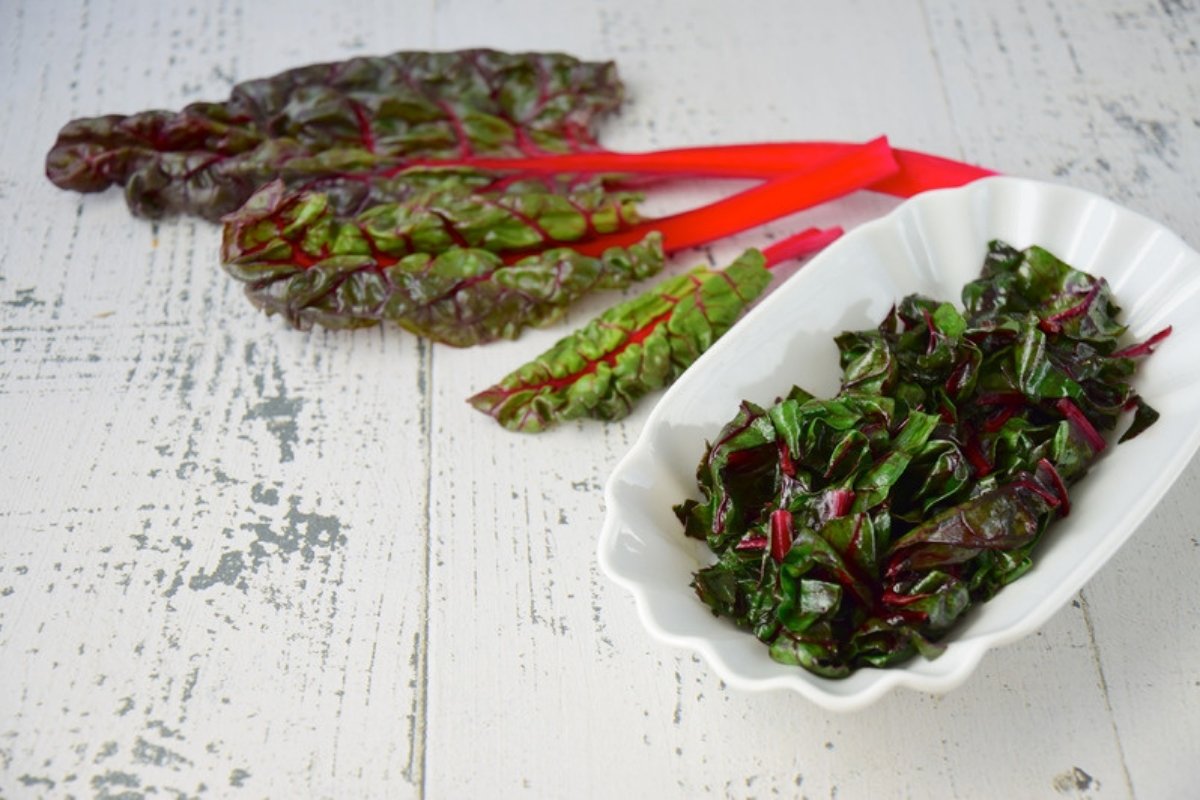
Chard shrinks a great deal when cooked, so a portion of cooked chard corresponds to a much larger quantity of fresh leaves.
Nutrient and health claims
Under EU Regulation 1924/2006, a food may be described as a source of a vitamin or mineral when it provides at least 15% of the reference value per 100 grams, and as high in it when it provides at least twice that. Based on values per 100 grams, raw chard meets the high condition for vitamin K, vitamin A and vitamin C, and the source condition for magnesium, potassium, manganese, copper and vitamin E. For iron, calcium and folate, the amounts fall below the threshold.
In the EU, any health claim for a food must be authorised and included in the Union register. Claims that circulate for chard, such as that it "regulates blood sugar" or is "anti-cancer", are not among the authorised health claims.
Sodium in Swiss chard
At 213 mg of sodium per 100 grams, chard contains almost three times as much sodium as raw spinach, which has 79 mg. This is not a large amount in absolute terms, but for people on a low-sodium diet it is worth counting, especially when chard is eaten in large portions with added salt.
Precautions
Vitamin K and blood thinners
Vitamin K is involved in blood clotting, and chard is one of its richest sources. According to the NIH Office of Dietary Supplements, people taking warfarin or similar anticoagulants need to keep their vitamin K intake consistent, because sudden changes can increase or decrease the effect of the medicine. Chard is not off the menu. The amount stays roughly the same from day to day, and any major dietary change is discussed with a doctor first.
Oxalates and kidney stones
Chard, like spinach and beetroot, is one of the foods high in oxalates. The low oxalate diet leaflet of the West Hertfordshire Teaching Hospitals NHS Trust lists it among high-oxalate foods, and the Oxalosis and Hyperoxaluria Foundation classes it as very high, with red chard higher than green. For most people this is not a problem. People who have formed calcium oxalate stones, or who have high oxalate levels in their urine, may need to limit it, always on their doctor's advice. According to Alberta Health Services in Canada, calcium-rich foods at the same meal, such as yoghurt or cheese, reduce oxalate absorption.
Frequently asked questions
How many calories are in Swiss chard
100 grams of raw chard provide just 19 kcal, because they contain almost 93 grams of water. A salad with 50 grams of leaves provides under 10 kcal.
What vitamins does Swiss chard contain
Chard is exceptionally rich in vitamin K, at about 11 times the reference value per 100 grams, and rich in vitamins A and C. It is also a source of vitamin E, magnesium, potassium, manganese and copper.
Does Swiss chard have side effects
For most people, no. People taking anticoagulants should keep the amount consistent, because of vitamin K, and people with a history of kidney stones may need to limit it, because of oxalates, on their doctor's advice.
Can I eat Swiss chard if I take blood thinners
Yes, as long as the amount stays consistent from day to day, because sudden changes in vitamin K affect how warfarin works. Discuss any major dietary change with your doctor.
Is Swiss chard high in iron
It has 1.8 mg per 100 grams, or 13% of the reference value, below the threshold for a "source of iron" claim. It stands out more for vitamin K, vitamins A and C, and magnesium.
How much sodium is in Swiss chard
It contains 213 mg of sodium per 100 grams of raw leaves, almost three times as much as raw spinach. For people on a low-sodium diet it is worth counting, especially with added salt.
Important notes
The health information in this article is for general awareness and does not replace medical advice.
References
- USDA FoodData Central, Chard, swiss, raw.
- Food Safety Authority of Ireland, Regulation (EU) 1169/2011, Annex XIII, reference intakes.
- Regulation (EC) No 1924/2006 on nutrition and health claims made on foods.
- NIH Office of Dietary Supplements, Vitamin K, fact sheet for health professionals.
- West Hertfordshire Teaching Hospitals NHS Trust, The low oxalate diet.
- Oxalosis and Hyperoxaluria Foundation, Vegetables oxalate.
- Alberta Health Services, Limit foods high in oxalates.