Seed is the single most important input in crop production. It accounts for only about 5% to 10% of a season's production costs, yet it sets the genetic ceiling on what the crop can yield. No amount of good fertiliser, well-timed irrigation, or disciplined pest management will lift a crop above the potential of the seed it grew from.
Choosing seed on price or brand name alone leads to poor emergence, uneven stands, greater disease exposure, and a smaller cheque at harvest. Protecting that investment means understanding what seed quality actually consists of, knowing how to read the label, and running a few checks before money changes hands.
The four pillars of seed quality
Seed quality is defined across four separate parameters, and a proper assessment looks at all of them.
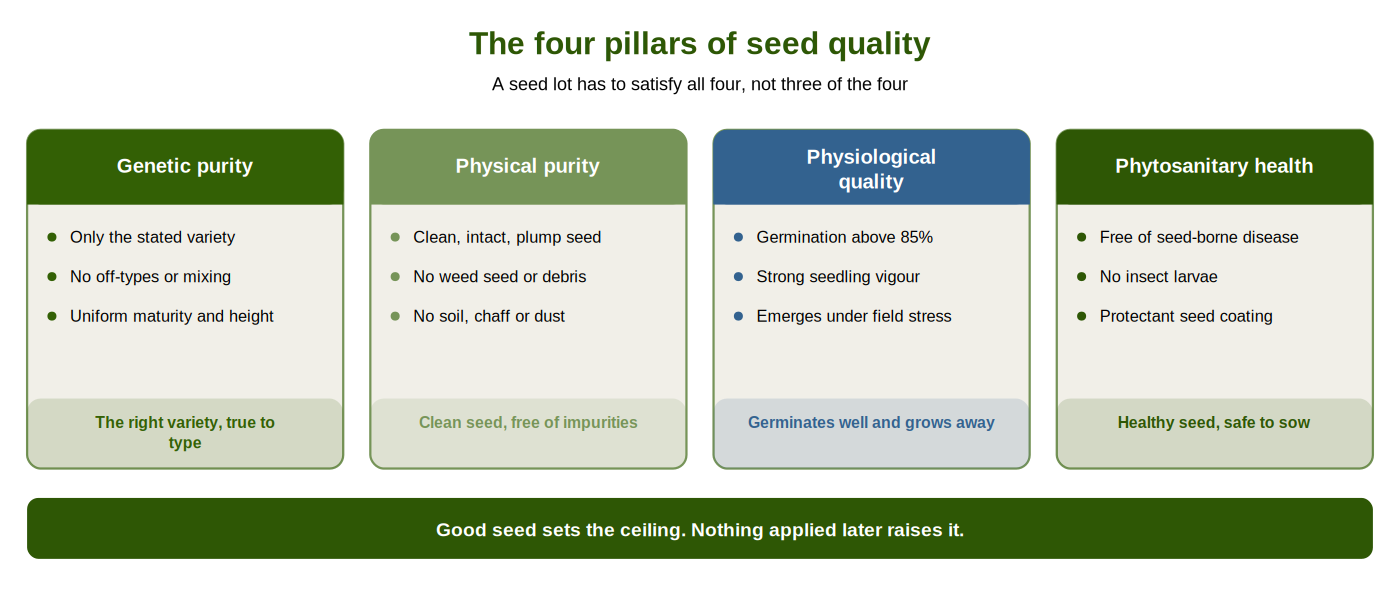
Genetic purity means the lot contains only the stated variety, without off-types from cross-pollination or mixing. Pure genetics give consistent maturity dates, uniform canopy height, dependable drought or pest resistance, and predictable quality traits such as grain texture or oil content. Where purity is poor, flowering and ripening become uneven, harvesting is less efficient, and non-uniform grain fetches a lower price.
Physical purity measures how clean the lot is. Good seed consists of intact, plump seeds of the target crop and nothing else, free of cracked kernels, dust, chaff, soil, and above all weed seeds. Seed contaminated with noxious weed seed introduces a persistent problem into clean ground and raises weed-control costs for seasons afterwards.
Physiological quality covers germination and vigour. Germination percentage is the proportion of seeds producing normal, healthy seedlings under favourable laboratory conditions, and commercial field seed should generally test at 85% or above, though the standard varies by crop. Vigour is different and matters just as much. It is the capacity to emerge quickly and evenly under field stress such as cold soil, crusting, or a dry spell. Two lots can both germinate at 85% in the laboratory while the higher-vigour lot substantially outperforms the other in a difficult seedbed.
Phytosanitary health means freedom from seed-borne fungi, bacteria, viruses, and insect larvae. Infected seed carries pathogens straight into the soil, causing seedling rot, damping-off, or an early disease outbreak across the field. Good commercial seed is often pre-treated with protective fungicide or insecticide, which is usually visible as a bright red, pink, or green coating on the seed.
Reading the seed tag
Never buy seed without reading the certification tag attached to the bag. Seed producers are required to declare the key measurements, and the tag is what tells you whether the lot is worth its price.
| Label field | What it tells you | Typical benchmark |
| Pure seed % | Share of the bag that is actual seed of the target crop | Above 98% |
| Germination % | Share of seeds capable of normal growth in the laboratory | Above 85%, varies by crop |
| Inert matter % | Debris, dirt, and damaged seed fragments | Below 1.5% to 2% |
| Other crop and weed seed % | Contamination from other crops or weed species | Below 0.1%, noxious weeds zero |
| Date of test | Month and year the lot was tested for germination | As recent as possible, commonly within 9 months |
| Lot number | Code identifying the seed origin and processing batch | Must match your receipt and the bag tag |
Benchmarks are typical values and vary by crop and by country. Check the standard that applies in your own jurisdiction.
The date of the test deserves particular attention. A seed is a living organism, and it deteriorates quickly in hot or humid storage. Many seed laws require that the germination test be completed within 9 months before sale, and if a tag is older than that, the germination figure on the label may no longer reflect what is in the bag.
That nine-month figure is a common benchmark rather than a universal rule, and the legal requirement differs considerably between countries and seed types. Some regulations allow only five months for certain vegetable seed, others allow twelve, and hermetically sealed containers are usually given far longer. The benchmark figures in the table vary by crop and jurisdiction. Check what applies where you farm, and treat a recent test date as a good sign regardless of the legal minimum.
Hybrid seed and open-pollinated varieties
The choice between the two comes down to matching farm goals to the seed budget.
Hybrid seed, usually labelled F1, comes from a controlled cross between two distinct parent lines. Hybrids offer higher yield potential, stronger disease resistance, and marked uniformity thanks to hybrid vigour. The trade-off is that the seed cannot be saved. Seed harvested from a hybrid crop segregates in the following generation, producing plants that are neither uniform nor high-yielding.
Open-pollinated varieties are pollinated naturally by wind or insects. Yields may be slightly below those of the best hybrids, but seed saved from a healthy open-pollinated crop grows true to type the following season, which lets a farmer cut annual seed costs, provided the seed is harvested, dried, and stored properly.
A checklist before you buy
Check the variety suits your conditions: Make sure it is registered and proven for your soil type, rainfall pattern, temperature range, and the disease pressure typical of your area.
Buy from certified dealers: Use licensed, reputable suppliers who store seed cool, dry, and well-ventilated. Walk away from bags kept outdoors, on damp floors, or in direct sun.
Inspect the bag: Seals should be unbroken, the original tags intact, and there should be no moisture clumping, mould, or insect exit holes.
Keep the paperwork: Retain the invoice, the lot numbers, and the empty tags until harvest. If the seed underperforms and a dispute follows, that documentation is what you will need.
Testing germination yourself
When planting saved seed or checking a commercial lot before committing a large area, a ragdoll test gives a reliable answer in about a week and costs nothing.
- Take 100 seeds at random from the lot.
- Dampen a clean paper towel or cotton cloth so it is moist but not dripping.
- Space the 100 seeds evenly across the towel.
- Roll the towel loosely into a cylinder and put it inside a loosely closed plastic bag.
- Keep it somewhere warm, 20°C to 25°C, out of direct sun.
- Count the normal, strong seedlings after five to seven days.
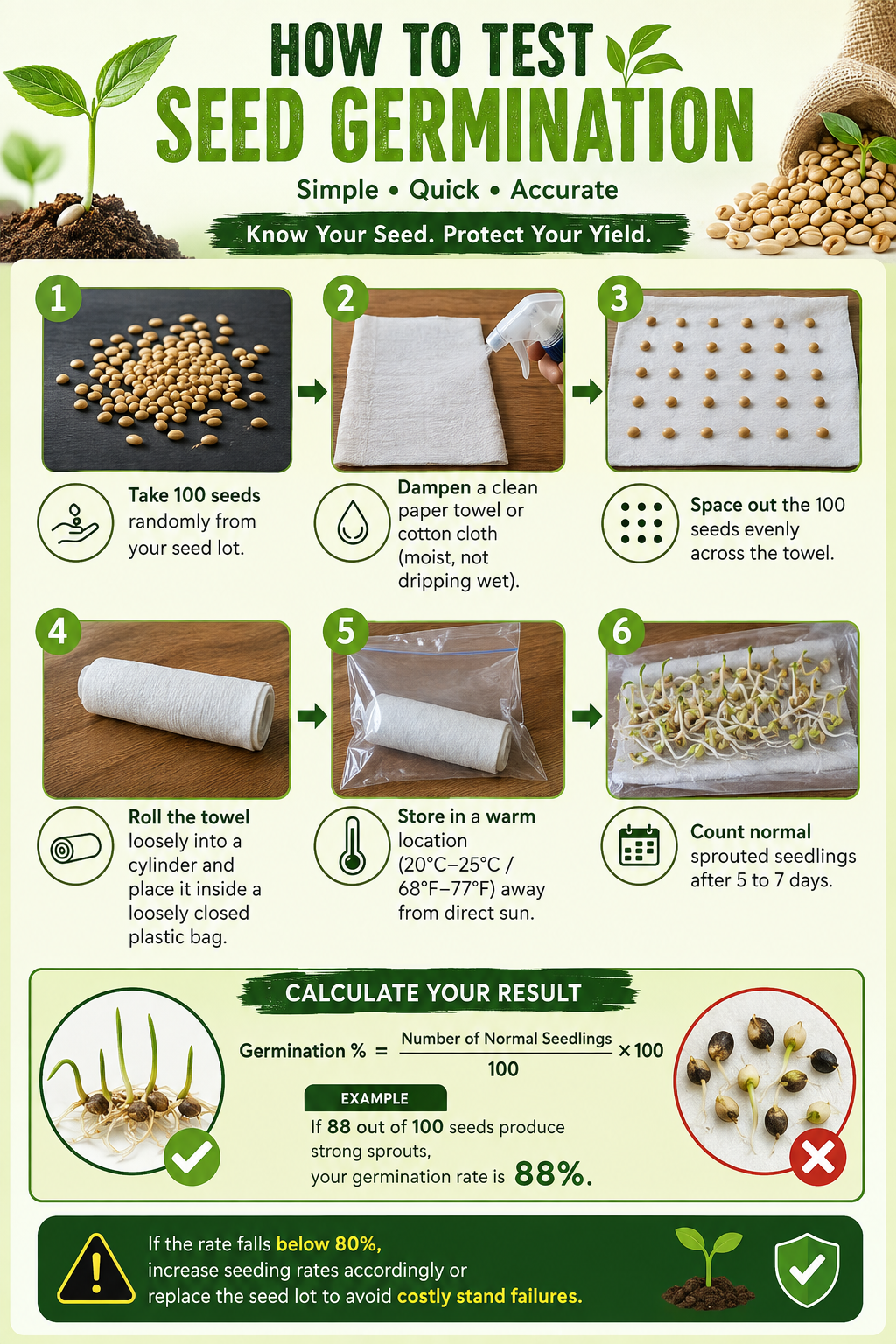
The count is the percentage. If 88 of the 100 seeds produce strong sprouts, germination is 88%. Below 80%, either raise the seeding rate to compensate or replace the lot rather than risk a failed stand.
Sources and further reading
International Seed Testing Association. International rules for seed testing.
Food and Agriculture Organization of the United Nations. Seed toolkit, module on seed quality assurance.
Association of Official Seed Certifying Agencies. Operational procedures and crop standards.
United States Department of Agriculture, Agricultural Marketing Service. Federal Seed Act.
McDonald, M. B., and Copeland, L. O. Principles of Seed Science and Technology. Springer.