When we talk about agriculture, we usually think of land preparation, fertilisers, irrigation, pesticides and harvesting. One input comes before all of them. Seed.
A farmer can prepare the land perfectly, fertilise optimally and manage irrigation with care, but if the seed is poor, the harvest will disappoint. Good-quality seed is the first input for establishing a healthy, productive and resilient crop.
Seed production is not simply growing a crop and harvesting its seeds. It is a rigorously managed process in which farmers and seed producers preserve a variety's genetic identity, purity, health, germination and vigour, so that the farmer who buys the seed receives material capable of delivering a uniform, high-yielding crop season after season.
Why seed production matters
Imagine two neighbouring farmers on identical land, with the same fertiliser and irrigation. One plants high-quality seed with verified germination and genetic purity. The other uses weak, uncertified or mixed seed. With identical field management, their crops will perform very differently.
High-quality seed delivers advantages across the whole crop cycle:
Better and uniform germination: an optimal plant population across the field from day one.
Healthy and vigorous seedlings: young plants establish quickly and outcompete early weeds.
Uniform crop canopy: synchronised flowering, easier field management, and cleaner mechanical harvesting.
Stress tolerance: greater resistance to environmental stress, pests, and disease.
Higher yield potential: the full genetic capacity of the improved variety is expressed rather than lost.
Superior grain quality: a uniform harvest that meets premium market standards.
Reliable establishment: less risk of crop failure or costly re-sowing.
This is why seed is recognised everywhere as the foundation of crop production. A strong harvest begins with a strong seed.
The generation sequence
Quality seed production rests on a traceable generation hierarchy, and each generation must keep the strict genetic identity of the original variety. If the starting material carries impurities, producing pure seed downstream becomes practically impossible.
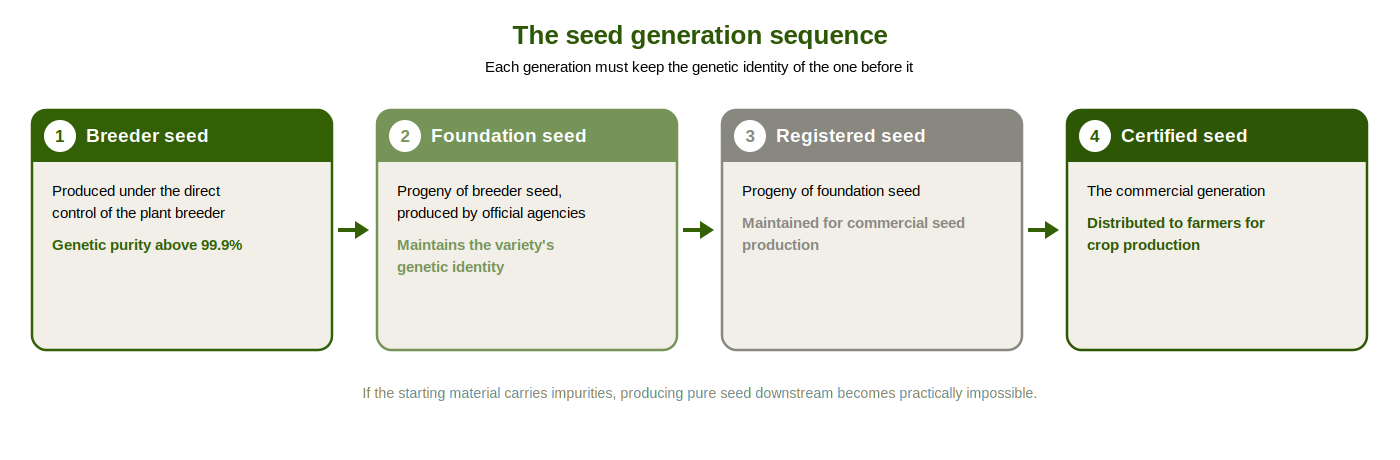
The generation hierarchy. Each step multiplies the seed while preserving the identity of the previous step.
Breeder seed: produced directly under the control of the plant breeder, with genetic purity above 99.9%.
Foundation seed: the progeny of breeder seed, produced by official agencies to maintain the variety's genetic identity.
Registered seed: the progeny of foundation seed, maintained for commercial seed production.
Certified seed: the commercial generation distributed to farmers for general crop production.
Site selection and isolation
The physical location of a seed field is critical because off-type pollen from neighbouring fields or wild relatives can cross-pollinate the crop, permanently degrading its genetic purity.
Cross-pollinated crops such as maize, sunflower and canola need substantially larger isolation distances than self-pollinated crops such as wheat and rice. Hybrid maize seed fields, for instance, often require 200 to 400 metres of isolation from other maize.
Isolation is managed in four ways.
- Distance: standard spatial separation between varieties.
- Time: staggered planting dates to prevent flowering periods from overlapping with adjacent fields.
- Physical barriers: windbreaks, tall crops, or greenhouse structures.
- Field selection: fields clear of weed seeds and previous crop residues.
Land preparation and planting
The seedbed must be clean, well-drained, and entirely free of volunteer plants growing from previous seasons. Proper preparation gives uniform germination, which in turn makes field inspection and roguing far easier.
Roguing protects genetic and physical purity.
Roguing, the systematic identification and removal of undesirable plants, is the single most important practice in seed production. It removes off-types, diseased plants, volunteers and noxious weeds before they contaminate the seed lot, and it continues across three developmental stages.
Vegetative stage: early in the season, watch for deviations in leaf morphology (shape, width, angle, or pigmentation) and in growth habit (height, tillering, or orientation).
Flowering stage, the most critical: off-type plants must be removed before they shed pollen. Watch for differences in flower colour, anther colour, head or panicle shape, and glume structure, and for plants that flower noticeably earlier or later than the surrounding field.
Maturity stage: inspect as harvest approaches for late-expressing traits, meaning differences in glume or seed coat colour, ear shape or grain density, and plants with abnormal maturation timing or late disease symptoms.
Field inspection
Official inspections confirm the seed crop meets certification criteria, with inspectors evaluating isolation distance, off-type percentages, weed levels and overall seed health. Producers should not rely on the formal inspection days alone. Walking the field weekly allows a producer to catch and correct small problems before they lead to certification rejections.
Harvesting and equipment sanitation
Harvest must come at optimal seed maturity. Too early gives shrivelled, low-vigour seed. Too late increases the risk of shattering, mechanical damage, and weather damage.
Two harvest rules matter above the rest. Clean the machinery thoroughly: combines, threshers, drills and transport wagons must be rigorously cleaned before switching between varieties or seed lots, because a single handful of leftover grain can contaminate an entire lot. Control moisture at harvest: avoid harvesting in high humidity or rain, which bruises the seed and encourages fungal growth.
Post-harvest processing and quality testing
After harvest, the seed is cleaned, graded, dried and tested. Cleaners remove inert material, weed seeds, broken grains and lightweight seed. Before bagging and distribution, laboratory tests follow standard rules, most widely those of the International Seed Testing Association:
Germination test: the percentage of seeds producing normal seedlings under ideal conditions.
Physical purity test: the exact proportion of pure crop seed against weed seeds, other crop seeds and inert matter.
Moisture content test: confirms moisture is within safe storage levels, typically below 12-14% for cereals.
Vigour test: how strongly the seed germinates under stressful, real-world conditions.
Health test: checks for seed-borne fungi, bacteria and viruses that would compromise establishment.
Storage preserves what production achieved
Producing high-quality seed is half the job. Maintaining that quality until the next planting season is the other half, and poor storage quickly ruins premium seed.
Facilities must be clean, dry, cool, well-ventilated, and protected against rodents and insects. High temperature and humidity accelerate seed respiration and ageing. And every bag needs a secure label showing the variety, lot number, germination percentage and any treatment details, which is exactly the information a buyer should check on the label before buying seed.
Seed security is food security
Seed production is a precise science whose impact reaches everyone. When farmers receive pure, healthy, vigorous seed, they lay the foundation for strong crops, better farm profitability and food security. As agriculture confronts climate volatility, water scarcity and shifting pest pressure, the importance of certified quality seed will only grow. Seed producers are not merely harvesting crops. They are safeguarding the harvests to come.
Sources
FAO (2006). Quality declared seed system. Plant Production and Protection Paper 185. Food and Agriculture Organization of the United Nations, Rome.
FAO (1993). Quality declared seed, technical guidelines for standards and procedures. Plant Production and Protection Paper 117. FAO, Rome.
International Seed Testing Association. International rules for seed testing, 2026 edition.
USDA Agricultural Marketing Service..