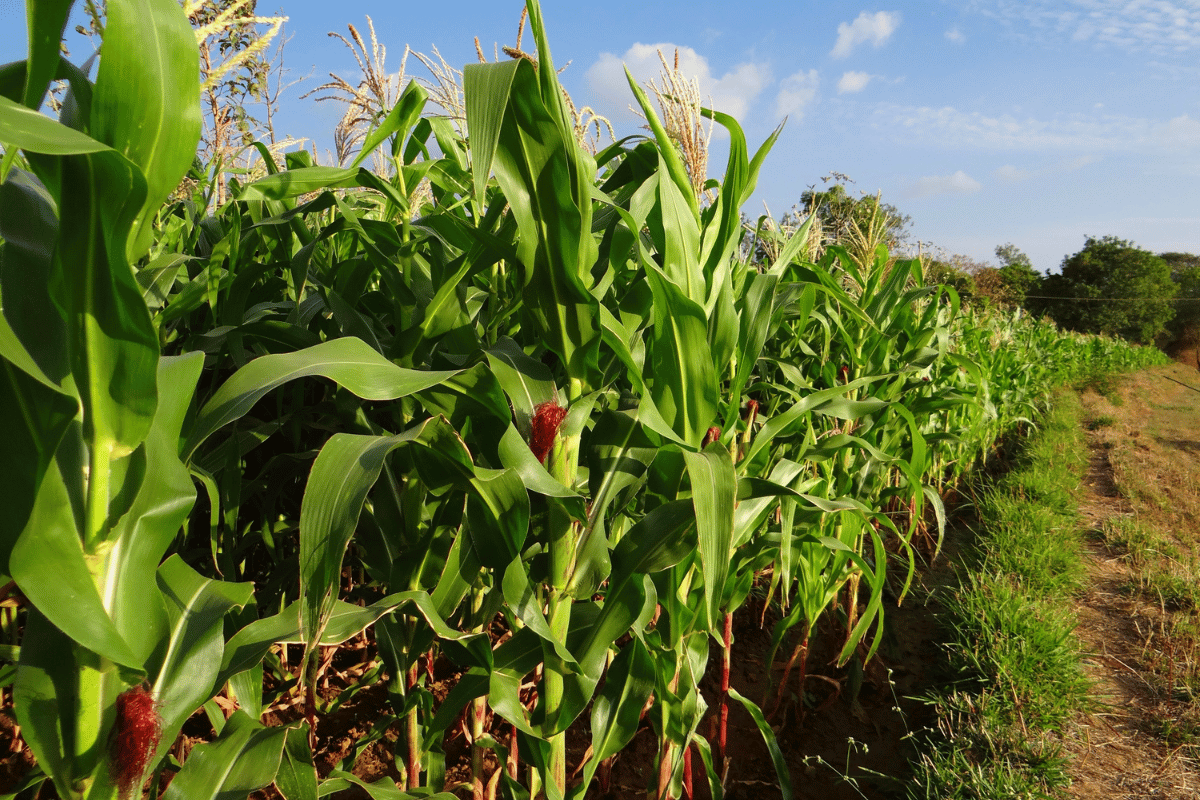
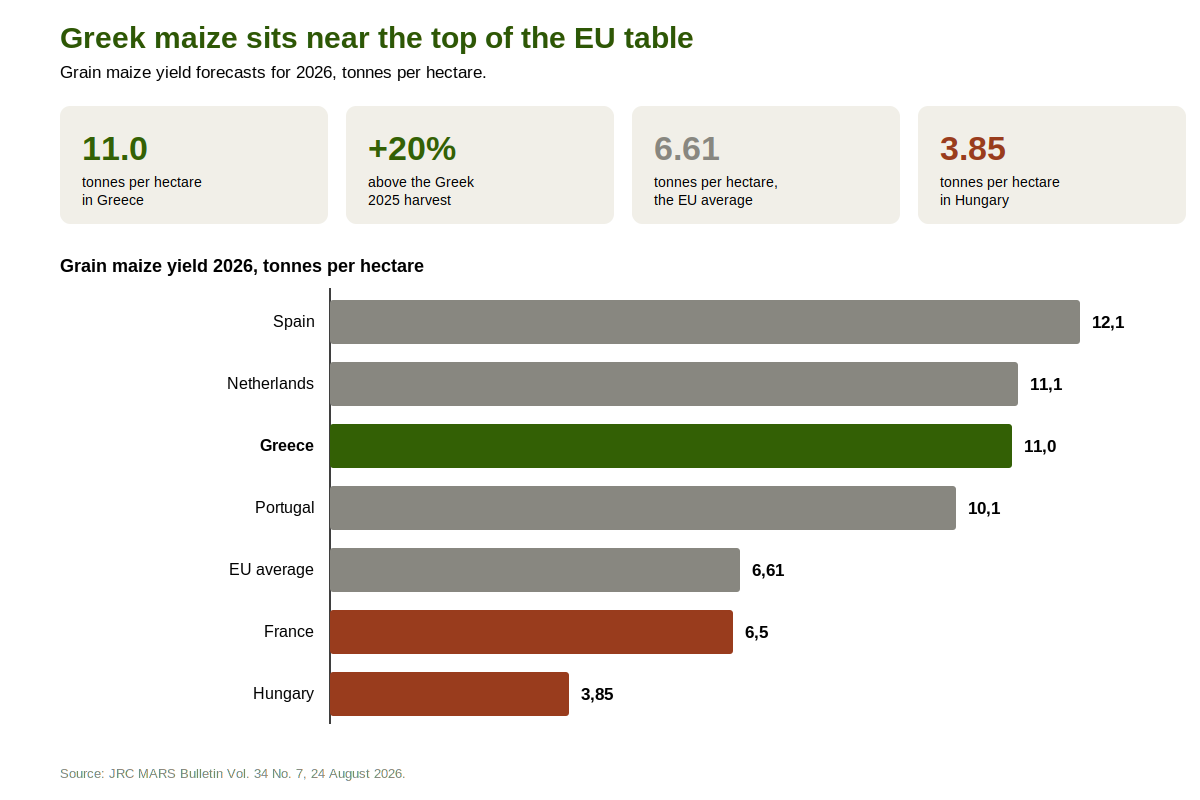
French maize has fallen to a record low and Hungary has lost roughly a third of its crop, but Greek grain maize is forecast at 11.0 tonnes per hectare this season. That is 1% above the five-year average and 20% above last year, according to the August bulletin from the European Commission's Joint Research Centre, published in the same edition that cut the EU average to 6.61 tonnes.
Greece, therefore, sits about 66% above the EU average and ranks third in yield across the whole Union, behind only Spain at 12.1 tonnes and the Netherlands at 11.1 tonnes.
Greece appears on the JRC map in yellow at 11.0 tonnes per hectare, close to its own average, while western and central Europe are shaded red, with losses exceeding 10%. Source: JRC MARS Bulletin Vol. 34 No. 7, August 2026.
Sunflower and cereals also finished above average
Maize is not the only crop that holds. Sunflower reached 2.49 tonnes per hectare, 3% above the five-year average and 19% above last year, with plants moving from flowering into seed filling under adequate moisture.
Cereals tell a similar story. Wheat came in at 3.06 tonnes per hectare, 1% above the five-year average and 10% above 2025, while soft wheat finished 2% above its average and 11% above last year. Barley also sits 1% above the five-year mark.
Green maize is already being harvested across several producing regions with satisfactory biomass yields, at a time when the equivalent crop is collapsing in France, Germany and Hungary and creating a fodder problem. Satellite measurements over southern Europe show biomass accumulation near normal, and Greek grasslands are in their expected summer dormancy.
Irrigation explains most of the difference
The explanation is not the weather. Greece had the heat, too. The difference is that Greek maize is almost entirely irrigated, whereas in France, less than a third of the maize area receives water. Where aquifers and distribution networks hold up, the crop gets through flowering and grain filling without collapsing, however high the temperature climbs.
The same pattern repeats across Europe. In Spain, where maize, potatoes and sugar beet are irrigated as standard, yields held despite high temperatures, while the rainfed crops in the same country suffered from heat stress. Hungary shows the reverse case. Rivers there ran low, many irrigation systems stopped operating altogether, and the result was the steepest loss in the EU.
The Greek advantage in this season is infrastructure rather than climate, and it holds only while there is water to distribute.
Where the pressure points are
The same bulletin records the weak spots, and all of them concern water. Western Greece experienced irrigation problems during maize pollination and grain filling. In Central Greece, limited water availability remains a key challenge for potato production. For sunflowers, prolonged heat may still affect final yields wherever irrigation is limited.
On the positive side, no widespread pest or disease pressure was observed, which in a season this hot was not a given.
The harvest calendar is running normally. Potato lifting began in mid-August in Eastern Macedonia and Thrace; sunflower harvesting starts from mid-August in the north and during September elsewhere; and grain maize began in late August, with the bulk of the crop coming in September.
What a good season means in a short European market
This year's numbers put Greek production into a market that is looking for supply. With EU maize 7% below average, France down 28% and Hungary down 34%, the shortfall will be covered either by imports or by the countries that had a good season. Bulgaria sits 29% above its average, Romania 11% above and Portugal 6% above.
The Greek position is not guaranteed for the years ahead. The same bulletin forecasts above-average temperatures across most of Europe through the autumn, and the pressure points it already recorded in Western and Central Greece concern exactly the availability of irrigation water. This season's 11 tonnes rested on water being there when the crop needed it, and that is the variable that will decide whether the result repeats.
Sources
- European Commission Joint Research Centre. (2026). JRC MARS Bulletin, Crop monitoring in Europe, August 2026, Vol. 34 No. 7. Publications Office of the European Union, Luxembourg.