After a season in which production reached about 500,000 tonnes, a record for the country, Tunisian farm organisations expect a much smaller olive oil crop in 2026/27. The National Chamber of Olive Producers estimates about 300,000 tonnes, a 40% fall, while the farmers' organisation Synagri put the crop on 9 October at 200,000 to 250,000 tonnes, close to half of last season. Tunisia's agriculture ministry has not yet published an official national estimate.
The fall comes straight after a year of very strong exports. According to Tunisia's National Agricultural Observatory, ONAGRI, the country exported 381,200 tonnes of olive oil between November 2025 and August 2026, 50.8% more than in the same period a year earlier. The development matters for Greek producers because Tunisia sells mainly bulk oil to Spain and Italy, the same markets that absorb much of Greece's bulk olive oil.
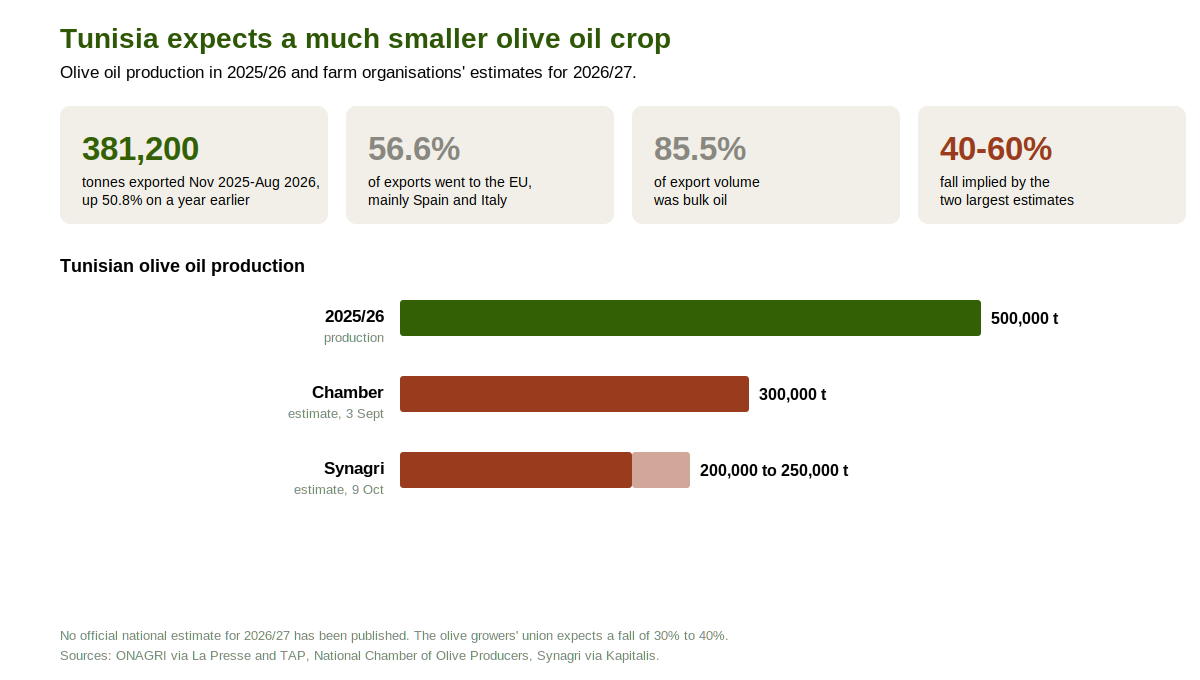
Production in 2025/26 and the National Chamber of Olive Producers' and Synagri's estimates for 2026/27. Sources: ONAGRI, National Chamber of Olive Producers, Synagri.
Estimates of the new crop differ
The first estimate came on 3 September from the president of the National Chamber of Olive Producers, Najah Saïdi Hamed, who put production at about 300,000 tonnes and attributed the fall to alternate bearing, the familiar pattern of a heavy crop followed by a lighter one. She added that revenue could stay close to last season's level if international prices rise.
On 9 October the president of Synagri, Midani Dhaoui, gave a lower estimate of 200,000 to 250,000 tonnes and attributed the fall mainly to the late harvest of the previous season, which in his view put strain on the trees. The following day, a member of the olive growers' union spoke of a 30% to 40% fall in the harvest.
Regional figures point the same way. In Sidi Bouzid, one of the main olive-growing areas, the olive harvest is estimated at about 350,000 tonnes against 500,000 last season, and in Manouba at 14,000 tonnes of oil olives against 20,750, a fall of about 32%. These figures refer to olives rather than oil, and as the Tunisian press itself notes, they are not enough for an overall national estimate.
Exports in 2025/26 rose by 50.8%
ONAGRI's figures, published on 22 September, show export value over the ten months reaching 4,780.4 million dinars, up 41.2%. Bulk oil accounted for 85.5% of volume and 80.7% of value, while packaged oil, at 55,400 tonnes and up 48.7%, made up 14.5% of volume and 19.3% of value. Extra virgin accounted for 83.5% of exports.
Because volume rose faster than value, the average value per kilo over the ten months was about 6% lower than a year earlier, by our calculation from ONAGRI's totals. In August, however, the average export price was 7.1% higher than in August 2025.
Organic oil is a significant part of the picture. Organic exports reached 53,000 tonnes, worth about 699.7 million dinars, with Italy the leading destination at 39%, followed by Spain at 26%, the United States at 23% and France at 8%. Only 6.3% of organic oil was exported packaged.
Tunisia sells mainly bulk oil to Spain and Italy
Tunisian olive oil reached more than 82 countries, but the EU took 56.6% of the volume, with Spain at 31.9% and Italy at 19.8%. This is mostly bulk oil later packed by Spanish and Italian companies, the same market where a large share of Greek bulk olive oil is sold.
Imports have also become an issue in Spain, where agriculture minister Luis Planas said when presenting the national forecast that total imports account for no more than 5.82% of the olive oil handled in the country. At the same time, Spain is considering whether to trigger its olive oil withdrawal mechanism for the first time, with a decision expected in the first half of November, as set out in our olive oil outlook for 2026/27.
Tunisia's fall is of the same order as Spain's rise
In volume, the fall implied by the two largest Tunisian estimates, 200,000 to 300,000 tonnes, is of the same order as the increase Spain expects, where the agriculture ministry forecasts production at 1,602,596 tonnes, about 300,000 tonnes above the previous season. Greece, according to its national olive oil interprofessional organisation, expects about 300,000 tonnes, against roughly 232,000 last season.
The comparison concerns quantities only and is not a price forecast. The final picture will depend on the official Tunisian estimate, Spain's decision on withdrawal and demand, in a market where farm-gate prices have already fallen, and where the cost of producing olive oil by grove type determines how much each producer can withstand.
Sources
- La Presse de Tunisie. (2026). Huile d'olive, des recettes records pour la saison 2025/2026. ONAGRI data, 22 September 2026.
- African Manager. (2026). Huile d'olive, 381,2 mille tonnes exportées pour une valeur de 4780,4 MDT. ONAGRI data on destinations and organic oil, September 2026.
- Tustex. (2026). Exportation de 381,2 mille tonnes de l'huile d'olives pour une valeur de 4780,4 MD en 10 mois. September 2026.
- Gnet News. (2026). Huile d'olive, une baisse de production attendue pour la saison 2026-2027. National Chamber of Olive Producers, 3 September 2026.
- Kapitalis. (2026). La Tunisie enregistre une forte baisse de la production d'olive. Synagri, 9 October 2026.
- Webdo. (2026). Huile d'olive, moins d'olives, des prix en hausse en Tunisie?. Olive growers' union and regional figures, 11 October 2026.
- PressDigital, Europa Press. (2026). Gobierno estima campaña de 1,6 millones de toneladas de aceite y estudia con rigor si aplica la autorregulación. 1 October 2026.