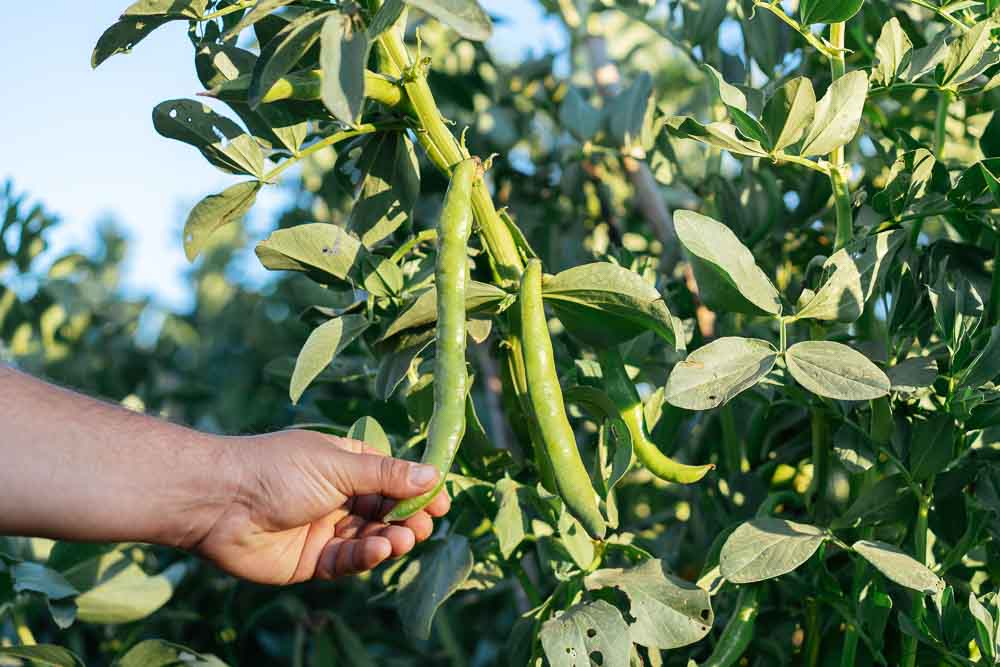
Broad beans (Vicia faba), also known as fava beans, are legumes of the family Fabaceae and among the oldest cultivated plants of the Mediterranean. They tolerate cold better than almost any other vegetable in the garden, which is why, in mild climates, they are sown in autumn and produce the first fresh beans in spring. Like all legumes, they also fix nitrogen from the air with the help of bacteria in their roots, so they leave the soil more fertile for the next crop. This guide covers when and how to sow them, how to care for them, when to harvest them, how to grow them in containers, the common problems that arise, and what everyone who eats them should know about favism.
When to sow broad beans
The sowing season depends on the local climate:
- Mild and warm regions: October to November, and in some areas as late as January
- Cold regions and uplands: from early February to late March, once the hardest frosts have passed
Autumn sowing takes longer because the plants spend the winter growing slowly. Around 30 weeks pass from sowing to harvest, while a spring sowing is ready in 12 to 16 weeks. Broad beans, therefore, go in alongside the rest of the autumn sowing jobs in the vegetable garden.
Position and soil
Broad beans prefer a sunny spot, with at least six hours of direct sun a day, sheltered from strong winds that topple the tall plants. They tolerate most soil types, including alkaline and chalky ones, but perform best in fertile, free-draining soil.
Before sowing, dig the ground well and enrich it with compost or well-rotted manure. Nitrogen fertiliser is not needed, since the plant secures all the nitrogen it requires on its own. Excess nitrogen, in fact, produces lush foliage with few pods and makes the plants more vulnerable to fungal disease.
How to sow
- Soaking: wrap the seeds in a damp cloth for 24 hours, or soak them in water for about an hour, so they germinate faster
- Depth: set each seed 3 to 5 cm deep, and up to 7 cm in light soils
- Seed orientation: every seed has a dark scar, the point where the root emerges. Place the seed with the scar facing down or sideways, so the root heads straight into the soil
- Spacing: 15 to 25 cm between plants and 40 to 60 cm between rows. Alternatively, sow double rows 23 cm apart with 60 cm between each pair, so the plants support one another
- Watering and protection: water after sowing, and where birds or mice are a problem, cover the bed with netting until the plants are up
In moist conditions at around 20°C, the seeds germinate within 10 to 14 days.
Watering
Broad beans have low water needs, and in a normal year, winter rain covers almost the whole growing period. Watering becomes essential in spring, when the plants flower and the pods fill, because drought at that stage cuts the crop considerably. Keep the soil moderately moist, never waterlogged, since standing water rots the roots.
Staking
Most broad beans reach 90 cm to 1.2 m in height, and some varieties up to 1.5 m. Once laden with pods, they become top-heavy, and the wind knocks them over easily. The simplest answer is a sturdy stake at each corner of the row and every 1.2 m along it, with a string running around the plants at two or three heights. Dwarf varieties, 30 to 50 cm tall, usually stand on their own.
Pinching out against blackfly
The single most useful technique with this crop is pinching out. As soon as the first pods set at the base of the plant, remove the top 5-8 cm of the main stem. This steers the plant's energy into filling the pods and, above all, removes the soft growth where the black bean aphid (Aphis fabae), known to gardeners as blackfly, gathers. The tips you remove are edible and can be cooked like spinach. If aphids are already established, wash the colonies off with a strong jet of water or treat them with insecticidal soap.
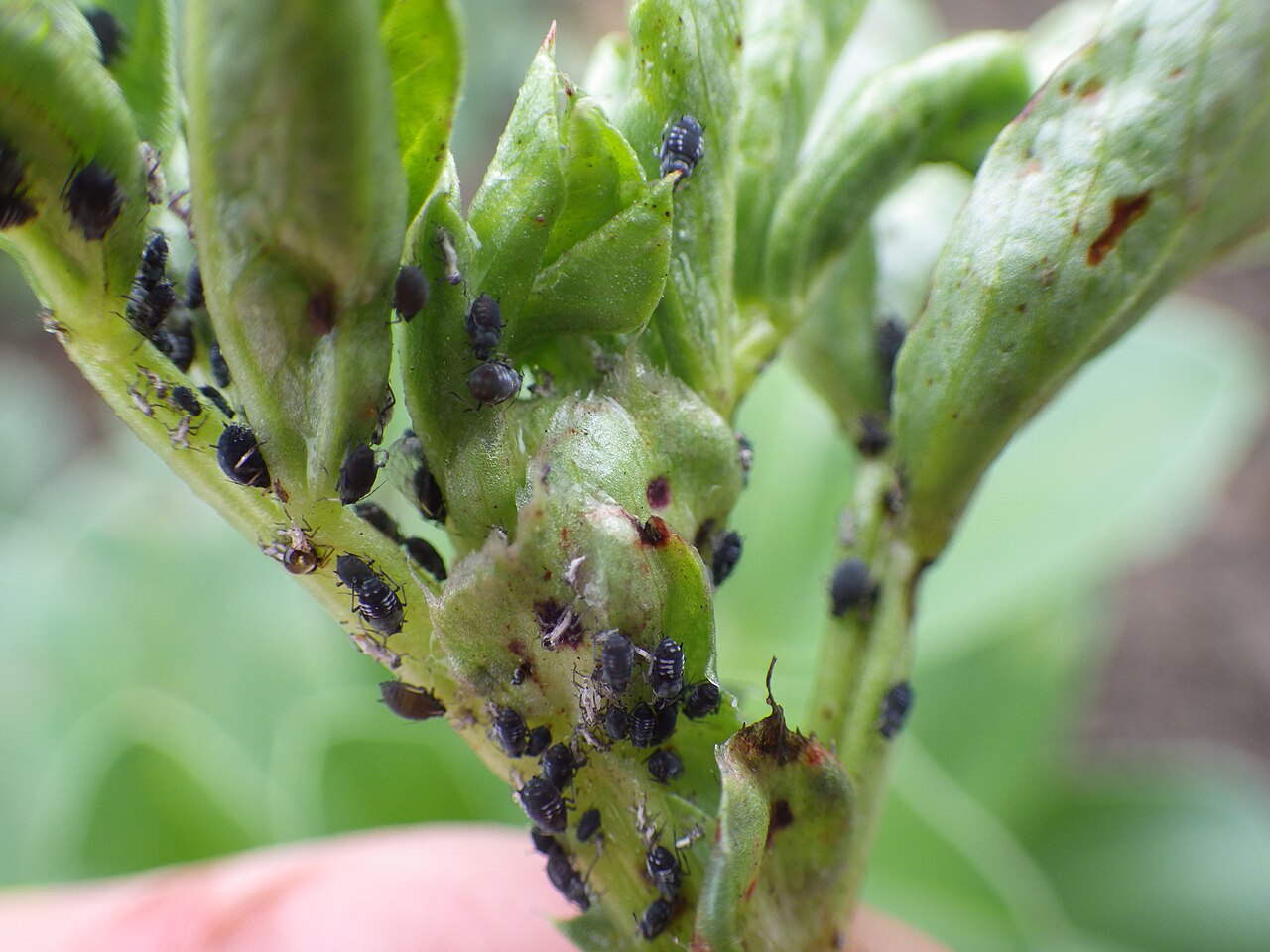
Blackfly gathers on the soft growing tips, which is why pinching out the top of the plant helps.
Harvesting at three stages
Broad beans are picked gradually, from the lowest pods upward, about 3 to 5 months after sowing. Cut the pods with scissors or snap them off with a sharp downward pull while holding the stem with the other hand, so the plant does not tear. Depending on how you want to use them, harvest at one of three stages:
- Whole pods: when the pods are 5 to 7.5 cm long and still flat, cook them whole like green beans
- Fresh beans: when the seeds bulge noticeably inside the pod but are still tender and green, the stage for stews and salads
- Dry beans: when the pods have dried and blackened on the plant, the seeds have hardened and are stored as a pulse
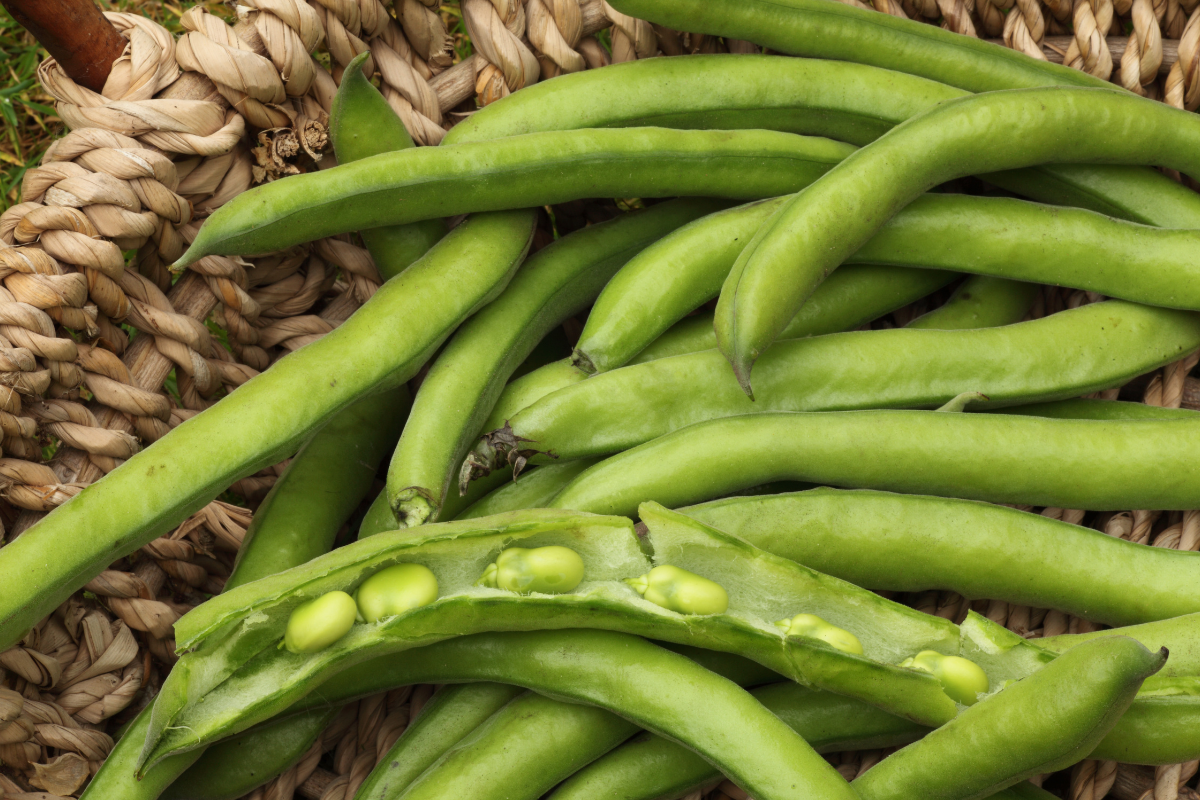
Fresh beans are picked when the seeds have swelled inside the pod but are still tender and green.
Broad beans in pots
Broad beans grow well in containers, provided you choose a dwarf variety such as 'The Sutton' and a large enough pot:
- Container: at least 30 cm deep and 35 cm wide, with drainage holes
- Growing medium: rich potting compost with added perlite for good drainage
- Sowing: three or four seeds per large container, at the same depth as in the garden
- Position: a south- or west-facing balcony, for plenty of hours of sun
- Watering: more often than in the ground, because pots dry out faster, especially once the plants flower and set pods
Common problems
- Blackfly: dense colonies of small black insects on the soft growing tips. Controlled by pinching out and washing off
- Chocolate spot: small reddish-brown spots on leaves, stems and pods, caused by the fungus Botrytis fabae. It thrives on humidity and crowded planting, so correct spacing and watering at the base are the best prevention
- Rust: orange-brown powdery pustules on the leaves, mostly late in the season in damp weather. Clear away plant debris at the end of the crop
- Pea and bean weevil: distinctive scalloped notches along the leaf edges. Mature plants usually outgrow the damage without any treatment
- Flowers but no pods: usually from too much nitrogen, or from drought and heat during flowering
Pods blacken naturally as they dry on the plant, which shows the seeds are ready as dry beans. Dark spots on leaves and pods while the plant is still green, however, point to chocolate spot.
What happens after broad beans
At the end of the crop, cut the plants at the base and leave the roots in the soil. Small nodules form on the roots, where bacteria fix nitrogen from the air, and as the roots decompose, that nitrogen remains available to the next crop. That makes broad beans an ideal predecessor for nitrogen-hungry vegetables such as cabbage, cauliflower or spinach. To avoid disease build-up, return broad beans to the same spot in the garden only about every four years.
What to know about favism
Favism is an acute haemolytic anaemia that develops after eating broad beans in people with an inherited deficiency of the enzyme G6PD. Glucosides in beans generate free radicals in the body, which, in people with the deficiency, destroy red blood cells. The deficiency is common around the Mediterranean, and favism has been documented in the region since the nineteenth century.
Because the gene is located on the X chromosome, it primarily affects men, while most women are asymptomatic carriers. Symptoms, meaning jaundice, weakness and dark urine, usually appear 2 to 4 days after eating the beans, and haemolysis can be triggered by cooked beans as well as raw ones. Anyone unsure whether they carry the deficiency can find out with a simple blood test, and any symptoms after eating broad beans require immediate medical attention.
Frequently asked questions
When should broad beans be planted?
In mild regions, from October to November, and in some areas as late as January. In cold regions and uplands, from February to March, once the hardest frosts have passed.
Do broad beans need to be soaked before planting?
Soaking helps but is not essential. Wrap the seeds in a damp cloth for 24 hours, or soak them in water for an hour; they germinate faster.
Which way up do you plant broad beans?
With the dark scar facing down or sideways, because that is where the root emerges, even if a seed goes in upside down, the root eventually finds its way down, though germination takes slightly longer.
Why do broad bean pods turn black?
Pods blacken naturally as they dry on the plant, meaning the seeds are ready as dry beans. Reddish-brown spots on a plant that is still green indicate chocolate spot.
Why do broad beans flower but not set pods
Usually, it is due to excess nitrogen, which produces foliage rather than pods, or to drought and heat during flowering. Watering in the spring and avoiding nitrogen can correct the picture.
Are fresh broad beans dangerous?
For people with G6PD deficiency, yes, as do cooked and dried beans, because they cause favism. For everyone else, broad beans are a safe and nutritious pulse.
Important notes
Every garden differs, and sowing dates shift with region, altitude and each year's weather. For persistent disease problems, a local agronomist can help with an accurate diagnosis.
The information on favism is for general awareness and does not replace medical advice.
References
- Royal Horticultural Society, How to grow broad beans.
- Luzzatto L., Arese P., Favism and glucose-6-phosphate dehydrogenase deficiency, New England Journal of Medicine, 2018.
- Favism, clinical features at different ages, Nutrients, 2023.
- Effects of nitrogen management and intercropping on faba bean chocolate spot disease development, Crop Protection, 2019.