
A poor harvest in a single major grain exporter does not stay local. Within weeks its exports fall, world prices climb, and the increase reaches shop shelves thousands of kilometres away, hitting hardest in countries that import most of what they eat. That chain of events is the central finding of The State of Agricultural Commodity Markets 2026, FAO's flagship analysis of food trade, which examined how shocks travel through the global market for wheat, maize and rice.
The reassuring part of the report is that these disruptions are usually short-lived. Using high-frequency trade data, FAO found that a weather-related production shock in a cereal-exporting country causes an immediate drop in exports, followed by recovery, with most trade flows rebounding within about six months. The worrying part is what happens during those months. A price spike that lasts half a year is long enough to push food out of reach for millions of people in low-income countries, where cereals supply about 45% of the calories available and households spend a large share of their income on food.
Key takeaways
- Weather drives roughly a third of cereal yield swings. Globally, about one-third of the year-to-year variation in wheat, maize and rice yields traces back to weather, and in some major growing areas that figure passes 60%.
- Shocks hit exports fast, then fade. A production shock in an exporting country cuts its exports immediately, but flows typically recover within about six months, which is why FAO calls the global market resilient.
- The damage lands on import-dependent countries. Where cereals are 45% of calories and incomes are low, a six-month price spike is long enough to cut consumption and worsen nutrition.
- Connected countries recover faster. Importers with many trade partners and links to major hubs absorb a shock better than those tied to a single supplier.
- Diversifying suppliers is the practical defence. For an importing country, spreading purchases across several exporters is the most reliable buffer against a shock in any one of them.
Why weather set the starting price
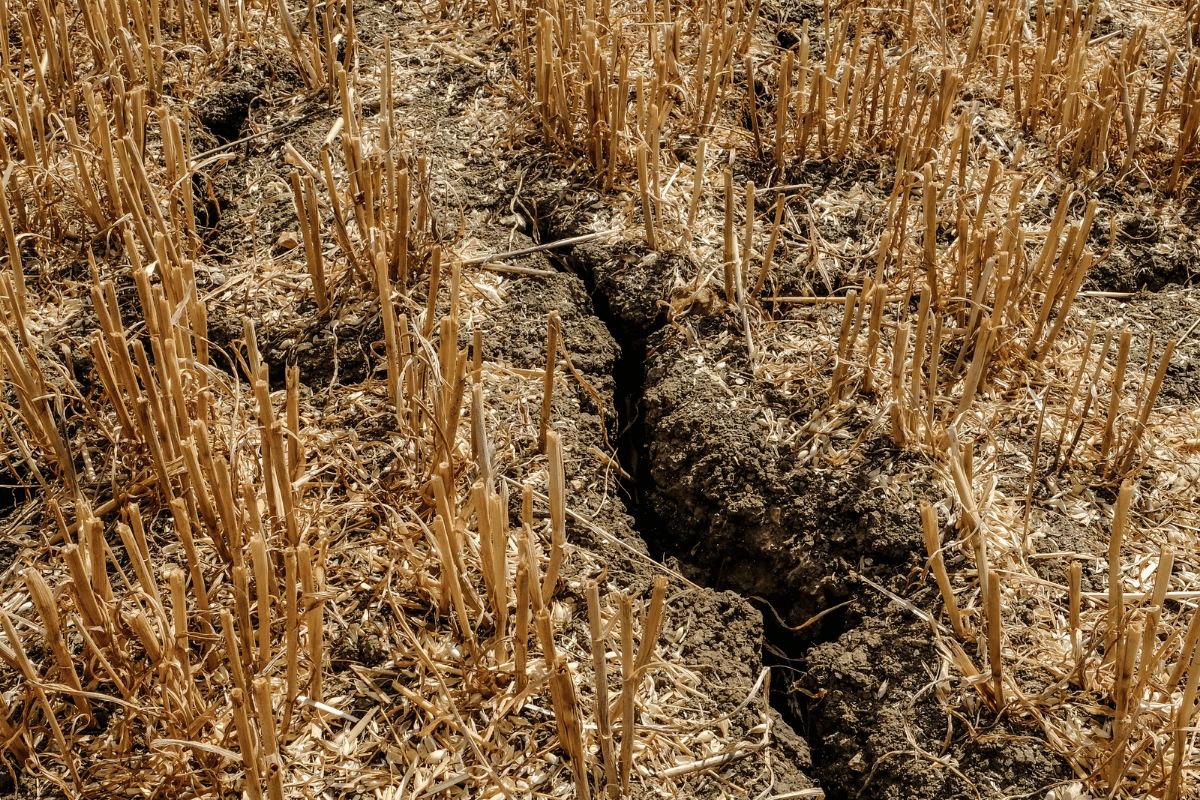
Cereal yields ride on the weather more than most other factors that a farmer cannot control. Across the world, roughly one-third of the year-to-year variation in wheat, maize and rice yields can be explained by weather alone, and in some major production regions, weather accounts for over 60% of the swing. Most crops have a narrow band of ideal growing conditions, and once temperature or rainfall moves outside it, yields fall or collapse. Drought does more damage than excess rain, and a combination of hot and dry conditions is especially punishing for all three staple cereals.
A shortfall in one place matters to the whole market because wheat and its close substitutes are traded globally. When a major exporter's crop comes in short, that country ships less, and the supply that disappears from the world market has to be made up from somewhere else or rationed by price. This is where a local weather event becomes a global price signal.
How the shock travels from the farm to the world price
Trade is the transmission line. When an exporter's harvest fails, its export volumes decline sharply and quickly, and buyers who depended on that supplier turn to others, bidding up prices in the process. The report traces this propagation directly: a one-off weather shock that lifts the world maize price feeds through into the domestic markets of importers within months, and the same pattern holds for wheat and rice. The size of the jump depends on the market's buffer. When global stocks are already low, as they were before the 2007–2008 food price crisis, the same shock produces a far larger spike.
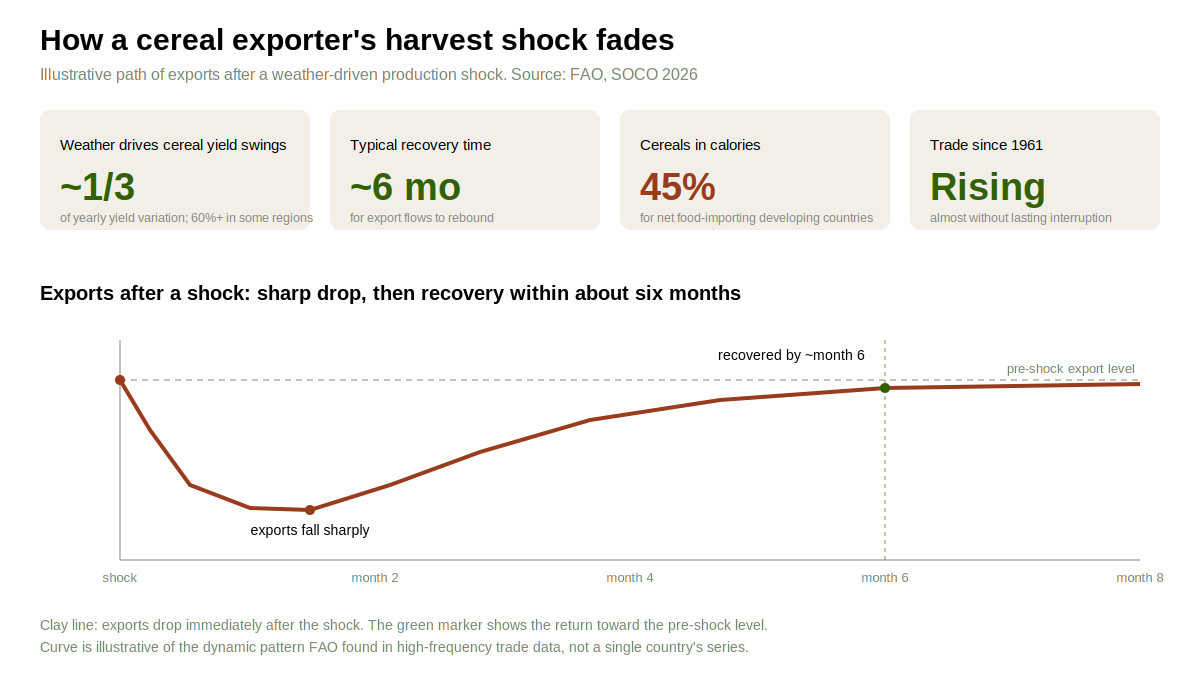
The recovery is what makes the system resilient rather than fragile. Because growing seasons differ around the world and a bad year in one region often coincides with a normal or good one elsewhere, trade lets surpluses offset shortfalls. Flows redirect, the gap closes, and within roughly six months exports are typically back near their previous path. Aggregate food and agricultural trade has grown almost without interruption since 1961 for exactly this reason, even through the COVID-19 pandemic and the opening phase of the war in Ukraine.
Why the same shock hurts some countries far more
Resilience at the global level hides sharp differences between countries. An importer with many trade partners and strong links to major trading hubs can respond to a supplier's failure by sourcing elsewhere, so the shock passes through with limited damage. An importer that leans on one or two suppliers has no such fallback, and the price increase lands with full force. During the war in Ukraine this split was stark: in 2021, 40 net food-importing countries drew more than 30% of their wheat from Ukraine and Russia, and those with diversified networks and stronger finances, such as Oman and Saudi Arabia, replaced the lost supply from Australia, India and the United States, while others faced import shortfalls larger than their stocks could cover.
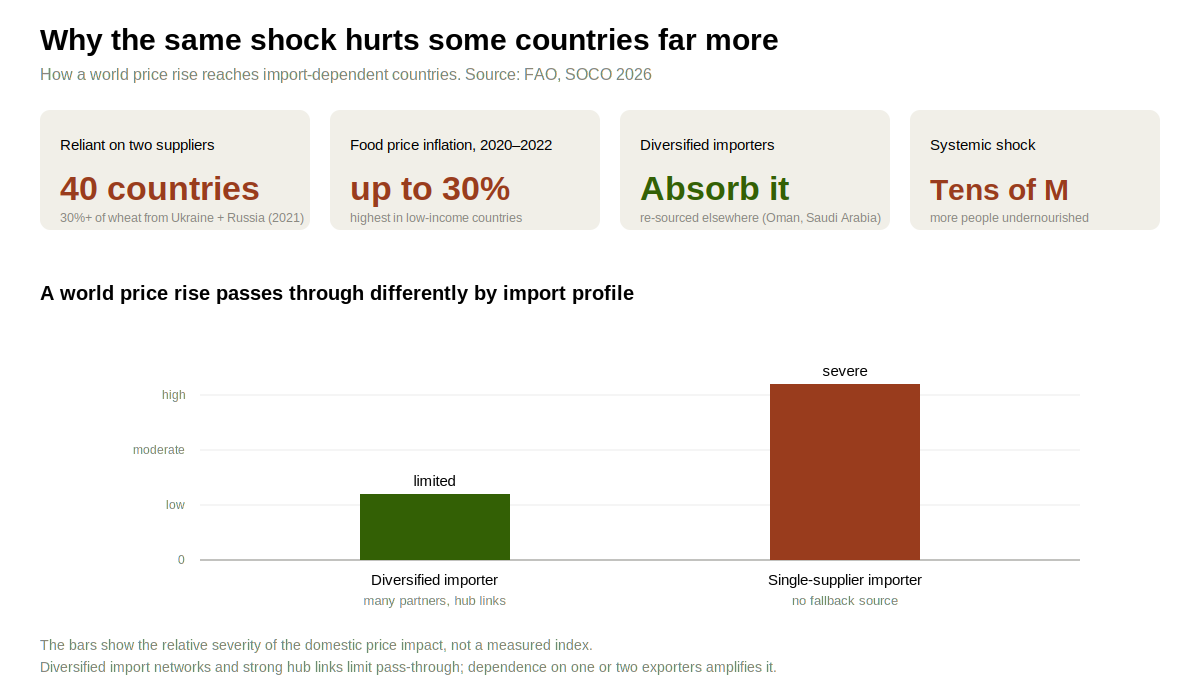
The household consequences follow the same logic. In net food-importing developing countries, cereals account for about 45% of available calories, so when world prices rise, the purchasing power of poor households falls, consumption drops, and diets narrow. Between 2020 and 2022, world price shocks from the pandemic and the war in Ukraine transmitted into domestic markets, and low-income countries recorded the highest food price inflation, reaching up to 30%, with the heaviest burden on the poorest. A systemic shock that hits several exporters at once can push tens of millions more people into undernourishment.
What reduces the exposure
Diversification is the clearest lesson for any country or business exposed to these swings. Spreading imports across several exporters and maintaining strong links to well-connected trade hubs allow a market to absorb a supplier's failure rather than amplify it. The report is direct on this point: resilience comes from reinforcing trade through openness and diversified partners, and retreating from trade leaves a country more exposed, not less.
On the production side, the exposure starts in the field, which is why drought-tolerant varieties and sound irrigation matter to the wider price picture as much as to the individual farm. The more that major growing regions can hold yields steady through a dry year, the smaller the shock that reaches the world market in the first place. Investment in climate-resilient crops works on the same problem from the supply side, reducing the size of the weather-driven swings that trade then has to smooth out.
For the countries most exposed, the report pairs open trade with targeted protection at home. Well-aimed safety nets, such as cash transfers and food assistance that can be scaled up quickly during a crisis, shield vulnerable households from a price spike without distorting the market or destabilising food security for everyone else. The combination, keeping trade open while protecting the poorest directly, is what turns a resilient global market into a resilient outcome for the people who depend on it.
Sources
- FAO. 2026. The State of Agricultural Commodity Markets 2026. Rome.