
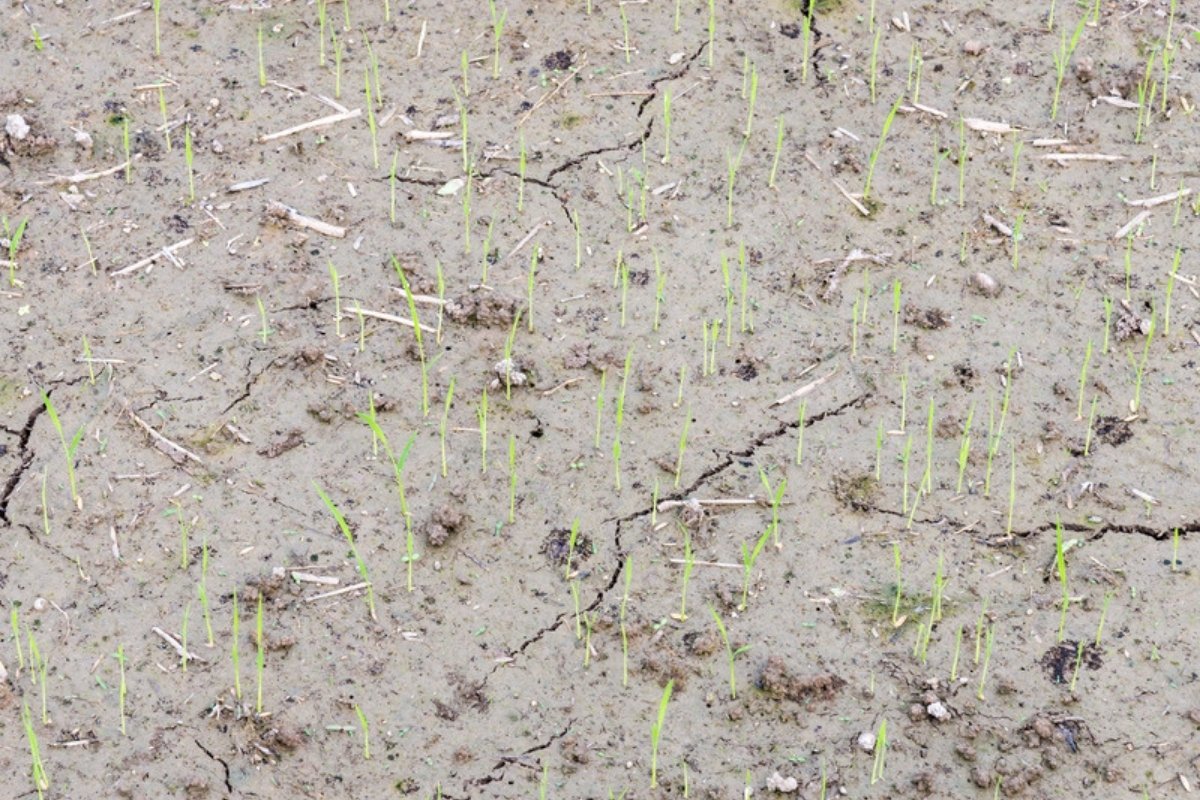
In the 30 days from 5 October to 3 November 2026, 10.5% of average rainfall fell at the grid point 41 km south of Tikhoretsk, in Krasnodar krai, and less than a fifth of average fell near Krasnodar and near Salsk in Rostov oblast, according to a Wikifarmer analysis of NASA POWER data. Since 1991, only the same period of 2013 was drier at these three points, and Russia's Hydrometcentre records a rainfall deficit over most of European Russia in October, with temperatures 2 to 3 °C above average. The dry spell comes as southern Russia's winter wheat is being sown and is emerging, and Russia is the largest wheat exporter, with 19% of world trade in 2026/27 according to the US Department of Agriculture (USDA).
5.9 mm of rain fell south of Tikhoretsk in 30 days
At the point south of Tikhoretsk, 5.9 mm of rain fell in the 30 days to 3 November, against an average of 56.1 mm in 1991 to 2020. Near Krasnodar 11.6 mm fell, 17.8% of average, and near Salsk 8.9 mm, 18.9%, while near Ipatovo, in Stavropol krai, 12.9 mm fell, 34.8%. At the first three points only 2013 had less rain in the same period between 1991 and 2025, while at Ipatovo four years were drier: 2013, 1998, 2021 and 2012. The mean temperature of the same 30 days was 4.9 to 5.7 °C above the 1991 to 2020 average at all four points.
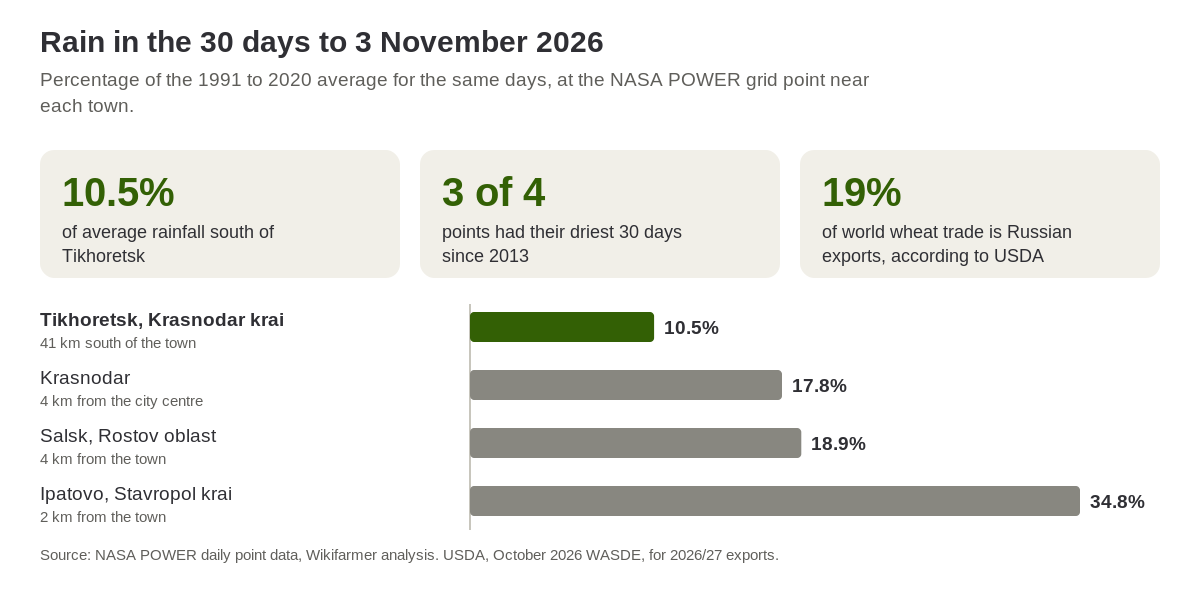
Source: NASA POWER daily point data, Wikifarmer analysis. USDA, October 2026 WASDE, for 2026/27 exports.
The deficit is mainly an October one, since it rained at the end of September at most points, with 19.3 mm on 30 September south of Tikhoretsk and 18.5 mm near Krasnodar. Over the 60 days to 3 November, rainfall reaches 62% to 79% of average, from 62.4% near Salsk to 79.4% near Ipatovo.
Russia's Hydrometcentre recorded a rainfall deficit in October
In its monthly forecast bulletin for November, compiled on 29 October, the Hydrometcentre of Russia, part of the federal hydrometeorological service Roshydromet, writes that in October the mean temperature over most of European Russia was 2 to 3 °C above average and that most of the territory had a rainfall deficit. According to the bulletin, rainfall was near normal in northern Karelia, the far east of the Nenets Autonomous Okrug, Vologda oblast, Kabardino-Balkaria, Chechnya and Dagestan, while Perm krai and Volgograd oblast had above-average rainfall. For November, the Hydrometcentre expects mean temperatures near average over most of European Russia and near-normal rainfall, with less rain in the south and east of the Volga Federal District, the east of Volgograd oblast and Astrakhan oblast. The same bulletin notes that its long-range forecasts verify in 70% to 75% of cases for temperature and 62% to 67% for precipitation, so according to the Hydrometcentre the monthly forecast is advisory for planning bodies. In the bulletin's table by federal district, the November rainfall forecast is "normal and below" for the northern part of the Southern Federal District and "normal" for its southern part and for the North Caucasian Federal District, with mean temperatures 0.5 to 1 °C above average.
USDA and GEOGLAM describe the winter wheat picture differently
In its Weekly Weather and Crop Bulletin of 3 November, USDA writes that a strong blocking high anchored north of the Caspian Sea maintained dry and warm weather, 3 to 5 °C above normal, across western Russia, and that drought continued to plague much of western Russia, where soil moisture supplies remained limited for winter wheat emergence and establishment. GEOGLAM, the international crop monitoring initiative of the Group on Earth Observations (GEO), rates Russian winter wheat conditions as favourable in its bulletin of 5 November, with conditions as of 28 October, as sowing of the 2026/2027 crop has caught up after some initial delays. The two assessments have different dates and look at different things, USDA at soil moisture for emergence and GEOGLAM at sowing progress and overall crop conditions. The next updates, USDA's weekly bulletins and GEOGLAM's December bulletin, will show whether the lack of moisture affects crop establishment.
ECMWF shows night frost in the wheat areas through 15 November
In its run of 00:00 UTC on 6 November 2026, the European Centre for Medium-Range Weather Forecasts (ECMWF) shows, for the ten days from 6 to 15 November, 26.4 mm of rain near Krasnodar, 15.4 mm south of Tikhoretsk, 9.8 mm near Salsk and 8.1 mm near Ipatovo. Over the same days, the model's minimum temperature falls to −3.5 °C near Salsk, −2.5 °C south of Tikhoretsk and near Ipatovo, and −0.8 °C near Krasnodar. This is a single run and the forecast changes from day to day. For the two weeks from 7 to 20 November, the forecast of the International Research Institute for Climate and Society (IRI), issued on 30 October and cited by GEOGLAM in its 5 November bulletin, shows a chance of above-average rainfall in southern and central Russia, while for November as a whole the Hydrometcentre of Russia expects near-normal rainfall over most of European Russia.
The wheat sown now will be harvested in the summer of 2027
In GEOGLAM's crop calendar for the Southern and North Caucasus federal districts, winter wheat planting and early vegetative growth start on 15 September and continue to mid-March, while ripening and harvest run from 1 June to 14 August. For growers in the region, the dry spell therefore falls on emergence and establishment before the northern hemisphere winter, and in the sources examined no official Russian advice to growers or official estimate of sown area was found.
For wheat buyers, the dry spell concerns the 2027 crop, not the wheat being exported this season. In its October WASDE report, USDA puts Russia's 2026/27 production at 88.0 million tonnes and lowered exports from 43.0 to 40.0 million tonnes, the lowest in five years, citing logistical disruptions caused by the continuing conflict in the Black Sea region. The 40.0 million tonnes are 19% of the 209.0 million tonnes of world wheat trade in the same report, and already in September a Wikifarmer analysis showed that Black Sea wheat was struggling to move. On the western coast of the Black Sea, sowing in the same weeks faced the opposite problem, with a red rain warning in Bulgaria in early November.
Frequently asked questions
How much rain fell in southern Russia's winter wheat areas?
In the 30 days to 3 November 2026, NASA POWER data give 5.9 mm south of Tikhoretsk, 10.5% of the 1991 to 2020 average, 11.6 mm near Krasnodar, 8.9 mm near Salsk and 12.9 mm near Ipatovo.
What does the Hydrometcentre of Russia forecast for November?
In its bulletin of 29 October it expects near-normal rainfall and temperatures over most of European Russia, with less rain in the south and east of the Volga Federal District, the east of Volgograd oblast and Astrakhan oblast.
What do USDA and GEOGLAM say about Russian winter wheat?
On 3 November USDA writes that drought continued to plague much of western Russia, with limited soil moisture for emergence, while GEOGLAM, with conditions as of 28 October, rates conditions as favourable, as sowing has caught up after some initial delays.
Does the dry spell affect Russia's 2026/27 wheat exports?
The dry spell falls on the sowing of the 2027 crop. In its October report, USDA attributed the cut in Russia's 2026/27 exports to 40.0 million tonnes to logistical disruptions caused by the continuing conflict in the Black Sea region.
When is winter wheat sown in southern Russia?
According to GEOGLAM's crop calendar, planting and early vegetative growth in the Southern and North Caucasus federal districts start on 15 September, while ripening and harvest run from 1 June to 14 August.
Important notes
Rainfall and temperature figures come from NASA POWER daily point data, which are estimates on a grid of about 0.5° and not station measurements, for four points: 45.5° N 40.0° E (41 km south of Tikhoretsk), 45.0° N 39.0° E (Krasnodar), 46.5° N 41.5° E (Salsk) and 45.7° N 42.9° E (Ipatovo). The 30-day period runs from 5 October to 3 November 2026, the last day with complete data, the average is that of the same days in 1991 to 2020, and the comparison with earlier years covers 1991 to 2025. The analysis was done by Wikifarmer. The rain and temperature forecast is ECMWF's, from the open data of the IFS model on a 0.25° grid, run of 00:00 UTC on 6 November 2026, at the nearest grid point, with rain from the model's accumulated total and minimum temperature from the model's three- and six-hour minimum values. The descriptions of October and the November forecast are the Hydrometcentre of Russia's, and the production and trade figures are USDA's, from the WASDE report of 9 October, the latest at the time of writing. The article does not estimate effects on production or prices.
Sources
- Гидрометцентр России. (2026, 29 October). Гидрометеорологический бюллетень. Прогноз аномалии средней месячной температуры воздуха и количества осадков на ноябрь 2026 г. (Hydrometeorological bulletin: forecast of monthly temperature and precipitation anomalies for November 2026)
- USDA. (2026, 3 November). Weekly Weather and Crop Bulletin.
- USDA. (2026, 9 October). World Agricultural Supply and Demand Estimates, WASDE-676.
- GEOGLAM Crop Monitor. (2026, 5 November). Crop Monitor for AMIS, No. 144, November 2026.
- GEOGLAM Crop Monitor. AMIS crop calendars, accessed 23 October 2026.
- NASA. POWER Data Access, daily point data, accessed 6 November 2026.
- European Centre for Medium-Range Weather Forecasts (ECMWF). (2026). Open data, IFS 0.25°, run of 00:00 UTC on 6 November 2026.