





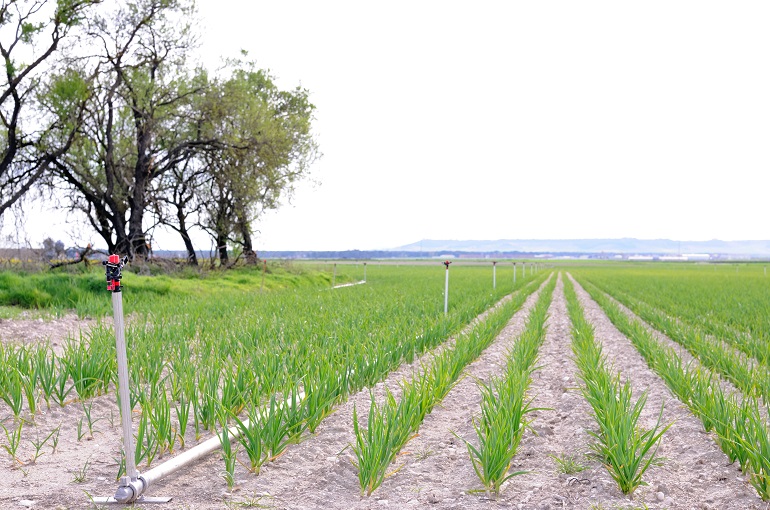
Garlic is planted from cloves at a depth of 2.5 to 5 cm, with spacing of 8 to 15 cm within the row and 25 to 40 cm between rows, while commercial plantings reach a density of about 50 plants per square metre. In mild and Mediterranean regions, planting takes place mainly in October and November, and in cold regions from mid-autumn or in late winter to early spring. The result is largely decided before the first clove goes into the ground, by field selection, soil preparation and the quality of the seed garlic. This guide covers soil requirements, field preparation, choosing and handling the cloves, seed garlic rates per hectare, spacing and how planting is carried out.
Soil requirements
Garlic performs best on fertile, well-drained loam or sandy loam soils, the kind that also suit onions. Heavy clay soils that do not drain produce misshapen bulbs, make harvesting difficult and favour rots. The ideal pH is 6 to 7, while the plant tolerates a range of 5.5 to 7. In acid soils yield drops, and lime is applied several months before planting to correct it.
Garlic has a shallow, fibrous root system, concentrated mainly in the top 60 cm of soil. That means the structure and drainage of the topsoil decide almost the whole crop, and that in poorly drained fields planting on raised beds is the safest option.
Field selection and rotation
- A field free of heavy weed pressure: garlic competes very poorly with weeds because of its limited foliage, so choosing a clean field matters from the outset
- A rotation of at least three years: garlic does not return to the same field within three years, and is not planted after onion or leek, with which it shares the same diseases
- Care with maize and wheat: in Greek practice, a common rotation is maize, green beans, beet or peas in the first year, cereals in the second and garlic in the third, with five-year rotations in some areas. According to the New South Wales Department of Primary Industries, however, planting garlic straight after maize or wheat favours the wheat curl mite (Aceria tosichella), which lives mainly on cereals but also attacks garlic cloves, so in fields with a history of infestation another crop should come in between
- No history of white rot: white rot sclerotia survive in soil for over 20 years, and the soilborne garlic diseases largely decide which fields are suitable
Soil preparation
Preparation begins with ploughing to a depth of 20 to 30 cm, which loosens the soil, removes stones and debris and suppresses perennial weeds. On heavy, compacted soils deeper cultivation may be needed to improve drainage.
About a week after ploughing, the base fertiliser is applied, as well-rotted manure or commercial fertiliser, always based on a soil analysis. Phosphorus and potassium are incorporated before planting, while the nitrogen in a garlic fertilisation programme is split into doses during the season. Final cultivation follows, along with forming the rows or beds and laying the drip irrigation lines.
Some growers cover the rows with black plastic film or infrared-transmitting film. The film keeps the root zone warm and suppresses weeds, and the cloves are planted through small holes.
Choosing and handling the cloves
Garlic has no true seed, because its flowers are sterile, and it is propagated entirely from cloves. Each bulb holds from 5 to 30 cloves, with around 12 in most varieties.
- Healthy, certified stock: seed garlic is bought from a licensed supplier to guarantee variety, purity and health. Viruses are present in much of the planting material in circulation and reduce yield, so virus-tested stock is preferred where available
- The right variety: choosing among garlic varieties depends on the local climate and market requirements
- Large cloves: bigger cloves produce bigger bulbs, and the small centre cloves are discarded
- Separated just before planting: whole bulbs store better, so they are broken into cloves only shortly before planting. All cloves are separated fully, to prevent double plants
- Storing seed garlic: until planting, bulbs are kept at about 10°C, within limits of 5 to 18°C. Storage for months at low temperature, around 4°C, causes rapid sprouting, side shoots, early maturity and rough bulbs
- Reject any with problems: cloves with spots, soft areas, mould or a green shoot already emerging are not planted
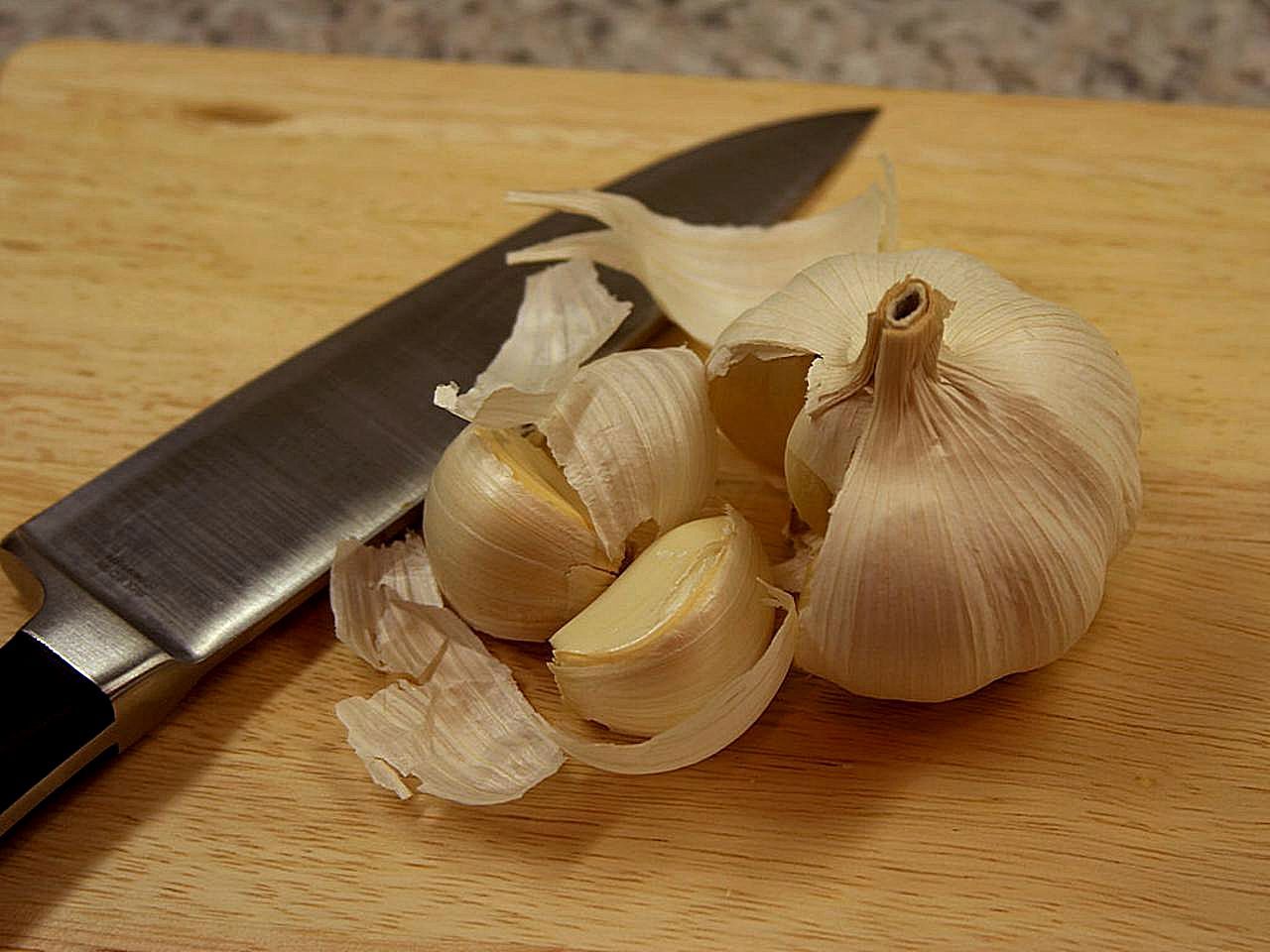
Bulbs are broken into cloves only shortly before planting, and the largest outer cloves are kept for seed.
How much seed garlic per hectare
The quantity depends on clove size and planting density. At a density of about 50 plants per square metre, or 500,000 per hectare, and with cloves of 2 to 4 g, roughly 1 to 2 tonnes of seed garlic per hectare are needed. Varieties with a few large cloves per bulb need more weight for the same number of plants than those with many small cloves.
Spacing and density
| System | Within the row | Between rows | Note |
|---|---|---|---|
| Single rows | 8 to 15 cm | 25 to 40 cm | The most common system with hand planting |
| Beds 1.2 m wide | 10 cm | 20 cm | About 50 plants per m², suited to mechanical harvesting |
| Double rows | 8 to 15 cm | 15 cm within the pair | Saves space and irrigation line |
Density is a balancing act. Higher density raises total yield per hectare, up to a point, but produces smaller bulbs. Wider spacing gives larger bulbs but lowers total yield. The final choice depends on the variety, the soil and the bulb size the market demands.
Planting time
In mild and Mediterranean regions, garlic for dry bulbs is planted mainly in October and November, and up to December, while in cold regions it goes in from mid-autumn or in late winter to early spring. Autumn planting produces the largest bulbs for two reasons. First, most varieties need one to two months at 0 to 10°C to form cloves. Second, new leaf initiation stops once bulbing starts in spring, triggered by higher temperatures and longer days. The longer the vegetative period before that stage, the larger the bulb and the higher the yield. The best average monthly temperature for garlic growth is 13 to 24°C.
With autumn planting, cloves need a few weeks to root before the first frosts. Where frosts occur, a 5 to 10 cm layer of straw straight after planting protects young plants and holds moisture. For spring planting, where winter cold is insufficient, cloves can be given a chilling period before planting.
How planting is done
Planting is done by hand on small areas or mechanically with planters on larger ones. Each clove goes in with the flat base down and the tip up, at a depth of 2.5 to 5 cm depending on its size. In light soils deeper planting helps, while in heavy soils cloves go in shallower. Elephant garlic, with much larger cloves, is planted slightly deeper, at 5 to 6 cm. If the soil is dry after planting, an irrigation follows, and garlic irrigation is then adjusted to the crop stage.
Frequently asked questions
How much seed garlic is needed per hectare
Roughly 1 to 2 tonnes, depending on clove size and planting density. Varieties with a few large cloves need more weight for the same number of plants.
What spacing is used for commercial garlic
Usually 8 to 15 cm within the row and 25 to 40 cm between rows. On beds 1.2 m wide, rows are 20 cm apart and plants 10 cm apart, for a density of about 50 plants per square metre.
What soil does garlic need
Fertile, well-drained loam or sandy loam with a pH of 6 to 7. Heavy clay soils produce misshapen bulbs and favour rots.
When is garlic planted commercially
In mild regions mainly in October and November, and in cold regions from mid-autumn or in late winter to early spring. Autumn planting gives a longer vegetative period and therefore larger bulbs.
How should seed garlic be stored before planting
As whole bulbs in a ventilated space at about 10°C, within limits of 5 to 18°C. They are broken into cloves only shortly before planting.
How deep should garlic cloves be planted
At 2.5 to 5 cm, depending on clove size and soil type. Slightly deeper in light soils, shallower in heavy ones.
Important notes
Spacing, density and seed rates are adapted to the variety, the soil and the production targets. Before a new planting, a soil analysis and advice from a local agronomist help with correct field preparation.
References
- NSW Department of Primary Industries, Growing garlic in NSW, Primefact 259.
- Plant Protection, Garlic cultivation technique (in Greek).
- Royal Horticultural Society, How to grow garlic.
- UC Statewide IPM Program, White rot in onion and garlic.