
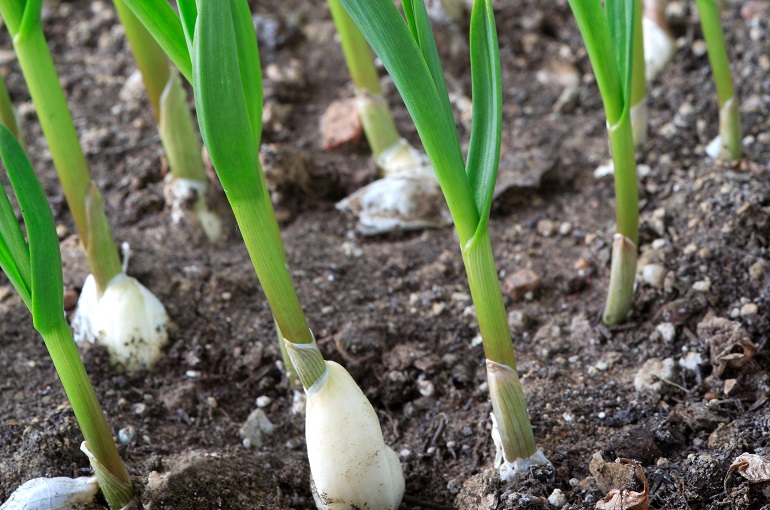
Garlic varieties fall into two broad types. Hardneck garlic produces a flower stalk, has fewer and larger cloves and suits regions with cold winters, while softneck garlic produces no stalk, has more cloves, suits mild climates and stores longer. In Greece, the best-known and most widely grown garlic is Vyssa garlic from Evros, alongside other local populations such as those of Platykampos near Larissa, Tripoli, Evia and Kalos Agros near Drama. This guide covers the difference between the two types, the ten groups into which all varieties are classified, the garlics of Greece, and how to choose the right variety for each region.
The plant in brief
Garlic (Allium sativum) belongs to the family Amaryllidaceae, specifically the subfamily Allioideae, which was formerly treated as a separate family under the name Alliaceae. It is related to onion, leek, shallot and chives. It is a perennial grown as an annual, and in practice it is propagated only from the cloves of the bulb.
To form a proper bulb with cloves, most varieties need one to two months at 0 to 10°C. The amount of cold required differs from variety to variety, however, and that is the main reason a variety that performs superbly in a cold northern region may give mediocre bulbs in a warm southern one.
Hardneck and softneck
| Trait | Hardneck | Softneck |
|---|---|---|
| Subspecies | Allium sativum ssp. ophioscorodon | Allium sativum ssp. sativum |
| Flower stalk | Yes, a stiff stalk in the centre of the bulb | Usually not |
| Climate | Cold winters | Mild winters |
| Cloves | Fewer and larger, easy to peel | More, in layers, with the smallest at the centre |
| Storage | Medium | Long |
| Braiding | Difficult, because of the stiff stalk | Braids easily |
| Where to find it | Mainly from growers and specialist suppliers | The garlic that dominates supermarkets |
Hardneck varieties are often favoured in the kitchen for their rich flavour and large, easy-to-peel cloves. Softneck varieties win on yield, adaptability and storage life, which is why they dominate the trade.
The ten garlic groups
Hundreds of varieties are sold under different names, but many are genetically identical and have simply been renamed from grower to grower. Genetic analyses in 2003 and 2004 placed all of these varieties into ten groups:
- Porcelain, Rocambole, Purple Stripe, Marbled Purple Stripe, Glazed Purple Stripe: the true hardnecks, which originate around the Black Sea and the Caspian and suit cold climates. Porcelain gives a few very large cloves, Rocambole stands out for its sweet, rich flavour, and the Purple Stripes for the purple streaks on their wrappers
- Creole, Asiatic, Turban: intermediate groups that bolt only weakly. They mature early and adapt better to warmer climates, which makes them interesting for Mediterranean growers
- Artichoke and Silverskin: the two softneck groups. Artichoke has a milder flavour and fewer, larger cloves, while Silverskin is high-yielding, adaptable and the type usually braided
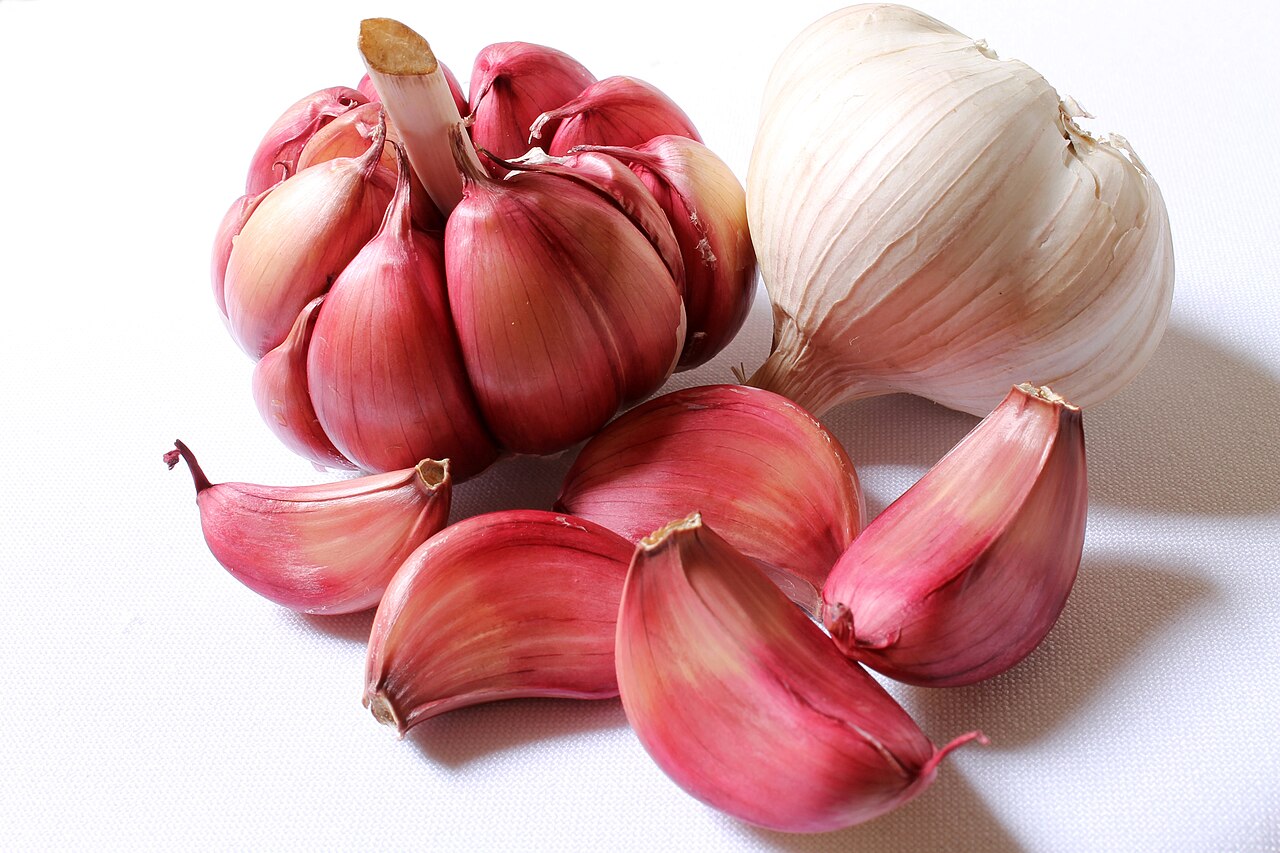
Purple-streaked wrappers are one of the traits that help tell the garlic groups apart.
The garlic of Greece
Garlic has been grown in Greece since antiquity and is mentioned by Herodotus, Theophrastus and Dioscorides. According to Greek Ministry of Rural Development and Food figures for 2010, around 1,250 hectares were grown, producing 9,700 tonnes of dry bulbs, mainly in Thrace, Evia and the Peloponnese. Domestic production does not meet demand.
Vyssa garlic from Evros
This is the best-known Greek garlic and is sold almost everywhere in the country. Around Nea Vyssa, near Orestiada, almost 300 hectares are grown, the largest garlic area in Greece, with yields of around 10 tonnes per hectare in a good year. The first agricultural cooperative in Greece dedicated solely to garlic was founded there, and today its 20 members grow about 20 hectares and harvested around 200 tonnes in 2024. Growers keep two local types, narrow-leaved and broad-leaved, brought by their refugee ancestors from the old village of Vyssa.
It is prized for its very strong, hot flavour and for cloves that peel easily, and it forms large bulbs of 12 to 16 cloves. The harsh Evros winter, with many days below freezing, is part of its character. Vyssa garlic has not yet been registered as a PDO or PGI. According to 2025 reports, local growers are continuing their efforts to secure protected status.
Platykampos garlic from Larissa
Platykampos is one of the largest garlic-producing areas in Greece, supplying both green and dry garlic, including traditional braids of 25 bulbs. The local cooperative focuses on the local variety, which stores well and has good quality but is sensitive to disease, and according to a 2025 report, the Region of Thessaly has submitted an application for Platykampos garlic to be registered as a PDO. Platykampos also produces black garlic, made from the local white garlic.
Other local populations
- Tripoli garlic: a white garlic described as milder and sweet, with large bulbs and rounded cloves
- Evia garlic and Kalos Agros garlic from Drama: local populations from areas with a long growing tradition
- Kefalonia or Erisos garlic: described as strongly flavoured, with very small purple bulbs and long, narrow cloves
- Tinos garlic: described as having large white bulbs with many rounded cloves
Many of these local populations have never been registered as official varieties and are maintained by growers and by seed-saving organisations such as Peliti.
Imported varieties
In recent years many Greek growers have turned to imported varieties for higher yields and a more uniform product, so local populations are declining. Among the imported varieties sold as seed garlic in Greece is the French Messidrome, white and strongly flavoured, also suitable for green garlic.
How to choose a variety
- Climate: in cold northern regions, hardneck varieties and local garlics from cold areas suit best. In mild southern and island regions, softneck varieties and the Creole, Asiatic and Turban groups do better
- Purpose: for long storage and braiding choose softneck varieties, while almost any variety works for green garlic
- Local adaptation: seed garlic from the same or a similar region nearly always outperforms stock from a very different climate
- Certification: certified seed garlic ensures the cloves are free of the diseases carried on planting material
Growing garlic in the garden starts from this choice, with planting done using the largest outer cloves of the chosen variety.
Things that look like varieties but are not
- Elephant garlic: this is Allium ampeloprasum, a relative of the leek rather than true garlic. It has huge cloves but a mild flavour, closer to leek
- Solo garlic: a single undivided bulb, which forms when the plant does not get enough cold to split into cloves
- Black garlic: white garlic aged for weeks under controlled temperature and humidity, in other words a processed product
- Wild garlic": wild garlic (Allium ursinum) is a separate species with broad leaves that grows in shady woodland
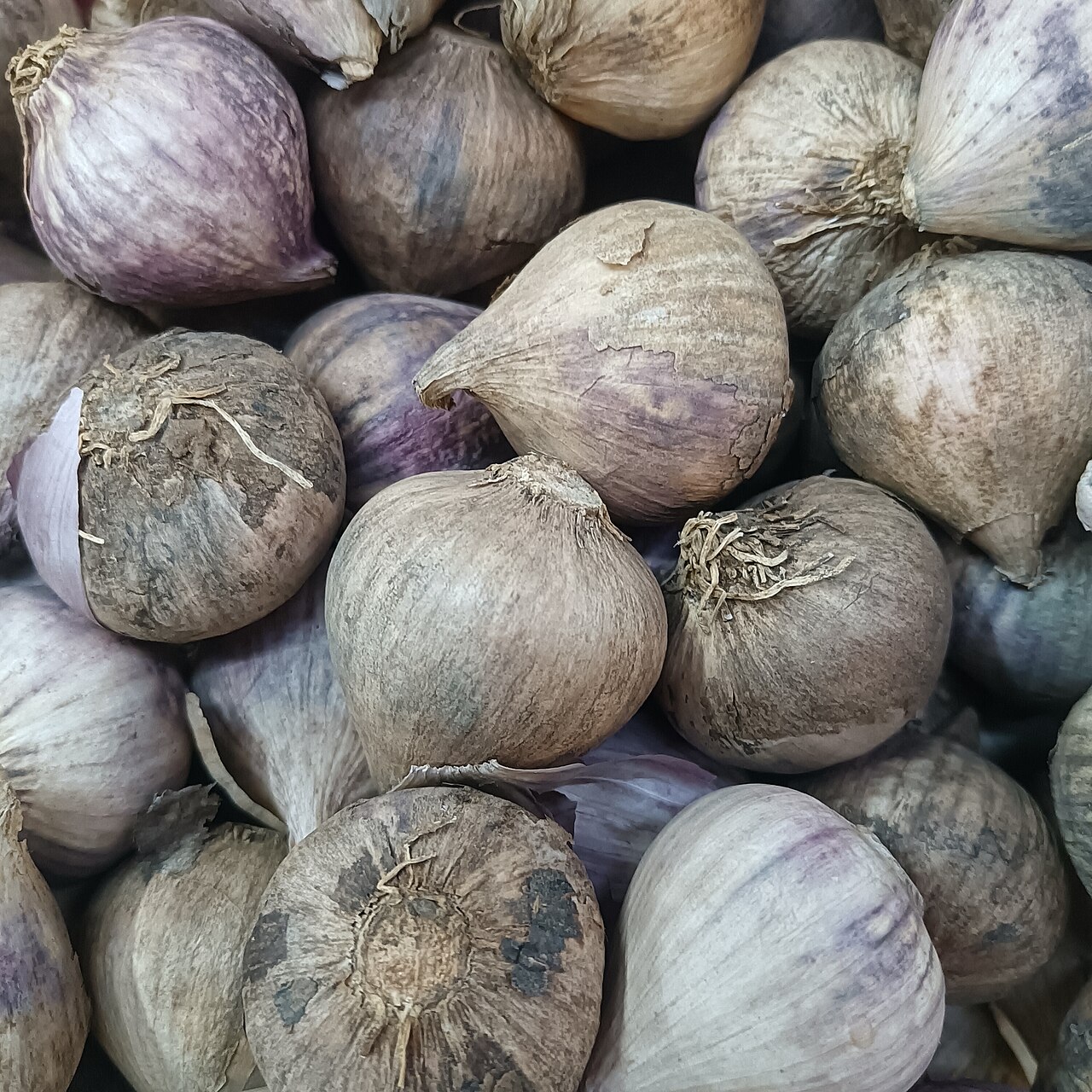
Solo garlic forms a single undivided bulb when the plant does not get enough winter cold.
Frequently asked questions
What is the difference between hardneck and softneck garlic
Hardneck garlic produces a flower stalk, has a few large cloves and suits cold winters. Softneck garlic produces no stalk, has more cloves, stores longer and can be braided.
Which garlic grows best in warm climates
Softneck varieties and the Creole, Asiatic and Turban groups, which need less cold and mature earlier. In very warm areas, chilling the cloves in the fridge before planting also helps.
What is the most famous Greek garlic
Vyssa garlic from Evros, known for its very strong flavour and large bulbs. It comes from the largest garlic-growing area in Greece, around Nea Vyssa near Orestiada.
Is Vyssa garlic a PDO product
Not yet. According to 2025 reports, growers in Nea Vyssa are continuing their efforts to have it registered as a PDO or PGI, while for Platykampos garlic the Region of Thessaly has submitted a PDO application.
Is elephant garlic real garlic
No. It is Allium ampeloprasum, a relative of the leek, with huge cloves and a mild, leek-like flavour.
Is solo garlic a separate variety
No. Solo garlic forms when the plant does not get enough cold to divide the bulb into cloves, which often happens with spring or very late planting.
Important notes
Each variety's performance depends on region, soil and the season's weather. For larger plantings, advice from a local agronomist helps with choosing the right variety.
References
- K-State Research and Extension, Growing garlic.
- Ypaithros Chora, Garlic cultivation, what growers need to know (in Greek).
- Voria.gr, Vyssa garlic, the history of Greece's most famous garlic (in Greek).
- Evros News, Vyssa garlic seeks PDO status, 2025 (in Greek).
- AgroTypos, Garlic planting in October, costs and prices keep the area low (in Greek), 2025.
- Royal Horticultural Society, How to grow garlic.