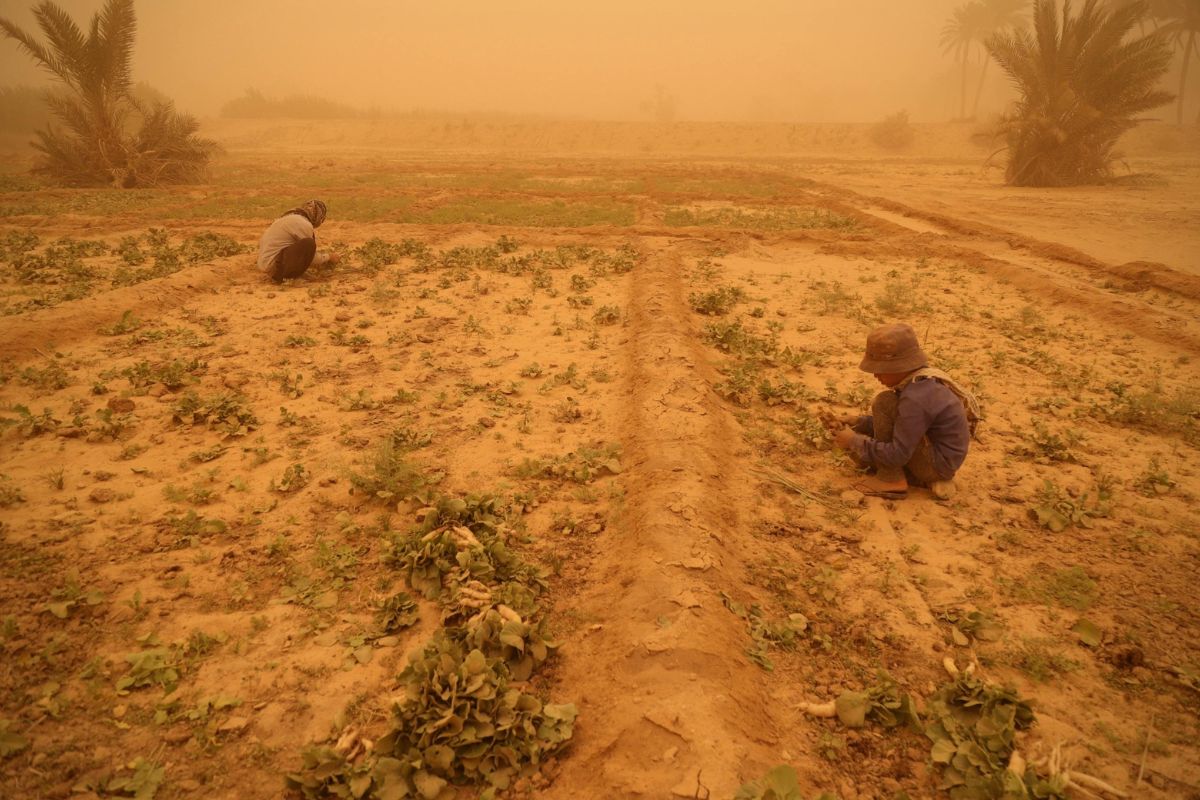
The heat has already changed how the world farms. What deserves attention on World Environment Day is the response, from Mértola to Puebla to the Kenyan highlands, where farmers are holding their ground and, in some cases, gaining it.
World Environment Day lands on 5 June, and UNEP has built this year's around climate, under the theme "Inspired by Nature. For Climate. For Our Future" and the rallying call #NowForClimate. The idea behind it is that nature is at once the casualty of a warming world and the best tool we have for living in it.
Few people meet that idea as squarely as farmers. They read the weather for a living, and the weather has stopped following the script their parents farmed by. What that has already cost is measurable, and it is large. The more interesting question is what farmers are doing about it.
The signals the Earth is sending
Ask anyone who has worked the same field for twenty years and they will tell you what the data is only now confirming, that the season has stopped keeping its promises. The rains arrive late or all at once, the heat comes earlier and stays longer, and the calendar their parents farmed by no longer lines up with the sky.
The numbers tell the same story, and the clearest of them comes from a joint FAO and WMO report published in April 2026, Extreme Heat and Agriculture. Between 1992 and 2020, across 110 countries, farmers brought 88 million hectares of new land into production. The purpose was to stand still, to replace harvests that heat had already taken away. A continent's worth of forest and grassland was cleared and planted, much of it simply to break even.
The bill for that runs deeper than it first appears. Clearing the land released roughly 21.8 billion tonnes of CO2 equivalent. Heat has also shaved an estimated 21% off global farm productivity since 1961, the equivalent of around seven years of progress wiped off the board.
The damage is specific, and it has been measured rather than guessed. For every extra degree of warming during the growing season, maize gives up about 7.5% of its yield, soybean 6.8%, wheat 6%, rice 1.2%. Most major crops begin to struggle once the thermometer passes about 30°C. The real trouble starts when heat and drought arrive together, since a hot year on its own costs roughly 9% of yield while a hot and dry year costs closer to 25%. Across the Mediterranean, that combination has become a feature of the ordinary summer.
Southern Europe lived the full version of it last year. Spain reached 46°C, and cotton, olives, tomatoes and wine grapes took heavy losses from Andalusia to Thrace. Researchers expect those combined heat-and-drought events to become two to three times more common across the wider region by the end of the century.
The hardest part to swallow is that farming has not quietly absorbed all this on its own. Across fifty years of grain data, there is still no sign that crops have grown more tolerant of extreme heat over time. On any single farm the familiar moves do help, switching to a tougher variety, planting earlier, leaving residue on the soil. But measured globally, warming has been cancelling out those gains almost as fast as farmers can make them.
So there is no point dressing up the starting position. The climate has already changed, the heat is in the field, and agriculture is being remade by it whether or not anyone planned for the change.
Up close, that remaking is mostly unglamorous, practical work, the kind that rarely makes headlines. When we asked 14 growers and agronomists across Europe, Africa and Asia what adapting actually means from one day to the next, not one of them reached for a grand plan. They described a thousand small decisions taken under pressure. In Greece, the pest map is being redrawn faster than the playbook can keep up. In greenhouses further north, a daily check of humidity and wind has replaced the old spray calendar. The same growers living through those numbers are the ones already writing the answer to them.
The signals we choose to send back
Most of what works comes down to three things, better genetics, healthier soil, and sharper management. In 2026, each one has real farms behind it, on four continents, and the results are already in.
Reviving land that everyone else wrote off
Mértola, in Portugal's semi-arid Alentejo, is about as hard a test as Europe offers. Rain can vanish for eight months at a stretch, summers scorch above 40°C, and the surrounding soils hold as little as 0.5% organic matter, far below what is needed to keep water or nutrients in the ground. Decades of monoculture and overgrazing drove many farmers off the land.
António Coelho stayed. "If the land is dying," he says, "then our job is to learn how to help it live again."
Using syntropic farming, a dense, layered method that mimics how a forest builds itself, with constant pruning and heavy mulch, Coelho increased organic matter in his managed plots from 0.5% to between 4.6% and 7.5%, turning dust into something closer to a sponge. On 1.5 hectares, with no synthetic fertilisers or pesticides, a failing herb farm became a food forest of vegetables, olives, tomatoes, melons and grapes.
"We stopped measuring productivity only in yields," he says. "The productive part is the soil."
Across the research, agroforestry systems lift soil organic carbon by around 15% over two decades, raise on-farm biodiversity by 25% to 40%, and increase yields by up to 30% over monocropping, all while holding water better through drought. FAO's most recent assessment puts the upside at scale, with better soil carbon across the world's croplands, where agroforestry shows real promise, capable of cutting global emissions by a midpoint of 1.9 gigatonnes of CO2 equivalent a year through 2050 while protecting yields.
Soil-first thinking spreads from farmer to farmer
Kumar Sheth had never so much as watered a garden. An accountant who moved from India to Kenya, he was pulled into farming by a single realization, that most growers were treating the symptoms of sick soil without ever asking what made it sick. He has since walked more than 4,000 farms across Kenya, Uganda, Rwanda, and Ghana.
His multi-layer model stacks crops on top of one another, onions and ginger at ground level, passion fruit climbing the middle, papaya forming a canopy, and that canopy creates a microclimate that cuts water needs by more than 70% while returning up to six harvests a year from one plot. The whole structure costs under 3,000 dollars an acre, against 150,000 or more for a conventional greenhouse, and he makes a tonne of organic fertilizer from local waste for under 100 dollars. His advice fits in a sentence, feed the soil that sustains your farm and it will look after itself.
Thiong'o Gachie bet the opposite way on scale and landed in the same place. He built a deliberately small one-acre model farm in Rumuruti, Kenya, packed with crops, trees, goats, bees, and fish, precisely because most smallholders in the global south live on one to three acres. Now one of East Africa's most sought-after regenerative trainers, he works across eleven countries and always starts the same way, with a living demonstration garden, "because people believe by seeing, not by hearing." His argument is as much statistical as moral, since small, diverse farms grow up to 80% of the world's food, and it is large-scale monoculture that turns out to be the fragile system.
Both men are working the management-and-diversity bucket, and both land on the same lesson the fourteen growers kept repeating, that what separates the farms that cope from the ones that fail is access, to knowledge, to neighbors who have done it, to inputs, to water.
Surviving the shock and coming back stronger
The plant-health collection raised a quiet warning, that diseases now spread on plants whose defenses are already worn down by heat. Julia Ortega lived through exactly that. Coffee rust nearly finished Finca Los Pinos, her family farm in Puebla, Mexico. The cure was brutal, tearing out healthy plants and replanting the whole farm with rust-resistant varieties. It worked. The farm has now been carbon-neutral for six years, exports specialty beans to Denmark, Japan, the United States, Saudi Arabia, and the United Kingdom, and runs close to zero waste, turning pulp into fertilizer and flour, spent grounds into soap, and premium beans into liqueur.
"The word 'waste' doesn't exist on this farm," she says.
That mix of better genetics and circular thinking reaches well past one farm. CIMMYT has now had a hand in more than 160 drought-tolerant maize varieties that yield up to 30% more grain under drought, and in Uganda and Zambia, farmers who plant them are raising harvests and cutting the risk of losing a crop outright.
Flora Farms, a 25-acre organic operation in Baja California Sur, shows the management bucket under live fire. Two summers ago a heatwave brought water shortages, insect pressure and fungal outbreaks, and the team planted sorghum to shade heat-sensitive lettuce and arugula, building cooler pockets around the vulnerable beds. When a freak storm wiped out six weeks of young plants, they shifted early-season crops onto higher ground less prone to flooding and dropped the varieties that could no longer keep up.
When the knowledge is there but the capital is not
On a 36-hectare family plot in Ambohimasina, Madagascar, Sarah Andriamihajarimanana farms alongside five local families, organic by design. Her crop choices are strategy more than sentiment, with chickpeas and beans chosen because they drink less water and shrug off the region's erratic rainfall. She is moving toward drip irrigation and a closed loop of livestock, compost and biogas. What holds her back is capital. She has the knowledge; what she lacks are the pumps, pipes and tanks that would let her work more than the fifth of the land she currently farms, and it is the same gap the fourteen growers named over and over.
Kathurima Mwongera, who walked away from a Nairobi HR career to farm in Meru, Kenya, took that capital barrier and recast it as a coordination problem. His initiative, Upcountry Success, pools idle land, labour and inputs so rural youth can start with no money of their own, paired with conservation agriculture, intercropping for natural pest control, mulching to hold soil moisture, and strict recordkeeping on shared spreadsheets. "Farming should make sense on paper," he says. "If you don't see the end, don't start."
Pollinators are climate workers too
The plant-health collection was blunt about one thing that is too easily filed under "nice to have." The beekeeper Dylan Larsen argued that pollinator health is now climate-adaptation work, because the same heat that stresses crops also thins nectar and shortens pollinator lives. The orchard plan and the hive plan have become one plan.
Filip Šinko Morandini, a digital marketer in Varaždin, Croatia, rebuilt a dormant family beekeeping line into ten hives, earned a state certification focused on disease prevention, and now visits schools to teach children about pollinators. Small in scale, but aimed the same way as the bigger operations.
Adaptation has a ceiling
None of this resets that ceiling, and it would be dishonest to pretend otherwise. The modelling is clear that on a high-emissions path, farm productivity keeps sliding even if every known on-farm fix is taken up in full. Adaptation softens the blow without changing the trajectory. The 88 million hectares already cleared, and the carbon released in clearing them, are still working against the next round.
That is also why this year's theme lands. Nature is the system under pressure, and it is also the toolkit. None of the farmers here are waiting for one miracle technology. They are stacking small, mostly unglamorous decisions, residue on the soil, the variety suited to the climate the farm actually has rather than the one in the planting guide, a forecast that arrives in time to act on, a more varied plot, and they are getting results now, on real ground, in 2026.
"If the land is dying, then our job is to learn how to help it live again." On 5 June, that line may be the most useful thing World Environment Day can put in front of a grower. The response is already underway, and on the ground it is producing results.
References
- FAO and WMO (2026). Extreme heat and agriculture – FAO–WMO joint report. Rome and Geneva.
- Burke, M., Zahid, M., Martins, M. C. M., et al. (2024). Are we adapting to climate change? NBER Working Paper No. 32985.
- A systematic review on the role of agroforestry practices in climate change mitigation and adaptation (2025). Climate Resilience and Sustainability.
- FAO (2025). Update on scientific findings on the interactions between agriculture, food systems and climate change. White paper, COP30, Belém.
- CIMMYT (2025). Drought Tolerant Maize for Africa and The CIMMYT science powering Africa's maize revolution.
- UNEP (2026). World Environment Day 2026: theme and host.