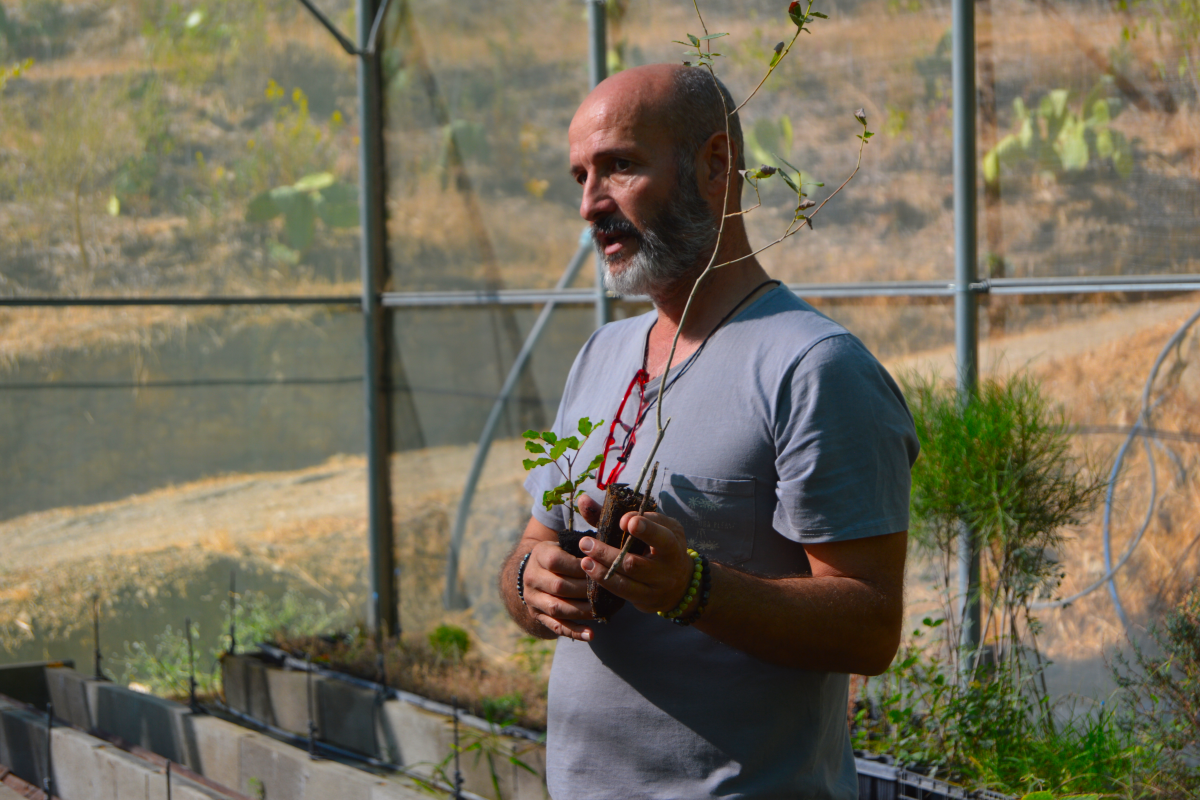
In the semi-arid region of Mértola, Portugal, syntropic farmer António Coelho has transformed a struggling herb farm on desertified land into a thriving multi-layered food forest. His work restores soils, rebuilds local food systems, and inspires a new vision of climate-resilient farming in one of Europe’s most vulnerable regions.
Farming on the edge of desertification
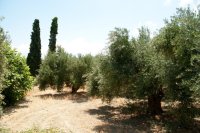
Rain can vanish for eight months at a stretch. Summers scorch above 40°C. Shallow soils erode faster than they form. In Portugal’s semi-arid Alentejo region, decades of monoculture, overgrazing, and intensifying climate extremes have pushed many farmers to abandon their land. António Coelho chose to stay. “If the land is dying, then our job is to learn how to help it live again,” he says.
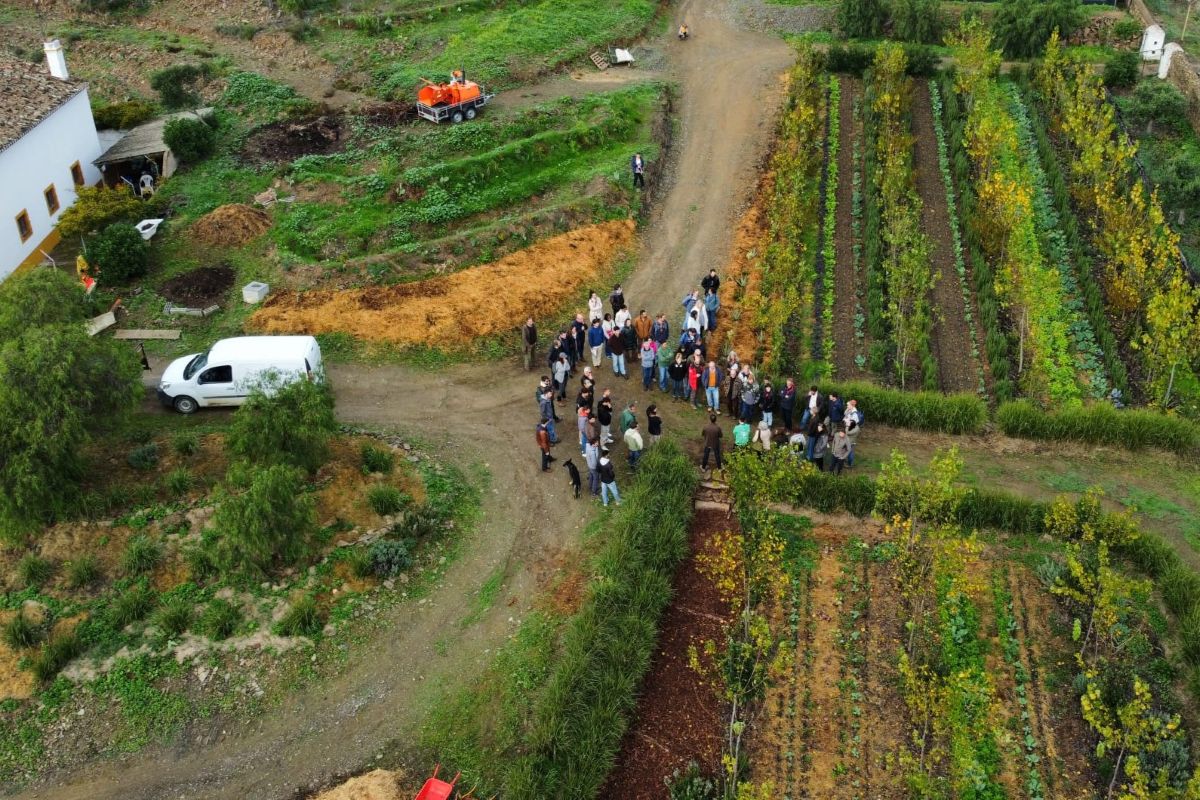
Today, on a few hectares outside Mértola, Coelho coordinates CARES, the Centre for Agroecology and Regeneration for the Semi-Arid, a project that reverses soil degradation, rebuilds local food systems, and works towards climate resilience.
Annual rainfall averages around 300 millimetres, often arriving in violent bursts after long droughts. Surrounding soils contain as little as 0.5 per cent organic matter—far below the level needed to retain water or nutrients. “When it finally rains, the soil can’t absorb it,” Coelho explains. “The water just runs off, taking fertility with it. When it doesn’t rain, everything burns.”
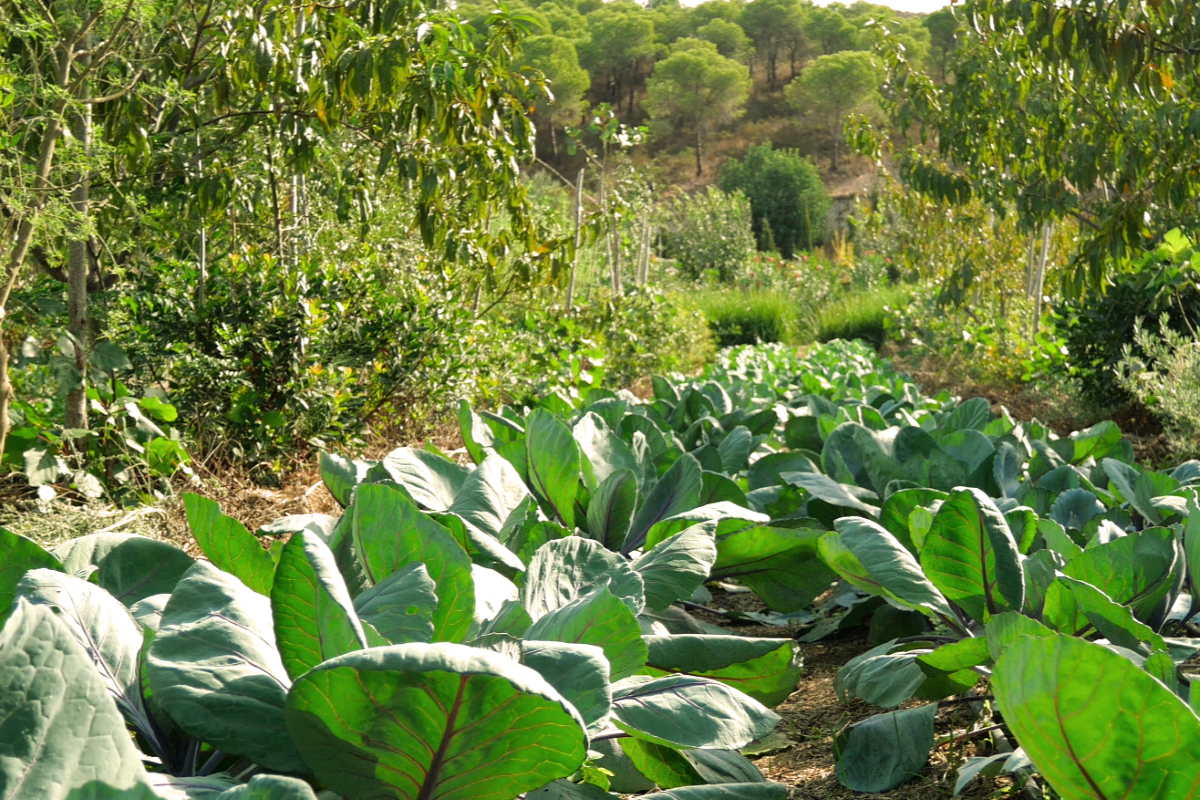
Yet degraded land can respond. On his intensively managed plots at Horta da Malhadinha, soil organic matter has risen from 0.5% to between 4.6 and 7.5%, turning dust into sponge and enabling crops to thrive even in harsh conditions.
From family roots to purposeful farming
Coelho’s connection to the land runs deep. Both of his grandfathers were farmers, raising animals and tending olive groves.
"All the summer school holidays, I used to spend with my grandfather," he recalls. "He taught me a lot about natural systems, although at the time I just wanted to climb trees and run free. He seeded the seed in me.”
Despite this heritage, Coelho initially took a different path. He worked in the UK’s conventional food industry, coordinating labour for industrial animal production supply chains.
“I wanted to be in food,” he says, “but working with processes of life instead of processes of death. I wanted to farm.”
He returned to Mértola in 2004 and, in 2008, started an organic herb and vegetable farm with his wife. But repeated droughts and rising costs pushed the operation toward collapse.
“I realised I couldn’t continue like that for another five or ten years. Either the method changed, or I had to leave farming.”
The syntropic turning point
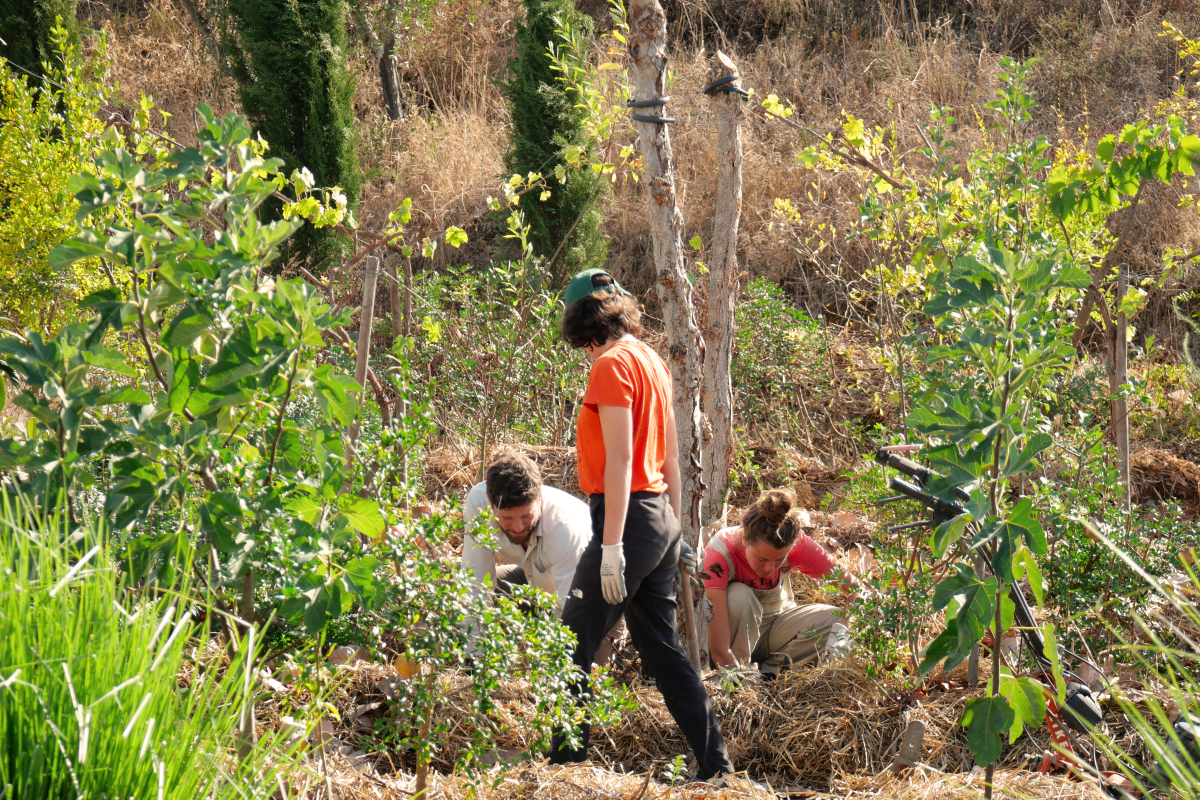
Around 2016, Coelho discovered syntropic agriculture, a Brazilian-developed approach that mimics forest succession. Crops are planted densely in layered systems, with trees, shrubs, and vegetables growing together. Frequent pruning feeds soil life, while constant photosynthesis builds biomass and fertility. Visiting practitioners, Felipe Pasini and Dayana Andrade from Life in Sintropy, offered a simple piece of advice: just try it.
He started small, experimenting with vegetables under young fruit trees, heavy mulching, and systematic pruning. The results transformed his farm.
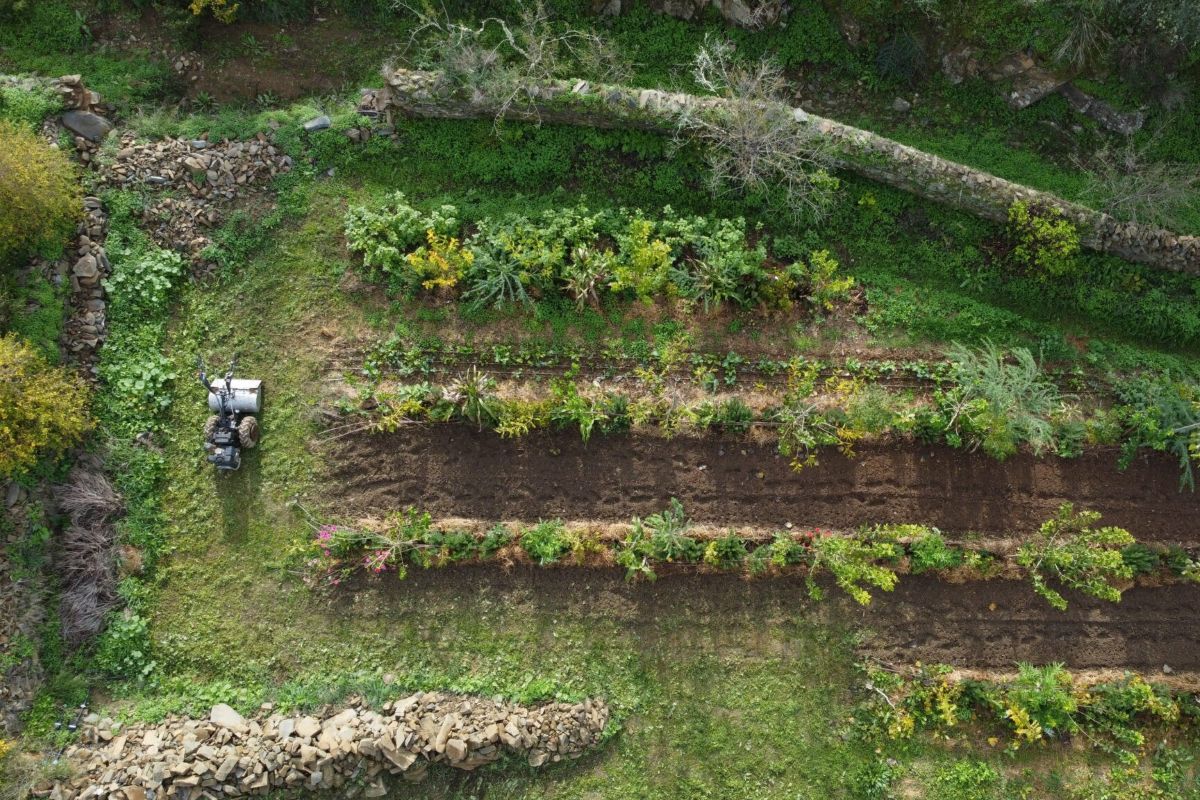
“I learned not to be afraid of photosynthesis,” he says. “More green growth means more energy in the system—more sugars, more soil life.”
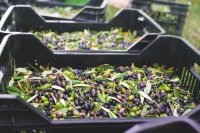
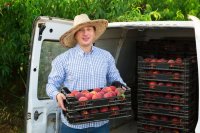
Over time, his small herb farm became a food forest, producing vegetables, fruits, olives, sunflowers, tomatoes, melons, grapes, leafy greens, and more—all on just 1.5 hectares, without synthetic fertilisers or pesticides. “We stopped measuring productivity only in yields. The productive part is the soil,” Coelho notes.
Terra Sintropica: Building an ecosystem of change
In 2018, Coelho and a group of like-minded friends founded Associação Terra Sintropica, a 16-member non-profit at the intersection of food production, education, and ecological restoration.
The organisation’s mission goes beyond farming: it seeks to foster regeneration through use, demonstrating, researching, and sharing models of ecosystem and community restoration in semi-arid regions.
The association operates on several fronts:
- Productive agroforestry site: Vegetables, fruits, and biomass are grown intensively throughout the year.
- Local food system hub: Produce supplies restaurants and municipal canteens through CSA (community-supported agriculture) schemes.
- Education centre: School gardens and training programs teach children soil, water, and ecosystem literacy.
- Living laboratory: CARES allows researchers, policymakers, and farmers to observe regenerative practices, test solutions for soil and water management, and replicate them elsewhere.
- Experimental landscapes & community hub: Converts degraded monocultures into biodiverse forests and runs PREC, a community food hub where visitors experience farm-to-plate regenerative practices firsthand.
“In this web of activities, I am still a farmer at heart,” Coelho says. “I feel the need to produce.”
From a small garden to global impact
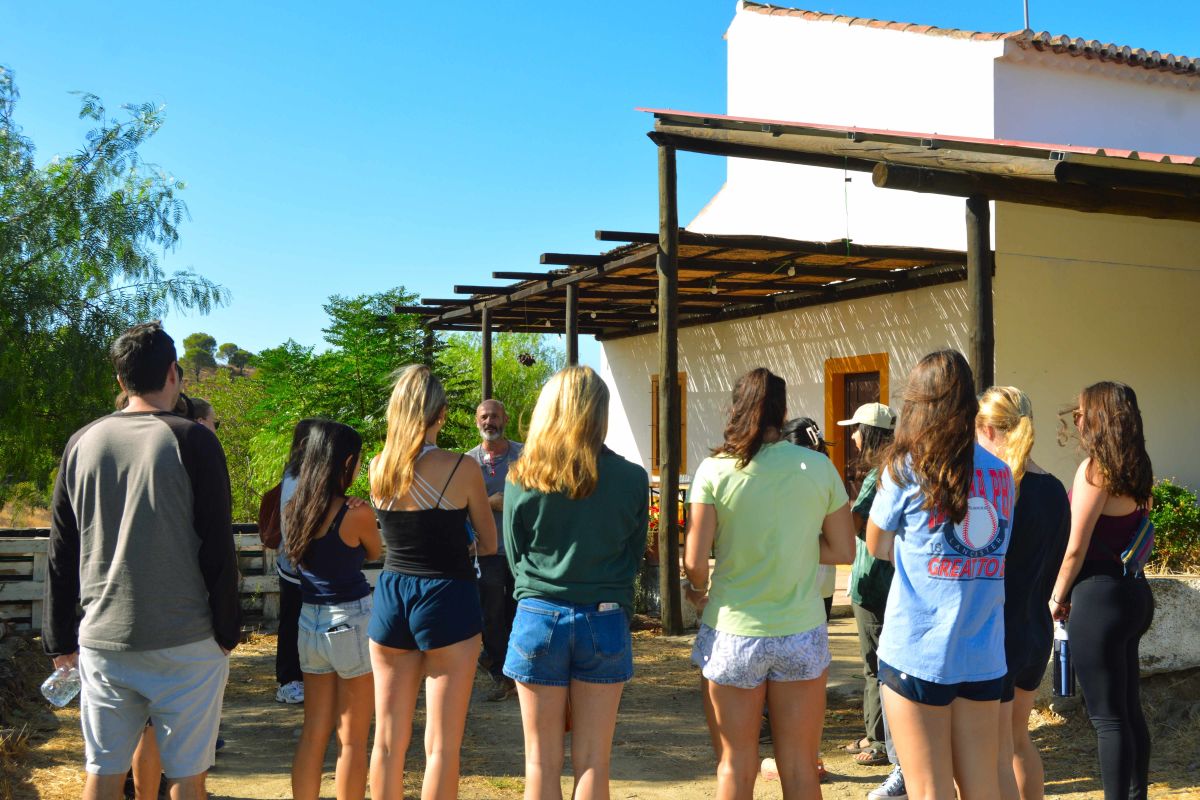
What began as a personal journey has evolved into a global network. Today, Coelho consults on regenerative and syntropic agriculture initiatives across Portugal, Europe, and North Africa. He leads workshops and permaculture programs — particularly for women and youth — integrating syntropic agroforestry with holistic grazing practices inspired by the Savory approach. His work in these regions centres on empowering communities facing severe climate and political pressures.
He also contributes to refugee initiatives, sharing regenerative land-use practices with displaced communities — knowledge that may one day travel back with them to their home countries.
At home in Portugal, he sees hope in younger generations. “I can say this with joy — young people are choosing the path of regeneration,” he says. “My role is to stay open, supporting them as they bring new questions, challenges, and solutions.”
Working with uncertainty
In a syntropic system, the farmer is part of the ecosystem, fully implicated in both successes and failures.
“We make a lot of mistakes,” Coelho admits. “We are part of a living system. We work with nature, and nature responds back. Each season teaches us something new, and every challenge helps us refine our approach.
Storms can flatten treelines overnight, and droughts stunt carefully planned successions. Yet syntropic design builds resilience through biodiversity, soil cover, and root depth—buffering extremes rather than resisting them.
Opening minds, one mulch layer at a time
Syntropy raises more than a few eyebrows, but Coelho’s results are undeniable. He recalls a sceptical neighbour visiting his newly mulched potato field.
“He started asking about diseases, pests, and yields,” Coelho remembers. He invited the farmer to return after a few months. “He saw 20–30 centimetres of mulch and was astonished. Within months, he was using the same method himself. Small steps, small wins.”
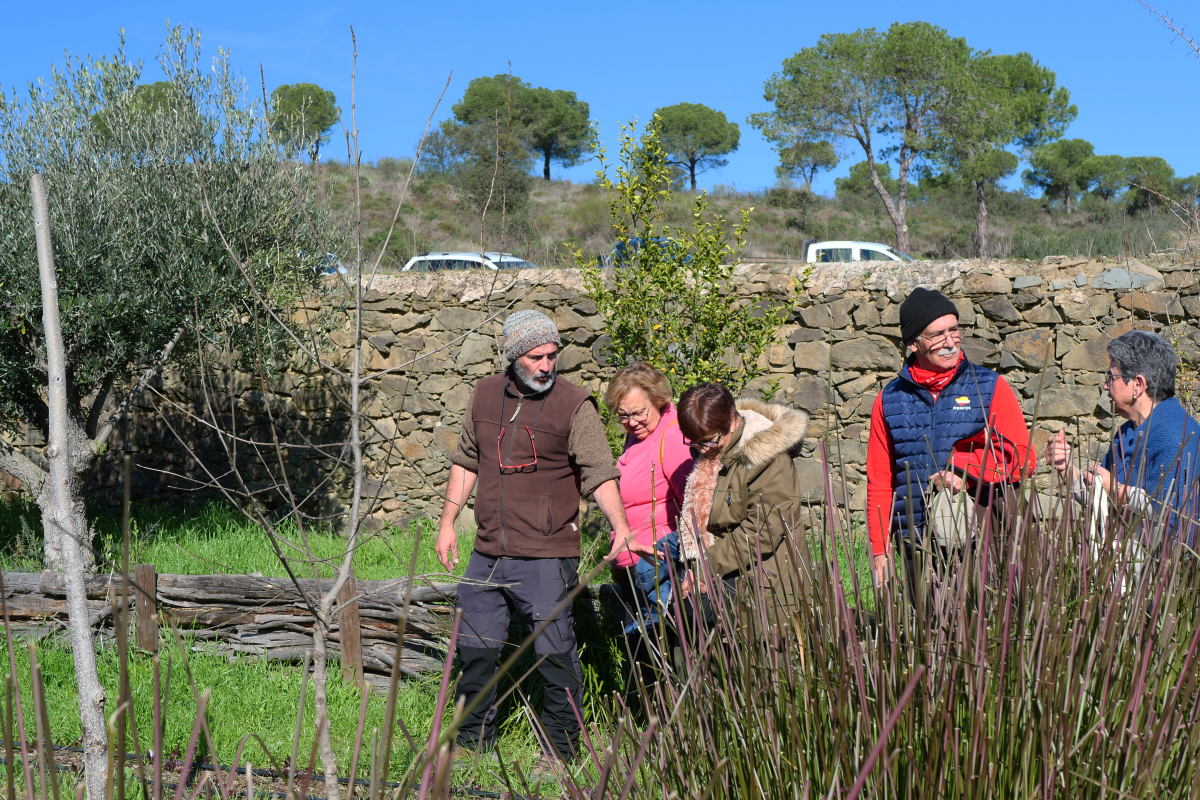
Coelho prefers demonstration over instruction. “We just invite people. Let them experience it—walk the fields, ask questions, express concerns. It works much better when they see it for themselves.”
Advice for aspiring syntropic farmers
Coelho’s advice is simple: start small, learn from mistakes, and focus on soil health first. Scaling up comes later.
Adapt to your location and situation. Every design must be tailored to the local context — climate, terrain, labour, and economics. “Designs aren’t copy-paste,” he says. “You need to adapt to your location and resources.”
Success comes from treating land as a living partner, not a resource to exploit. Even in harsh, dry landscapes, abundance is possible when farming is done thoughtfully, patiently, and in harmony with nature.