






Garlic is one of the weakest crops against weeds, because its narrow, upright leaves shade very little soil and it is grown at relatively low plant densities. In two years of trials in Brazil, weed competition cut average total yield by 24% and marketable yield by about 29% overall, while the critical period for weed control lasted from the first days after emergence to 126 days, almost the entire crop. That is why control starts before planting and combines a clean field, mulching, cultivation, hand weeding and, where needed, registered herbicides. This guide covers why garlic is so vulnerable, which weeds matter most, and how integrated weed management is organised before and after planting.
Why garlic loses to weeds
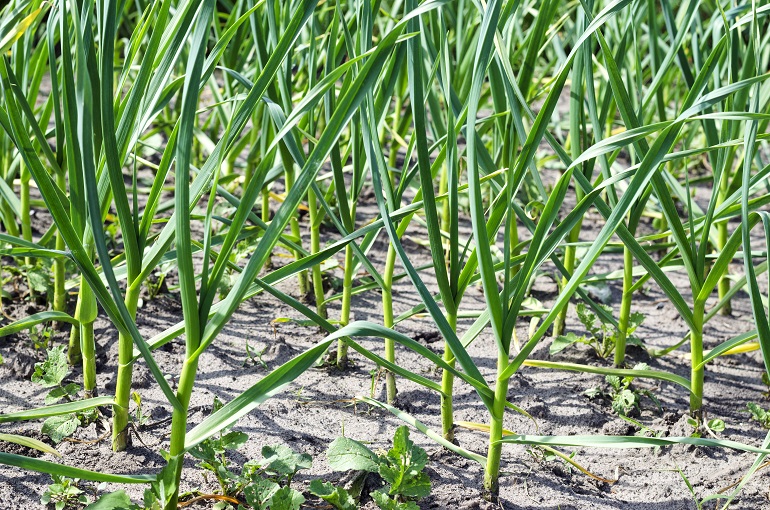
Garlic's limited foliage leaves the soil between plants exposed to sunlight, which encourages weed germination, while its slow winter growth gives weeds a head start. Weeds compete with garlic for space, light, water and nutrients, resulting in smaller and less uniform bulbs. According to Cornell University, once weeds are allowed to establish in a field, garlic is virtually unable to compete. Weeds also host thrips and hold moisture around the plants, favouring garlic diseases.
The critical period
The critical period for weed control is the window during which the crop must be kept weed-free so that yield loss stays below an acceptable threshold, usually 5%. In garlic this window is unusually long. In the Brazilian trials it began 3 to 6 days after emergence and ran to 126 days, while in trials in Iran it covered about 120 to 127 days. In practice, the field must stay clean from emergence through bulb fill.
The main weeds
| Weed | Type | Why it is difficult |
|---|---|---|
| Bermuda grass (Cynodon dactylon) | Perennial grass | Spreads by rhizomes and stolons |
| Johnson grass (Sorghum halepense) | Perennial grass | Strong rhizomes that regrow after cultivation |
| Purple nutsedge (Cyperus rotundus) | Perennial | Multiplies through underground tubers |
| Field bindweed (Convolvulus arvensis) | Perennial broadleaf | Deep root system, climbs over plants |
| Creeping thistle (Cirsium arvense) | Perennial broadleaf | Deep creeping roots |
| Fat hen (Chenopodium album) | Annual broadleaf | Produces very large numbers of seeds |
| Field pennycress (Thlaspi arvense) | Annual broadleaf | Germinates alongside the autumn crop |
| White clover (Trifolium repens) | Perennial | Quickly covers the soil between rows |
Perennial weeds with rhizomes, tubers or deep roots are the hardest, because they regrow from underground organs and are not controlled by a single cultivation. The main defence against them is field selection and preparation before planting.
Before planting
- Field selection: fields with serious, hard-to-control weed problems are not recommended. Growers need to know the field history and the dominant weeds
- Ploughing and cultivation: ploughing and final cultivation during garlic planting destroy emerged weeds and suppress perennials
- Stale seedbed: prepare the soil 2 to 4 weeks before planting so annual weed seeds germinate, then destroy them with a light cultivation before the cloves go in
- Soil solarisation: in badly infested fields, covering moist soil with clear plastic during the hottest months reduces weed seed viability, as well as some soilborne diseases
Mulching
Many growers cover the soil with black plastic film, between the rows or across the whole bed, and plant the cloves through small holes. The film prevents weed emergence and warms the soil at the same time. On small areas, a 5 to 8 cm layer of straw does a similar job while also holding soil moisture.
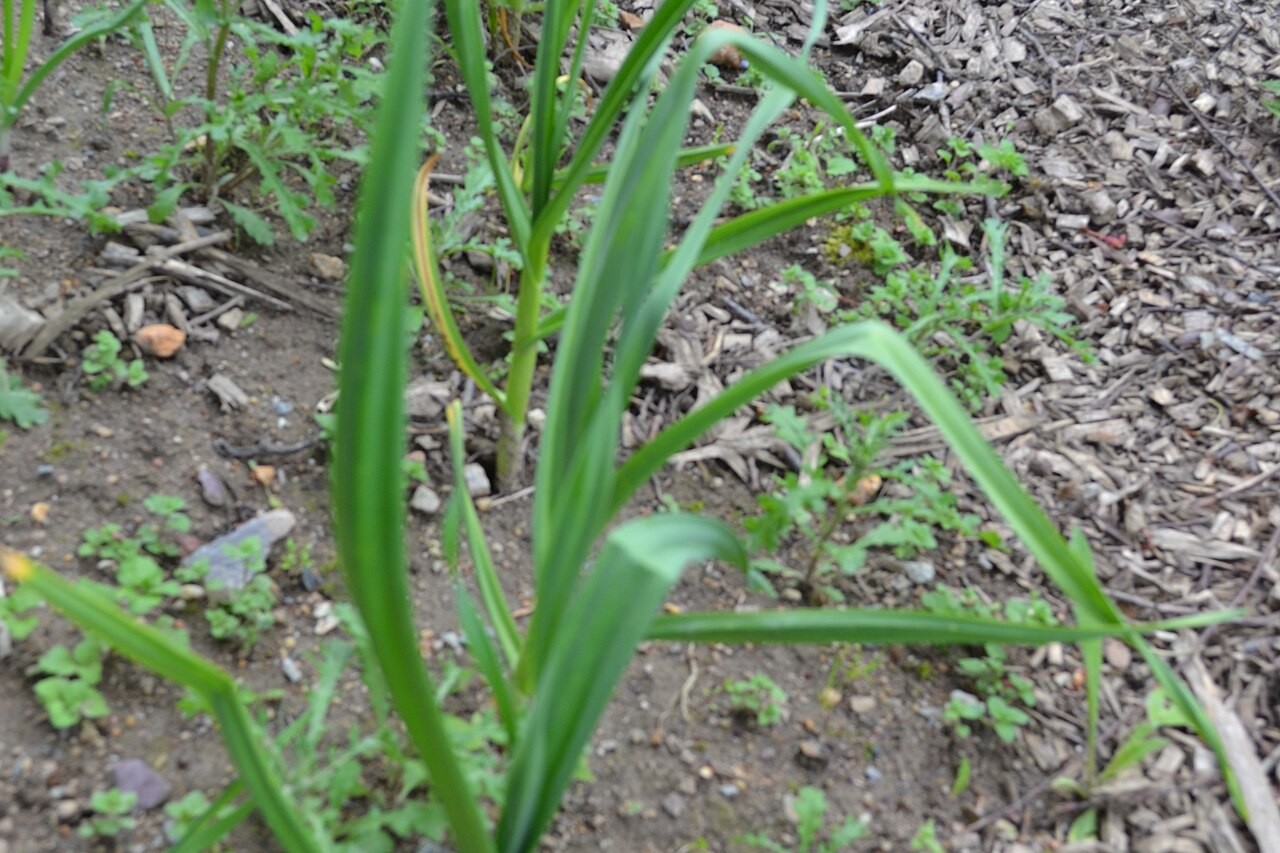
Weeds emerging around young garlic are removed early, because the crop's narrow leaves shade very little soil.
Cultivation and hand weeding
After emergence, weeds between the rows are controlled with shallow cultivation, and those between plants by hand weeding. Cultivation is kept shallow, because garlic's roots lie close to the surface and are easily damaged, as are the bulbs. The first weedings are the most valuable, because early control is particularly important for a good crop.
Chemical control
On large areas, weeds are controlled mainly with herbicides, pre-emergence or post-emergence, depending on the weeds present in the field. Few herbicides are registered for garlic, and registrations change, so products are chosen only among those registered for the crop in your country and always with advice from an agronomist. Active substances listed in older or foreign guides may no longer be permitted, particularly in the European Union.
A few basic rules apply to every application:
- Soil texture and pH: they determine the rate. Light soils low in organic matter take lower rates, heavy soils high in organic matter higher ones, always within label limits
- Weather: avoid applying when heavy, prolonged rain is forecast
- Rotating modes of action: alternating herbicides from different groups limits the development of resistance
- Label and pre-harvest intervals: observed strictly, to protect the crop, the environment, the operator and the consumer
Crop rotation
Rotation is one of the most effective long-term measures, because crops with dense foliage and fast growth, such as cereals, smother weeds and reduce their seed bank in the soil. In Greek practice, a common rotation is maize, green beans, beet or peas in the first year, cereals in the second and garlic in the third. The field should also be kept weed-free between crops, so the seed bank is not replenished.
Frequently asked questions
How much do weeds reduce garlic yield
In two years of trials in Brazil, the average loss was 24% of total yield and 29% of marketable yield. Losses depend on weed density and species and on how long competition lasts.
When must garlic be kept weed-free
From the first days after emergence through bulb fill. The critical period for garlic covers almost the entire crop, about 120 to 126 days.
Which weeds are hardest to control in garlic
Perennials with underground organs, such as Bermuda grass, Johnson grass, purple nutsedge, field bindweed and creeping thistle, because they regrow from rhizomes, tubers or deep roots. The main defence is choosing a clean field.
Does mulching help with garlic weeds
Yes. Black plastic film prevents weed emergence and warms the soil, while on small areas a 5 to 8 cm straw layer suppresses weeds and holds moisture.
Why must cultivation in garlic be shallow
Because garlic's root system is shallow and the bulbs sit close to the surface. Deep cultivation cuts roots and damages bulbs, opening the way to rots.
Which herbicides can be used in garlic
Only those registered for garlic in your country, chosen with advice from an agronomist. Registrations change, and active substances in older or foreign guides may no longer be permitted in the EU.
Important notes
The choice of control measures depends on the dominant weeds, the soil and the size of the crop, and treatment timing is adapted to each season's conditions.
Use only products registered for garlic in your country, follow the label and the maximum number of applications per season, and apply cultural measures first. For serious or persistent weed problems, consult a local agronomist.
References
- Chemical weed management in garlic, 2023.
- Guerra N. et al., Periods of weed interference in garlic crop, Acta Scientiarum. Agronomy, 2024.
- Determining critical period for weed control of garlic in chemical and organic nutrition systems, 2023.
- Cornell Vegetable Program, Spring garlic recommendations.
- NSW Department of Primary Industries, Growing garlic in NSW, Primefact 259.
- Plant Protection, Garlic cultivation technique (in Greek).
- UMass Amherst, Critical period of weed control.