





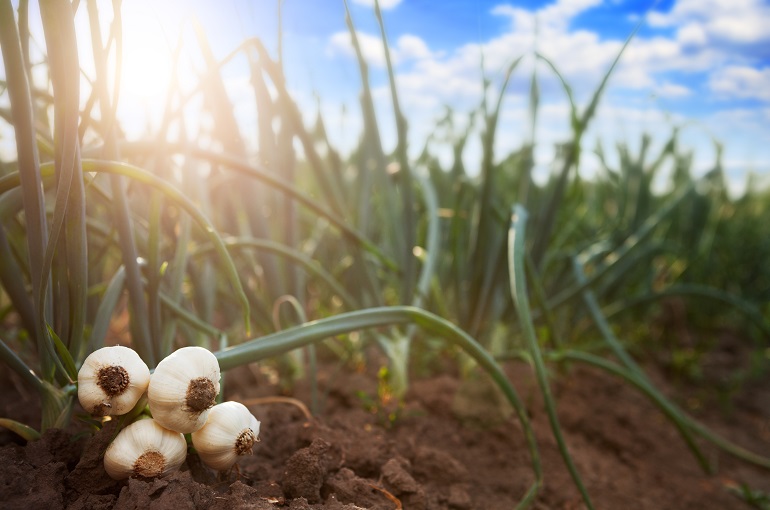
In Mediterranean climates, garlic is planted mainly from October to mid-November, with 1 to 2 tonnes of seed garlic per hectare and a density of about 50 plants per square metre, and it is harvested 6 to 8 months later, from May to August. It needs phosphorus and potassium in the base dressing, 100 to 140 kg of nitrogen per hectare in split doses, and about 4,260 cubic metres of water per hectare in spring, including rainfall. A good average yield is 10 tonnes per hectare, and in Greece production costs run to about €15,000 per hectare. It is a crop demanding in labour, water and crop protection, but Greek production does not meet domestic demand, and Greek garlic stands out on the market for its quality. This guide covers the crop in Greece, the calendar of field operations, the key figures per hectare, each stage from planting to storage, and the economics of the crop.
Garlic in Greece
According to Greek Ministry of Rural Development and Food figures for 2010, around 1,250 hectares of garlic were grown in Greece, producing 9,700 tonnes of dry bulbs, mainly in Thrace, Evia and the Peloponnese. The largest single production area today is Nea Vyssa in Evros, with almost 300 hectares, while Platykampos near Larissa also has a long garlic tradition. Local garlics such as Vyssa garlic are known for their strong flavour, and the choice among garlic varieties largely determines the result.
Domestic production does not meet demand, and needs are covered mainly by imports from China, which according to FAOSTAT produced 73% of world output in 2022. In recent years the area under garlic in Greece has been falling because of high costs, a shortage of farm labour and low producer prices, and growers in the main production areas see mechanisation as the key to lowering costs.
The crop calendar
| Period | Stage | Main operations |
|---|---|---|
| August to September | Preparation | Field selection, soil and water analysis, ploughing, base dressing, sourcing seed garlic |
| October to mid-November | Planting | Separating cloves, planting, laying drip lines. In cold regions, late winter to early spring |
| December to January | Rooting and slow growth | Weed control, monitoring drainage |
| February to April | Vegetative growth | Three top dressings, start of irrigation, monitoring thrips, downy mildew and rust |
| April to May | Bulbing | The most critical period for water, nitrogen stops |
| May to August | Maturity and harvest | Irrigation stops 1 to 3 weeks before, harvest, curing, grading |
| After harvest | Storage and sale | Cold store at 0 to 1°C for 6 to 7 months, or braids and a cool store |
Key figures per hectare
| Parameter | Indicative value |
|---|---|
| Seed garlic | 1 to 2 tonnes |
| Density | About 50 plants per m² |
| Spacing | 8 to 15 cm within the row, 25 to 40 cm between rows |
| Nitrogen | 100 to 140 kg, one third in the base dressing |
| Phosphorus and potassium | About 90 kg P₂O₅ and 80 kg K₂O in the base dressing, guided by analysis |
| Magnesium and sulphur | 5 to 10 kg Mg, about 45 kg S on soils low in sulphur |
| Water | About 4,260 m³ from March to late May, including rainfall |
| Yield | 5 to 20 tonnes, with a good average of 10 tonnes |
| Bulbs | 200,000 to 300,000, of which around 150,000 first size |
| Production cost in Greece | About €15,000, according to growers in Nea Vyssa and Platykampos in 2025 |
Field selection and planting
Garlic performs best on fertile, well-drained loam or sandy loam with a pH of 6 to 7, while heavy clay soils produce misshapen bulbs and favour rots. It returns to the same field only after three years, is not planted after onion or leek, and never goes into a field with a history of white rot.
The most important decision of the season is the seed garlic. Certified stock is preferred, large outer cloves give bigger bulbs, and bulbs are broken into cloves only shortly before planting, being kept at about 10°C until then. Autumn planting gives the largest bulbs, because it provides the chilling the plant needs and a longer vegetative period before bulbing. Spacing, depth and seed rates are adapted to variety and soil during garlic planting.
Fertilisation
The base dressing includes rotted manure, all the phosphorus, most of the potassium, one third of the nitrogen and all the magnesium. The remaining nitrogen is applied in three top dressings in February and April and stops once bulbing begins, because late nitrogen delays maturity and shortens storage life. Cornell University trials showed that seed clove size matters more than spring nitrogen, and that excessive nitrogen rarely pays. Sulphur, on which pungency depends, is the nutrient most often forgotten in garlic fertilisation.
Irrigation
Garlic has a shallow root system in the top 60 cm of soil and performs best when moisture in that layer stays close to field capacity in spring. The most critical period is bulbing and bulb fill, and irrigation stops 1 to 3 weeks before harvest, at the first signs of maturity. In Greece the most widespread garlic irrigation system is micro-sprinklers, while drip keeps foliage dry and saves water.
Weed management
Garlic competes very poorly with weeds, and the critical period for weed control covers almost the whole crop, about 120 to 126 days. In trials, competition cut total yield by 24% and marketable yield by 29%. Garlic weed management starts with a clean field and a stale seedbed, and continues with mulching, shallow cultivation, hand weeding and, where needed, registered herbicides.
Crop protection
The most serious diseases are white rot, Fusarium rot, Penicillium decay, downy mildew and rust, and the most important pests are thrips, the stem and bulb nematode and bulb mites. Most of them are carried on planting material or survive for years in soil, so healthy seed cloves and rotation are the foundation of crop protection. Where prevention is not enough, treatment uses only products registered for garlic, after diagnosis by an agronomist and in line with local plant protection guidance. For quick diagnosis in the field, garlic diseases can be told apart by one simple rule: Fusarium and white rot progress from the bulb base upward, while Botrytis and bacterial rots progress from the neck downward.
Harvest and storage
Harvest takes place when 80 to 90% of the crop has matured, meaning the neck has softened and the leaves have yellowed while keeping a little green. Bulbs are cured for about 7 days in the field, covered with their own leaves, or in a drying facility, and are then trimmed and graded by size. The European market applies the UNECE FFV-18 standard, with a minimum diameter of 45 mm for Extra Class and 30 mm for Classes I and II. For long-term garlic storage, bulbs are kept at 0 to 1°C and 60 to 70% humidity, where they last 6 to 7 months, while temperatures around 4°C and humidity above 70% must be avoided.
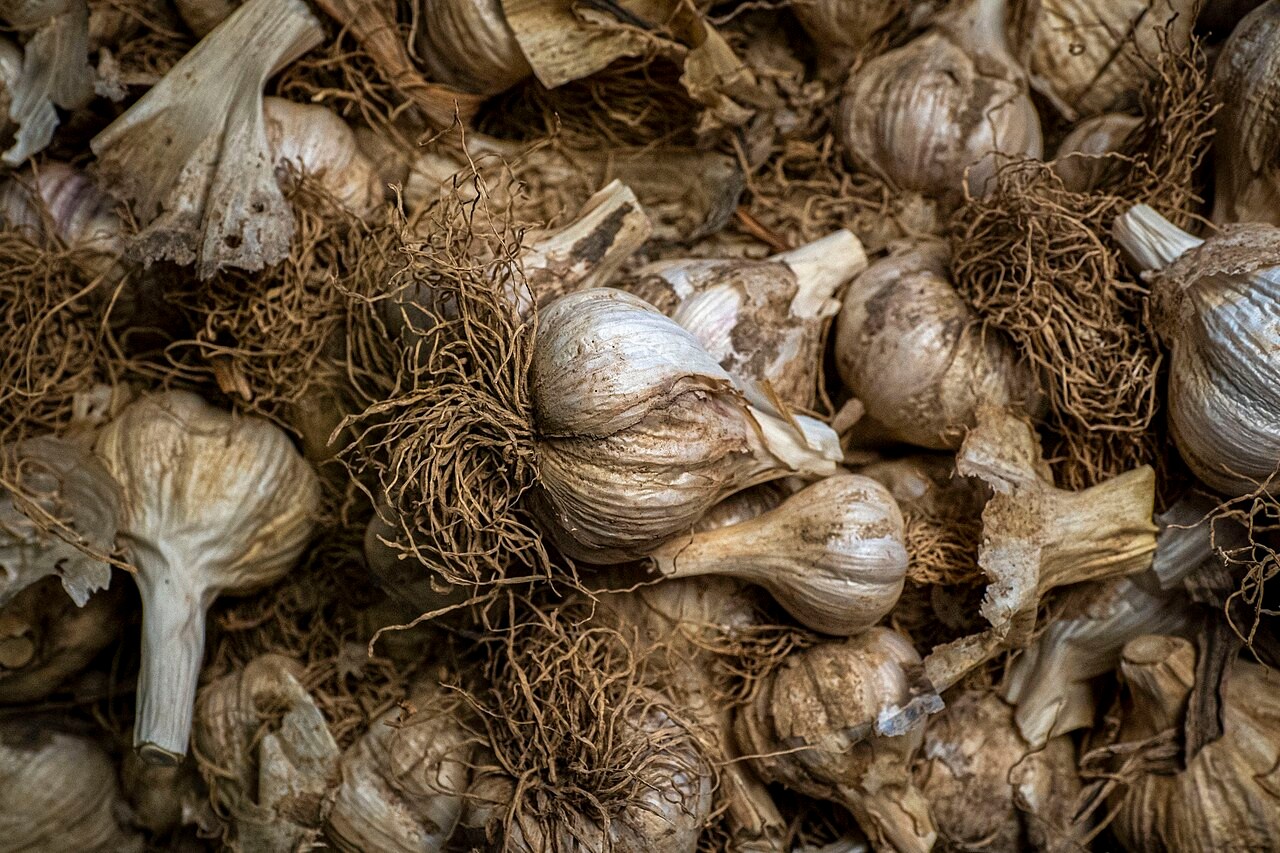
Freshly lifted bulbs still carry their roots and outer skins, which are trimmed after curing and before grading.
Costs and prices
According to growers in Nea Vyssa and Platykampos in 2025, production costs reach about €1,500 per stremma, or roughly €15,000 per hectare, with labour, crop protection and irrigation the heaviest items. The same year, dry garlic from Nea Vyssa sold at producer prices of 20 to 28 cents per bulb, about €2 per kilo, down from 28 to 30 cents the year before.
A simple indicative calculation shows how tight margins are. With a yield of 10 tonnes per hectare and a price of €2 per kilo, gross revenue reaches about €20,000 per hectare, leaving around €5,000 after the €15,000 in costs, before the grower's own labour and taxes. One bad season in yield or price can wipe out that margin. The economic result therefore depends on quality and correct grading, on long storage that allows sales at a better time, and on mechanisation that reduces labour costs.
Value-added products
Beyond dry garlic in cartons or mesh bags, growers sell fresh garlic in spring from successive plantings, and traditional braids of 25 bulbs, which suit softneck varieties best. One product in growing demand is black garlic, made from white garlic aged under controlled temperature and humidity, which is already being produced from Greek garlic. For small plots and home use, growing garlic in the garden follows the same principles in simpler form.
Frequently asked questions
How much does it cost to grow a hectare of garlic
According to growers in Nea Vyssa and Platykampos in Greece in 2025, about €15,000 per hectare. The largest items are labour, crop protection and irrigation.
What is the yield of garlic per hectare
From 5 to 20 tonnes, depending on variety, density and season, with a good average of about 10 tonnes. In number, that is 200,000 to 300,000 bulbs, of which around 150,000 are first size.
When is garlic planted commercially
In Mediterranean climates mainly from October to mid-November, and in cold regions in late winter to early spring. Autumn planting gives larger bulbs.
How much seed garlic is needed per hectare
About 1 to 2 tonnes, depending on clove size and planting density.
What is the producer price for garlic in Greece
In 2025, dry garlic from Nea Vyssa sold at 20 to 28 cents per bulb, about €2 per kilo, down from 28 to 30 cents the year before. Prices vary with region, size and time of sale.
Why is the garlic area in Greece shrinking
Because of high production costs, a shortage of farm labour and low producer prices against imports, mainly from China. Growers see mechanisation as the key to lowering costs.
Important notes
The figures in this guide are indicative and are adapted to variety, soil, region and each season's weather, while treatment timing follows local plant protection guidance.
Use only products registered for garlic in your country, follow the label and the maximum number of applications per season, and apply cultural measures first. For serious or persistent problems, consult a local agronomist for an accurate diagnosis.
References
- AgroTypos, Garlic planting in October, costs and prices keep the area low (in Greek), 2025.
- Ypaithros Chora, Garlic cultivation, what growers need to know (in Greek).
- Plant Protection, Garlic cultivation technique (in Greek).
- NSW Department of Primary Industries, Growing garlic in NSW, Primefact 259.
- Ayars J. E., Water requirement of irrigated garlic, USDA Agricultural Research Service, 2008.
- UNECE, Standard FFV-18 concerning the marketing and commercial quality control of garlic.
- List of countries by garlic production, based on FAOSTAT.