
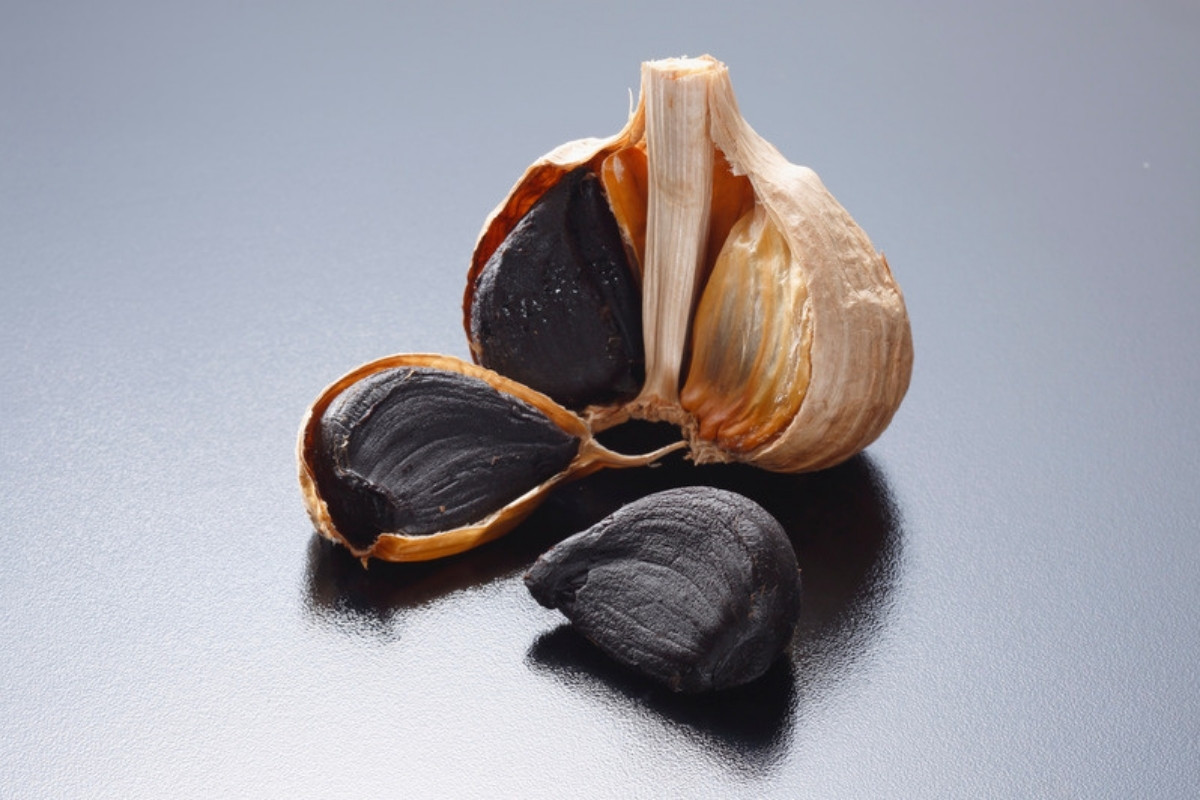
Black garlic is white garlic aged for weeks under controlled temperature and humidity, not a separate variety. Conditions are usually 60 to 90°C and 70 to 90% relative humidity. During this process the Maillard reaction, the same reaction that browns bread crust and roasted coffee, turns the cloves black and gives them a soft, jelly-like texture and a sweet-sour taste, without the pungency and strong smell of fresh garlic. Although it is often called "fermented", the changes are caused by heat, not by microbial fermentation. This article covers how black garlic is produced, what changes in its composition, what research actually says about health, which precautions apply, and how it is used.
How it is made
Whole heads of white garlic are placed in special chambers where temperature and humidity stay constant for weeks, with no additives or preservatives. Conditions vary between producers, and scientific studies have tested a wide range:
| Parameter | Usual range | Note |
|---|---|---|
| Temperature | 60 to 90°C | In practice often 65 to 80°C |
| Relative humidity | 70 to 90% | Humidity keeps the cloves from drying out |
| Duration | About 30 to 40 days | 10 to 80 days in the literature, depending on method |
Temperature and humidity are the critical parameters for the quality of the final product. In a study comparing 65, 75 and 85°C, researchers concluded that 75°C with 85% humidity were the most suitable conditions for retaining antioxidant capacity and nutrients. With the traditional method, at 70°C and 94% humidity, the characteristic black colour appears in about 30 days, while special pretreatments have cut this experimentally to 12 days.
The raw material matters as much as the process. Black garlic is made from healthy, well-cured bulbs, and in Greece it is also produced from Greek garlic, for example in Platykampos near Larissa and on Mount Pelion. For the raw material, the garlic variety and correct harvesting and storage both matter.
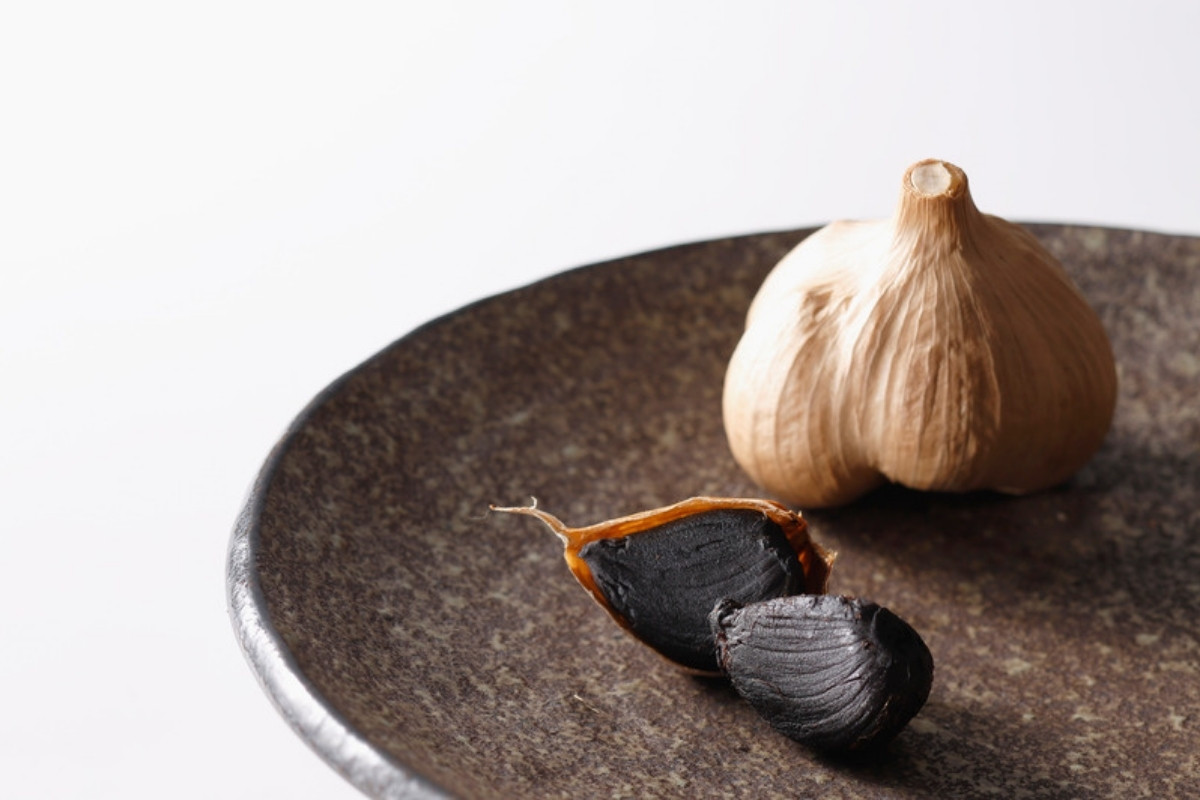
After weeks of ageing, the cloves turn black and soft, while the white bulb they started from stays firm and pale.
What changes in the garlic
| Characteristic | White garlic | Black garlic |
|---|---|---|
| Texture | Firm, crisp | Soft, elastic, jelly-like |
| Taste | Pungent | Sweet-sour, with a roasted aroma |
| Smell | Strong | Mild |
| Allicin | Forms when the clove is cut | Reduced or undetectable |
| S-allyl cysteine | Low | Up to 8 times higher |
| Sugars | Mainly as fructans | Fructans break down into simple sugars, mainly fructose |
| Polyphenols and flavonoids | Baseline level | Increased |
| 5-HMF | Absent | Forms as an intermediate product of the Maillard reaction |
Black garlic's sweetness comes from the breakdown of fructans, the storage polysaccharides of garlic, into simple sugars. Its mild smell and lack of pungency come from the fall in allicin, the compound that gives fresh garlic its intensity. By contrast, S-allyl cysteine, a stable sulphur compound, increases and is considered a quality marker for black garlic.
Is it fermented or probiotic
No, and both are common misconceptions. Black garlic is produced by the Maillard reaction and other heat-driven chemical changes under controlled humidity, not by microbial fermentation. Probiotics are by definition live microorganisms, while black garlic spends weeks at 60 to 90°C, so it is not a probiotic food.
What research says about health
In laboratory measurements, black garlic shows higher antioxidant activity than fresh garlic, attributed to its increased S-allyl cysteine, polyphenols and flavonoids. Reviews list many possible effects, such as anti-inflammatory, lipid-lowering or liver-protective activity. These findings, however, come mainly from cell and animal studies, and they do not automatically carry over to humans.
Clinical studies in people are few and small. In a recent randomised trial published in 2026, 75 people with grade I hypertension took 250 mg of black garlic extract or a placebo for 12 weeks, and no statistically significant change was seen in any conventional lipid marker, meaning total, LDL and HDL cholesterol or triglycerides. The researchers note that evidence from controlled trials remains limited.
Figures in circulation such as "twice" or "4.5 times more antioxidants" come from laboratory measurements and vary with the production and analysis method, so they do not describe any proven benefit for humans. In the European Union, as with white garlic, no health claim for black garlic appears on the list of authorised claims.
Side effects and precautions
As a food, black garlic is generally considered safe. It does, however, contain more simple sugars than white garlic, which is worth bearing in mind for anyone watching their sugar intake. Because it is a garlic product, it is sensible to apply the garlic precautions to it too, particularly for capsule supplements. Anyone taking anticoagulants or other medication, or facing surgery, should talk to their doctor before taking supplements.
How it is used
Black garlic is sold as whole bulbs, peeled cloves, paste, powder and capsule supplements. In the kitchen its soft texture lets it be spread on bread or melted easily into sauces, dressings and marinades, while its sweet flavour pairs with cheese, meat, fish and risotto. Because it neither burns nor smells strongly, it is also eaten on its own.
Frequently asked questions
What is black garlic
It is white garlic aged for weeks at about 60 to 90°C and 70 to 90% humidity. The Maillard reaction turns the cloves black and gives them a soft texture and sweet taste.
How is black garlic made
Whole garlic heads stay in special chambers at constant temperature and humidity for about 30 to 40 days, with no additives. In one study, 75°C with 85% humidity were the most suitable conditions for retaining nutrients.
Is black garlic fermented
No. Although it is often called fermented, the changes come from the Maillard reaction and other heat-driven chemical changes, not from microorganisms. For the same reason it is not a probiotic food.
What are the benefits of black garlic
In laboratory measurements it has higher antioxidant activity than fresh garlic and more S-allyl cysteine. Possible health benefits, however, come mainly from cell and animal studies, and the few clinical studies in people have not shown clear results.
Does black garlic have side effects
As a food it is generally considered safe, but it contains more sugars than white garlic. For supplements, anyone taking anticoagulants or other medication should consult their doctor first.
Does black garlic smell or burn
Not like fresh garlic. Allicin, which gives fresh garlic its pungency and strong smell, falls sharply or disappears during ageing, so black garlic has a mild smell and a sweet-sour taste.
Important notes
The health information in this article is for general awareness and does not replace medical advice.
References
- Unraveling phytochemistry and biofunctionality of black garlic, a systematic review, Food Science and Biotechnology, 2025.
- Black garlic and its bioactive compounds on human health diseases, a review, Molecules, 2021.
- Changes in nutritional and bio-functional compounds and antioxidant capacity during black garlic processing, Journal of Food Science and Technology, 2018.
- Optimization of the black garlic processing method and development of black garlic jam using high-pressure processing, Foods, 2023.
- Ohmic heating pretreatment accelerates black garlic processing, LWT, 2021.
- Effects of aged black garlic on lipoprotein subclass composition in grade I hypertension, a randomized triple-blind controlled trial, 2026.
- National Center for Complementary and Integrative Health, Garlic.