




Garlic needs phosphorus and potassium in the base dressing before planting, nitrogen in split doses from late winter into spring, and adequate magnesium and sulphur. As a guide, Greek recommendations cite 100 to 140 kg of nitrogen per hectare, one third of it in the base dressing, and 5 to 10 kg of magnesium, all of it at planting. Nitrogen stops once bulbing begins, because late nitrogen delays maturity and produces soft bulbs that store poorly. This guide covers how many nutrients the crop removes, indicative rates per hectare, the base and top-dressing programme, the role of sulphur, and the mistakes that cost yield.
Start with a soil analysis
Every fertilisation programme starts with a soil analysis, ideally alongside an analysis of the irrigation water, before planting. The analysis shows nutrient availability, organic matter and pH. Garlic prefers neutral to slightly acid soils with a pH of 6 to 7, while saline soils should be avoided. On soils below pH 5.5 to 5.8, lime is applied, and dolomitic lime adds magnesium at the same time. In intensive crops, leaf analysis during the season shows whether a corrective foliar feed is needed.
How many nutrients garlic needs
Garlic has lower nutrient requirements than onion, because both its biomass and its bulbs weigh less. According to Greek fertilisation guides, for every tonne of produce the crop takes up 5 kg of nitrogen, 1.5 kg of P₂O₅ and 3 kg of K₂O from the soil. The amount actually applied is higher, because some is lost or fixed in the soil, and it depends on soil type, the previous crop, organic inputs and water management.
| Nutrient | Indicative rate per hectare | When it is applied |
|---|---|---|
| Nitrogen (N) | 100 to 140 kg | One third in the base dressing, the rest as top dressings |
| Phosphorus (P₂O₅) | About 90 kg | All of it in the base dressing |
| Potassium (K₂O) | About 80 kg at planting, on soils low in potassium | Base dressing, topped up in spring |
| Magnesium (Mg) | 5 to 10 kg | All of it in the base dressing |
| Sulphur (S) | About 45 kg, on soils low in sulphur | As sulphate fertilisers, in the base dressing |
Nitrogen rates vary noticeably between sources. The New South Wales Department of Primary Industries suggests 60 to 80 kg per hectare, while trials by Cornell University in New York showed something even more striking. In eight comparisons, across three sites and two seasons, there was no yield difference between about 56, 112 and 168 kg of spring-applied nitrogen per hectare, while 56 kg raised yield by 20% compared with no nitrogen. The researchers concluded that the size of the seed clove mattered far more than spring nitrogen. The trials were run on fields following sod or an oat cover crop, with nitrogen supplied from organic matter, so they do not transfer directly. They do show that excessive nitrogen rarely pays.
Base dressing
The base dressing is applied during soil preparation and incorporated at harrowing. It includes:
- Organic matter: well-rotted manure or compost about a month before planting. Manure must be well rotted, because fresh manure encourages rot and onion fly
- All the phosphorus, which supports root development and is released gradually during the season
- Most of the potassium, which helps the uptake of nitrogen and phosphorus and makes plants more resistant to disease
- One third of the nitrogen
- All the magnesium, because magnesium deficiency can be devastating for the crop
For the base dressing, Greek fertilisation guides suggest compound fertilisers high in potassium and sulphur, such as 15-3-20, 12-8-16 or 15-10-15 with sulphur, at 500 to 800 kg per hectare, always guided by the soil analysis. On soils already rich in phosphorus, low- or zero-phosphorus grades are chosen.
Top dressing
The remaining nitrogen and part of the potassium are applied in doses as the plants grow. An indicative Greek programme for autumn planting is:
- 1st dose, in February: nitrogen fertilisers, as spring growth begins
- 2nd dose, in early April: compound fertilisers richer in potassium and trace elements
- 3rd dose, in late April: potassium fertilisers
Cornell recommends applying the first nitrogen dose as soon as plants reach about 15 cm with 4 to 5 leaves, because nitrogen applied later has very little effect on final bulb size. In the same research, plants already had all the nitrogen they needed by the end of May.
Nitrogen stops once bulbing begins. Excess nitrogen delays the onset of bulbing, and nitrogen applied after that stage produces softer bulbs with a shorter storage life.
Fertigation
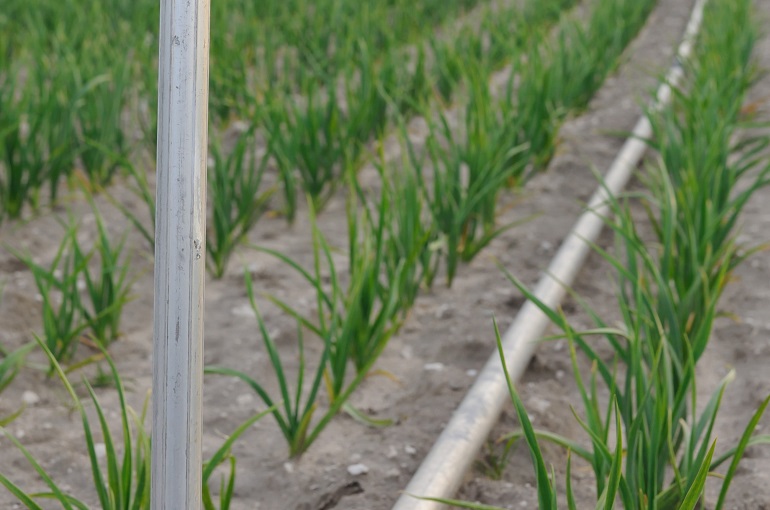
Where drip irrigation is in place, nitrogen and potassium can be delivered through garlic irrigation in small, frequent doses of water-soluble fertiliser. Fertigation follows the same logic as top dressing, meaning more nitrogen at the start of spring growth, more potassium later, and nitrogen stopped once bulbing begins.
Why sulphur matters
Garlic's characteristic pungency comes from sulphur compounds, above all alliin, which turns into allicin when the clove is cut or crushed. Sulphur therefore affects yield, flavour and quality at the same time. In two-year trials in Bangladesh, the optimum sulphur rate was calculated at about 44 kg per hectare, and 45 kg gave yields 55% higher than no sulphur. In a trial in Australia, one cultivar produced its heaviest bulbs and most allicin at 75 kg of sulphur per hectare, while a second cultivar, on soil already rich in sulphur, showed no response at all. In practice, sulphur is easily supplied through sulphate fertilisers such as ammonium sulphate or potassium sulphate, and through compound grades containing sulphur.
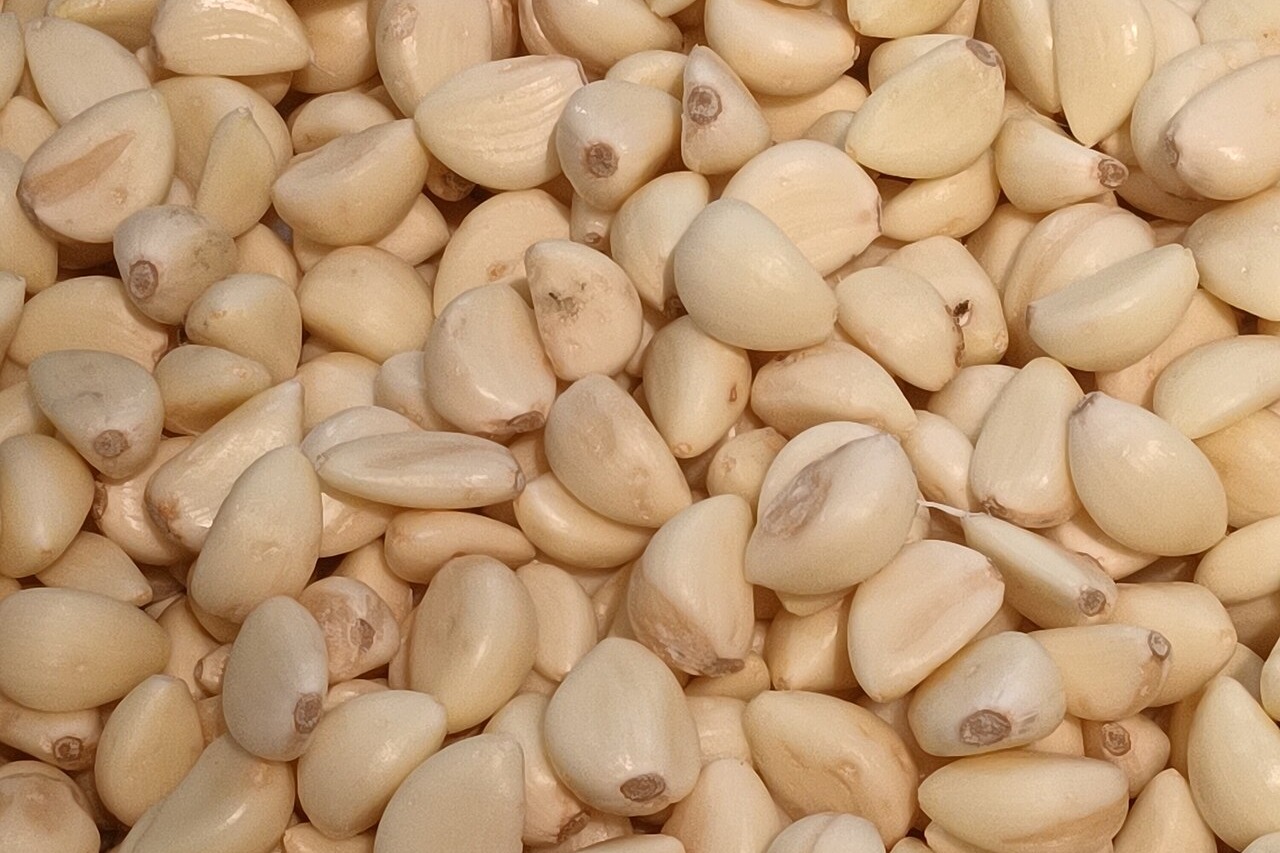
Garlic's pungency comes from sulphur compounds released when the clove is cut or crushed.
Trace elements
Garlic is sensitive to deficiencies of zinc, copper and boron. Deficiencies are best corrected with foliar feeds, ideally after a leaf analysis, so that only what is actually lacking is applied.
Costly mistakes
- Too much nitrogen: delays bulbing and produces lush foliage and soft bulbs, without raising yield
- Nitrogen late in the season: after bulbing starts it harms storage
- Leaving out magnesium and sulphur: two nutrients often forgotten, yet both directly affect yield and quality
- Fresh manure: encourages rot and onion fly
- Fertilising without analysis: leads to wasted money and nutrient imbalances
When growing garlic in the garden, fertilisation simplifies to compost or rotted manure at planting and a light nitrogen feed in spring.
Frequently asked questions
What fertiliser does garlic need
In the base dressing, a compound fertiliser high in potassium and sulphur, together with well-rotted manure or compost. In spring, a nitrogen fertiliser in February and a potassium fertiliser in April.
How much nitrogen does garlic need per hectare
Greek recommendations cite 100 to 140 kg of nitrogen per hectare, with one third in the base dressing. International trials show that lower rates are often enough, especially on soils rich in organic matter.
When should nitrogen stop
Once bulbing begins in spring. Nitrogen after that stage delays maturity and produces soft bulbs with a short storage life.
Does garlic need sulphur
Yes. Garlic's pungency comes from sulphur compounds, and in trials in Bangladesh about 45 kg of sulphur per hectare raised yield by 55%. On soils already rich in sulphur, adding it has no effect.
Does garlic need magnesium
Yes, about 5 to 10 kg per hectare, all in the base dressing. Magnesium deficiency can be devastating for the crop.
Can I fertilise garlic with manure
Yes, but only well-rotted manure, about a month before planting. Fresh manure encourages rot and onion fly.
Important notes
The rates in this guide are indicative, and each field's programme is set from the soil analysis, the previous crop and the production target. For serious or persistent nutrient problems, consult a local agronomist for an accurate diagnosis.
References
- Plant Protection, Garlic cultivation technique (in Greek), based on Greek Ministry of Rural Development integrated crop protection guidelines and C. Olympios, Agricultural University of Athens.
- Plant Protection, Fertilisation guide, field garlic (in Greek).
- Cornell Vegetable Program, Nitrogen requirements in garlic, 50 lb/A is enough.
- NSW Department of Primary Industries, Growing garlic in NSW, Primefact 259.
- Zaman M. S. et al., Effect of sulphur fertilization on the growth and yield of garlic, Bangladesh Journal of Agricultural Research, 2011.
- Sulfur nutrition affects garlic bulb yield and allicin concentration, Plants, 2022.