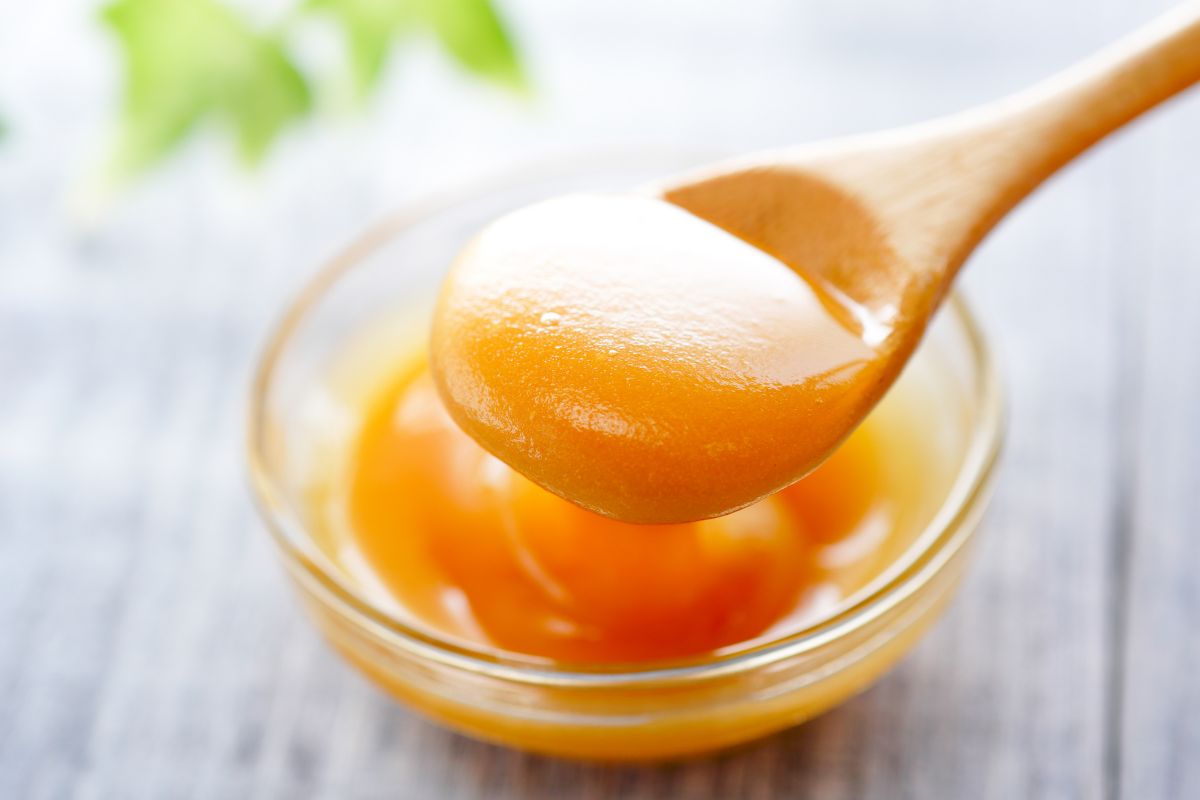
What is Manuka honey?
Manuka honey is honey produced with nectar from the manuka tree (Leptospermum scoparium), which is native to New Zealand and parts of coastal Australia.
The bees that produce it forage without limitations several kilometres from the hive, meaning the honey is never 100% Manuka nectar. In 2018, the New Zealand government's Ministry for Primary Industries (MPI) introduced a five-part test with four chemical markers from the nectar and one DNA marker from the pollen, which defines if a honey can be labelled and sold as Manuka.
How is Manuka honey different from regular honey?
All honey is antibacterial, as the enzyme that bees add to it during production creates hydrogen peroxide. However, Manuka honey contains levels of methylglyoxal (MGO) much higher than in regular honey, and this compound is also antibacterial.
In the 1980s, biochemist Peter Molan at the University of Waikato removed peroxide activity from various honeys and found that Manuka honey was the only one to retain its antibacterial properties. This is caused by the Manuka flower delivering dihydroxyacetone (DHA), which slowly converts into MGO over time, continuing even after packaging. Both are tracked for grading, as they determine future potency and shelf life.
Leptosperin is a compound that occurs only in Manuka nectar and cannot be added or faked, so labs check for it when analyzing the honey’s authenticity.
Monofloral vs. multifloral
Manuka honey comes in two different classes:
- Monofloral Manuka comes mostly from Manuka nectar, meets higher marker thresholds, and has a stronger taste.
- Multifloral Manuka is a blend of Manuka and other nectars, tastes milder, has lower MGO levels, and is for everyday use.
UMF vs. MGO
MGO indicates the amount of methylglyoxal in the honey at the time of testing, in milligrams per kilogram. It shows the potency of the honey. It does not show freshness or authenticity. MGO-labelled honey can be packed anywhere.
UMF (Unique Manuka Factor) is a certification administered by the UMF Honey Association. It verifies MGO for potency, DHA for shelf life, leptosperin for authenticity, and HMF for freshness, and it requires honey to be packed in New Zealand and traceable to a licensed supplier. The UMF honey association also buys and re-tests members' honey from retailers around the world.
Other things seen on labels include K Factor, BioActive, MGS, NPA, and TA. These are proprietary or older systems that may measure pollen or activity. They do not check retail honey like the UMF.
Manuka honey grades
Manuka honey is graded by how much MGO it contains. Lots of it means more antibacterial activity. A higher MGO level isn't necessarily the best option: For everyday use, a moderate grade is fine; higher grades are more commonly used for topical and targeted applications.
Two main systems are used to grade it: MGO (raw potency) and UMF (a broader certification that also checks the honey is genuine).
These are the grades:
- UMF 5+ contains MGO 83+ and is best for everyday consumption, for example, as a tea sweetener
- UMF 10+ contains MGO 263+, which is more common for wellness applications like sore throats
- UMF 15+ contains MGO 514+, which is very potent and more common for topical applications like skincare
- UMF 20+ contains MGO 829+, which is the premium product, the rarest, the most expensive, and usually for targeted topical applications
Manuka honey adulteration and verification
Manuka honey faces a high risk of adulteration. Reports have noted that significantly more honey labelled "Manuka" is sold worldwide than is believed to be produced annually in New Zealand and Australia. This means that much of the Manuka-labelled honey worldwide is fake. This can include blends of regular honey with some Manuka honey, multi-country blends, colour and aroma alteration, syrups, etc.
High-grade Manuka honey is a premium product with a premium price, so adulterated versions exist because they are cheaper to produce yet command the same price. Cross-border enforcement is not always guaranteed, which is why certification is so important.
It is important to verify that a product labelled as Manuka honey is genuinely derived from Manuka nectar.
Which grade of Manuka honey should I buy?
Buy Manuka honey based on the purpose you will use it for:
- Daily use for health or as a sweetener: UMF 5+ to 10+ (MGO 83–263+).
- General wellness applications, including soothing sore throats: UMF 10+ to 15+ (MGO 263–514+).
- Targeted or topical use, skincare: UMF 15+ to 20+ (MGO 514–829+).
Why is Manuka honey so expensive?
The higher the grade, the higher the price, as Manuka flowers only bloom for two to six weeks a year in certain regions, and testing and certification are costly.
How to ensure you are buying real Manuka honey?
- Look for the UMF™ trademark and licence number, which you can verify with the UMF Honey Association.
- If a jar only shows MGO or the producer, check that it was packaged in New Zealand and, if possible, ask for a test for leptosperin and DHA.
- Check for "monofloral" or "multifloral", which means it cleared New Zealand export testing.
- If the jar doesn't have either UMF or MGO figure, be wary.
- Expect a higher price. If the price seems low, be careful that it is not a fake.
- Packaging outside New Zealand may warrant additional scrutiny.
Manuka honey storage and usage
Manuka honey should be kept sealed at room temperature and out of direct light. Do not refrigerate, as this speeds up crystallization.
Avoid excessive heating, as it can degrade some compounds that contribute to Manuka honey's health benefits.
Never give it to a child under 12 months.