











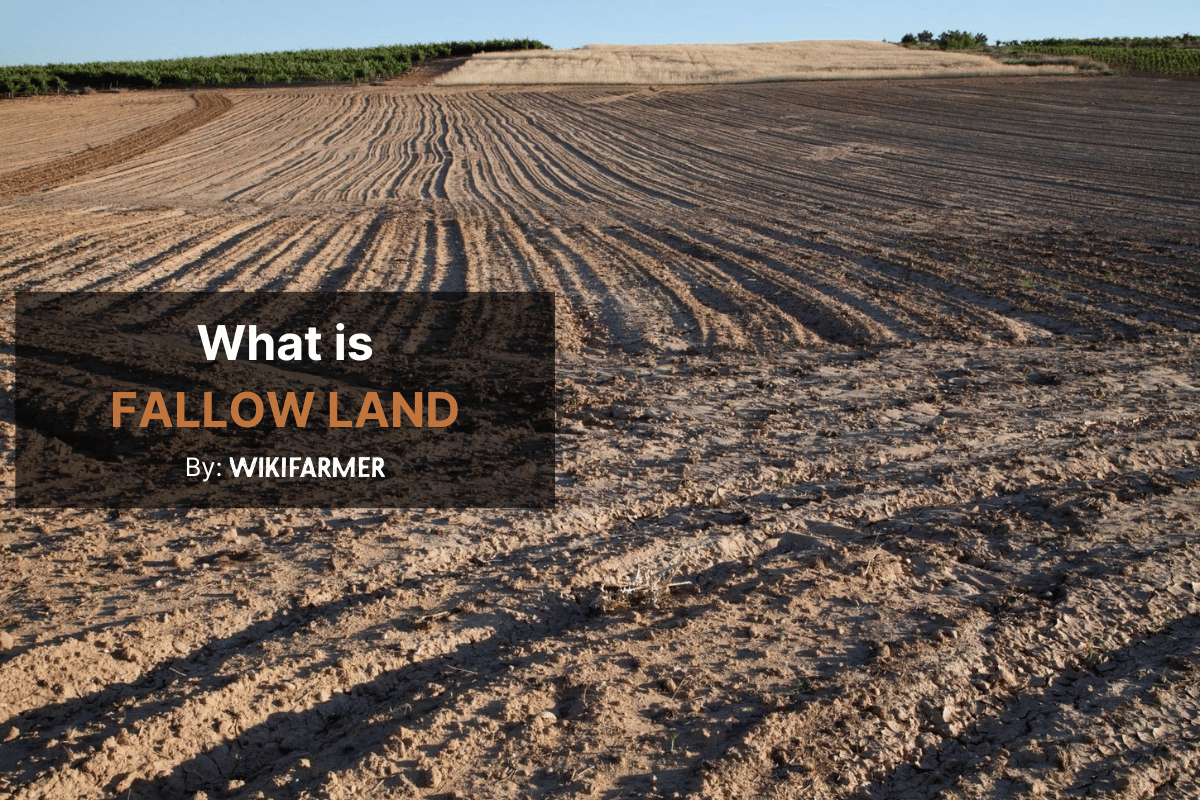
What is fallow land and why do farmers leave fields uncultivated?
Fallow land is arable land that is intentionally left uncultivated for one or more growing seasons to allow the soil to recover its fertility, moisture, and structure. Fallowing is one of the oldest agricultural practices, used for thousands of years across every farming region on Earth. It remains a core component of crop rotation in dryland farming, organic farming, and low-input agricultural systems.
Despite its long history, fallow land is declining worldwide. FAO data shows that the area used for fallow and temporary meadows decreased by approximately 85 million hectares between 2001 and 2022 as farmers intensified production by planting crops more frequently on the same land (FAO, 2024). This trend raises questions about whether continuous cropping is sustainable without the soil recovery that fallow periods provide.
What does fallowing mean in agriculture?
Fallowing means deliberately leaving a field out of crop production for a defined period, typically one growing season but sometimes two or more years. During the fallow period, the field may be left bare, tilled periodically to control weeds, or planted with non-harvested cover crops that are later incorporated into the soil.
The practice serves multiple purposes. It allows soil moisture to accumulate in dryland regions where rainfall is insufficient to support cropping every year. It lets soil microorganisms decompose crop residues and release locked-up nutrients back into plant-available forms. It breaks the life cycles of crop-specific pests, diseases, and weeds that build up under continuous cropping. In subsistence agriculture systems, particularly in tropical regions, shifting cultivation (clearing land, farming it for a few years, then abandoning it for a longer fallow period) was the traditional way of maintaining fertility without external inputs.
What are the different types of fallow?
Fallow practices vary depending on climate, farming system, and the farmer's goals. The two main categories are bare (or true) fallow and green fallow.
Bare fallow (also called "clean fallow") means the field is left without any growing plants. The soil surface may be tilled periodically to control weeds and create a dust mulch that reduces evaporation. In semi-arid regions of North America, Australia, and Central Asia, bare fallow is used in wheat-fallow rotations to accumulate two years of rainfall for one year of crop production. In some systems, herbicides replace tillage for weed control, a practice known as "chemical fallow."
Green fallow (also called "improved fallow" or "cover crop fallow") means the field is planted with a non-harvested crop, typically a legume (clover, vetch, lupins, cowpea) or a grass species (rye, oats). These cover crops protect the soil from erosion, suppress weeds, and add organic matter when they are mowed, grazed, or plowed back into the soil as green manure. Green fallow with legumes also fixes atmospheric nitrogen, reducing the need for synthetic fertilizer in the following crop. This approach shares principles with composting, as both aim to return organic material to the soil to feed microbial activity.
What are the benefits of leaving land fallow?
Fallowing provides measurable agronomic, economic, and ecological benefits when managed correctly.
Soil moisture recharge is the primary benefit in dryland farming. In semi-arid zones receiving 300 to 500 mm of annual rainfall, a fallow period can store 25 to 40% of precipitation in the soil profile, providing enough moisture to support a subsequent cereal crop. Without this stored moisture, crop failure rates in these regions increase significantly.
Nutrient recovery occurs as soil microorganisms break down crop residues and organic matter, releasing nitrogen, phosphorus, and micronutrients. Building soil organic matter through fallow periods, especially green fallow with legumes, improves the soil's long-term capacity to supply nutrients to crops.
Pest and disease cycle disruption is particularly valuable for soil-borne pathogens and nematodes that depend on a continuous host crop. Removing the host for one or more seasons reduces pathogen populations. This complements other weed management strategies by preventing weed species adapted to continuous cropping from becoming dominant.
What are the drawbacks of fallowing?
The main drawback of fallowing is the loss of production and income during the fallow season. A farmer who leaves one-third of their land fallow each year sacrifices one-third of potential output. This is why many farmers resist fallowing even when their soils would benefit from it.
Bare fallow, in particular, carries environmental risks. Uncovered soil is vulnerable to wind and water erosion, especially in flat or sloping landscapes. In the North American Great Plains, bare summer fallow contributed to the severe soil erosion of the Dust Bowl era in the 1930s. Bare fallow can also lead to nutrient leaching, as nitrates released by microbial activity move downward through the soil profile without plant roots to capture them.
There is also an opportunity cost in terms of land use efficiency. Global cropland per person fell from 0.24 to 0.19 hectares between 2001 and 2023 (FAO), intensifying pressure to crop every hectare every year. This pressure is one of the main reasons fallow area has been declining globally.
How does fallow fit into crop rotation?
Fallow is most effective when it is part of a planned crop rotation cycle rather than an ad hoc decision. In a rotation, different crops and fallow periods alternate on the same field over multiple years, with each element serving a specific soil management purpose.
Classic rotations that include fallow are common in dryland cereal production. In the semi-arid western US and Canadian prairies, a wheat-fallow rotation (one year of wheat followed by one year of fallow) has been standard practice for over a century. In Mediterranean climates, rotations may include cereals, legumes, and a fallow year. In tropical shifting cultivation, the fallow period can last 5 to 20 years to allow forest or bush regrowth.
Modern rotations are increasingly replacing bare fallow with green fallow or cover crops to capture the soil health benefits while reducing erosion and nutrient leaching. Good crop and field selection planning determines which fields benefit most from fallow in any given year.
Is fallow land declining globally?
Yes. FAO data shows a clear global trend toward reduced fallow area. Between 2001 and 2022, the combined area of fallow land and temporary meadows within arable land decreased by approximately 85 million hectares worldwide, while the area of temporary crops increased by about 98 million hectares over the same period (FAO, 2024). This shift reflects the intensification of agriculture as farmers plant crops more frequently to meet rising food demand.
The decline is not uniform across regions. Southern Asia holds the largest area of temporary fallow globally, at about 47 million hectares, roughly one-quarter of the world total (FAO, 2024). In Europe, fallow land has been influenced by EU agricultural policy, which has alternated between requiring set-aside (mandatory fallow) and relaxing those requirements depending on food market conditions.
The question facing agriculture today is whether the productivity gains from eliminating fallow periods are sustainable, or whether they are depleting the soil capital that future yields depend on.
What subsidies are available for fallow land?
In the European Union, farmers can receive payments for leaving land fallow under the Common Agricultural Policy (CAP). The current CAP framework (2023 to 2027) requires farmers receiving direct payments to dedicate a minimum share of their arable land to non-productive features, which can include fallow land. This requirement is part of the conditionality rules linked to Good Agricultural and Environmental Condition (GAEC) standards.
Specifically, GAEC 8 requires a minimum share of arable land devoted to non-productive areas or features, including fallow. The exact percentage and implementation rules vary by EU member state. In some years, the EU has temporarily relaxed these requirements in response to food supply concerns (as it did in 2022 and 2023 following disruptions to grain markets). Farmers should check their national rural development agency for the current rules and payment rates applicable to their region.
In the United States, the Conservation Reserve Program (CRP) pays farmers an annual rental rate to remove environmentally sensitive cropland from production for 10 to 15 year contracts, serving a similar function of resting land and restoring soil health.
Frequently asked questions
How long should land be left fallow? Typical fallow periods range from one growing season to five years. FAO defines fallow as land resting within crop rotation cycles of up to five years. Land left uncultivated longer may be classified as abandoned rather than fallow.
Is fallow the same as abandonment? No. Fallow is a deliberate, temporary practice where the farmer plans to return the land to production. Abandonment means the land is no longer part of an active farming operation.
Does fallow land still need management? Yes. Farmers typically manage weeds (through tillage, mowing, or herbicides) and monitor soil conditions during fallow. Unmanaged fallow can lead to weed seed buildup that creates problems for the next crop.
Can fallow improve yields in the following season? Yes. Crops planted after a fallow period consistently yield higher than crops in continuous monoculture, particularly in dryland systems. The increase comes from greater stored soil moisture, improved nutrient availability, and reduced pest pressure.
References
- FAO. (2024). Land statistics 2001 to 2022: Global, regional and country trends. FAO Analytical Brief.
- FAO. (2025). The State of the World's Land and Water Resources for Food and Agriculture 2025. FAO.
- FAO. (2024). FAOSTAT: Land Use. FAO.
- Our World in Data. (2024). Land Use. Our World in Data.