



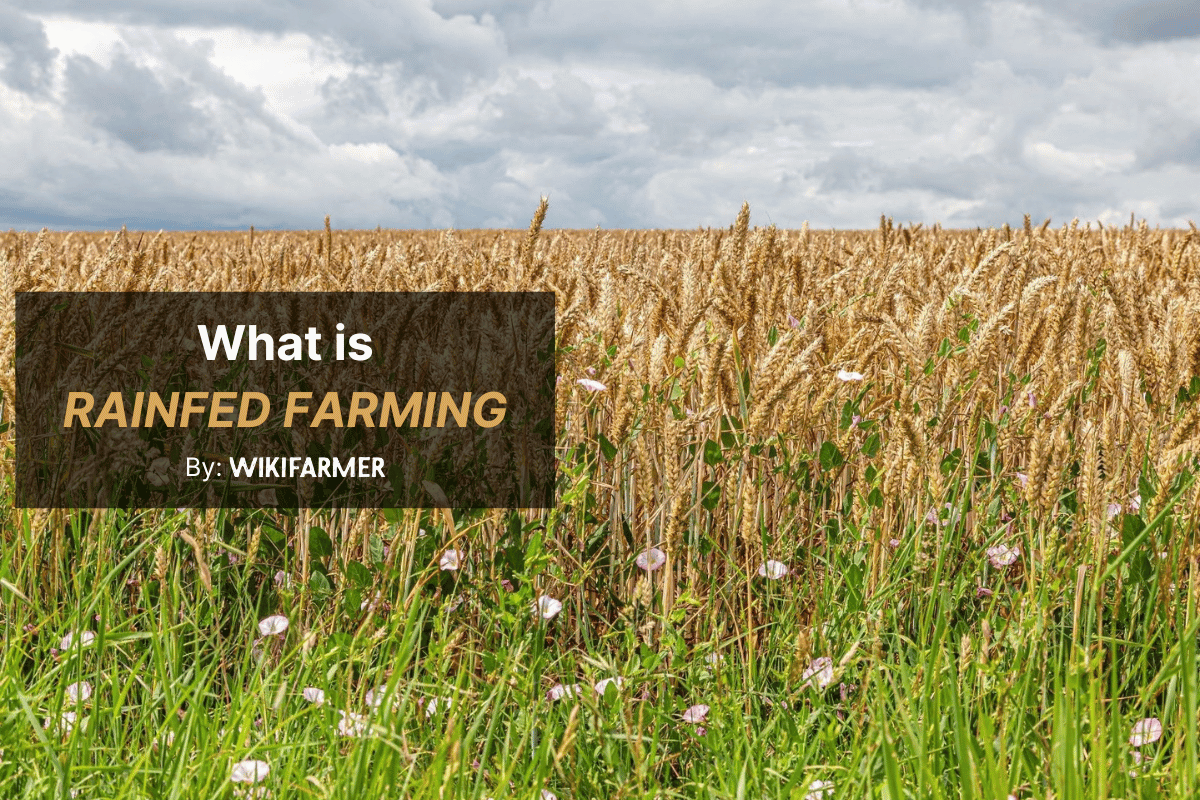
Rainfed farming is agriculture that depends entirely on natural rainfall to meet crop water needs, without supplemental irrigation. It covers the majority of the world's cropland and produces a large share of global food, yet receives far less investment and research attention than irrigated agriculture.
As of 2023, approximately 77% of the world's 1.6 billion hectares of cropland is rainfed, with only 23% equipped for irrigation (FAO, 2024). Despite this enormous land area, rainfed systems produce roughly 52% of global crop value, while irrigated land, on just 23% of the area, produces the other 48% (FAO, 2025). This productivity gap makes rainfed agriculture both the largest opportunity and the greatest vulnerability in global food security.
What is rainfed farming and why does it feed most of the world?
Rainfed farming means growing crops using only the water that falls as rain on the field, with no artificial water supply from rivers, wells, canals, or reservoirs. It includes both annual crops (cereals, pulses, oilseeds, vegetables) and perennial crops (fruit trees, coffee, tea, rubber).
The term is sometimes used interchangeably with "dryland farming," but the two are not identical. Dryland farming specifically refers to rainfed agriculture in semi-arid and arid regions where annual rainfall is typically below 500 mm. Rainfed agriculture also exists in humid and sub-humid zones where rainfall exceeds 1,000 mm per year but is unevenly distributed across the growing season. In both cases, the farmer has no control over the timing or quantity of water the crop receives, which makes soil moisture management and crop selection the two most critical decisions in rainfed systems.
How much of the world's food comes from rainfed agriculture?
Rainfed agriculture produces more than half of the world's food by value and more than 60% of the world's cereal grains (IWMI, 2007). In sub-Saharan Africa, approximately 95% of farmed land is rainfed. In South Asia, rainfed systems account for roughly 60% of the net sown area.
The productivity difference between rainfed and irrigated land is substantial. FAO's 2025 State of the World's Land and Water Resources report found that irrigated land is 3.2 times more productive than rainfed land in value terms, with irrigated yields averaging 76% higher than rainfed yields. In sub-Saharan Africa, rainfed crop yields reach only about 24% of their estimated attainable potential (FAO, 2025). This means that closing even a fraction of the yield gap on existing rainfed land could significantly increase food production without converting additional natural land to agriculture. Much of this production supports subsistence agriculture systems where farming families consume most of what they grow.
Which crops are grown under rainfed conditions?
Most of the world's staple food crops are grown under rainfed conditions in at least part of their global production area. The specific crops suited to rainfed farming depend on local rainfall patterns, soil type, temperature, and growing season length.
Cereals are the dominant rainfed crops globally. Millet, sorghum, and dryland maize are bred for low-rainfall environments and short growing seasons. Wheat and barley are widely grown as rainfed crops in temperate climates with reliable winter and spring rainfall. Even wheat irrigation requirements vary significantly by region, as many wheat-producing areas in Europe, Australia, and the Americas rely entirely on rainfall. Maize water requirements are higher, and rainfed maize yields are more vulnerable to mid-season drought.
Pulses and oilseeds such as chickpeas, lentils, cowpeas, soybeans, and groundnuts are well-suited to rainfed conditions because many species have deep root systems and can fix atmospheric nitrogen, reducing fertilizer needs.
Perennial crops including coffee, tea, rubber, cocoa, and many fruit trees are predominantly rainfed. The challenges of coffee cultivation in Africa are closely tied to changing rainfall patterns that affect flowering, berry development, and disease pressure.
What are the main challenges of rainfed farming?
The central challenge of rainfed farming is that the farmer cannot control the most important input: water. Rainfall variability between years, within seasons, and across small geographic distances creates uncertainty that affects every aspect of production planning.
Drought and dry spells are the primary yield-limiting factors. A two-week dry spell during flowering can reduce cereal yields by 30 to 50%, even in a year with adequate total rainfall. Climate change is intensifying this problem by shifting rainfall distributions, increasing the frequency of extreme events, and raising temperatures that accelerate crop water demand through evapotranspiration.
Soil degradation compounds water stress. Rainfed soils that have lost organic matter hold less moisture between rainfall events. FAO's 2025 report highlights that cropland degradation contributes directly to the yield gap, particularly on smallholder farms. Building soil organic matter through crop residue retention, composting, and cover cropping is one of the most effective ways to increase the water-holding capacity of rainfed soils.
Low investment is both a cause and a consequence of low yields. Because rainfed farming is riskier and less productive per hectare, it attracts less credit, less infrastructure, and less research funding than irrigated agriculture. This creates a cycle where farmers cannot afford the inputs (improved seed, fertilizer, soil amendments) that would close the yield gap.
How can farmers improve rainfed crop yields?
Improving rainfed productivity requires managing "green water" (soil moisture from rainfall) more effectively, rather than relying solely on "blue water" (rivers, reservoirs, and groundwater used for irrigation). Practical management strategies include:
Soil moisture conservation through mulching, minimum tillage, and contour plowing reduces evaporation and surface runoff, keeping more rainfall in the root zone. In semi-arid environments, tied ridges and micro-catchments concentrate rainfall around individual plants.
Crop selection and variety matching to local rainfall is essential. Short-duration varieties allow farmers to complete the crop cycle within the reliable rainfall window. Drought-tolerant varieties of maize, sorghum, and common bean bred by CGIAR centers are now available in many rainfed regions.
Crop diversification and rotation with legumes improves soil nitrogen status, breaks pest cycles, and spreads risk across crops with different water requirements. Intercropping cereals with pulses or oilseeds is a common rainfed strategy in sub-Saharan Africa and South Asia.
Supplemental irrigation from small-scale water harvesting (farm ponds, check dams, rooftop collection) can bridge critical dry spells during flowering or grain filling without requiring full irrigation infrastructure. Even 50 to 100 mm of supplemental water at the right growth stage can increase rainfed cereal yields by 50% or more.
Nutrient management is often overlooked in rainfed systems. Soil nutrients, particularly nitrogen and phosphorus, are the single most important factor limiting yields in both prime and marginal rainfed lands (FAO, 2025). Even modest fertilizer applications, when timed correctly, produce significant yield responses on rainfed soils.
What is the yield gap in rainfed agriculture?
The yield gap is the difference between what a crop currently produces and what it could produce under optimal management in the same location and climate. For rainfed agriculture globally, this gap is enormous and represents one of the largest untapped opportunities for increasing food production.
FAO's global assessment using GAEZ v5 data found that cereal yields on rainfed land average slightly above 50% of estimated attainable yields, corresponding to a gap of approximately 2,200 kg per hectare (FAO, 2025). Oil crops perform better at about 65% of attainable yields, while roots and tubers reach approximately 50%. The gap is largest in sub-Saharan Africa and parts of South Asia, where it commonly exceeds 60 to 70%.
Closing even one-third of the rainfed yield gap for cereals would produce tens of millions of additional tonnes of grain annually without expanding cropland. This is why rainfed agriculture is increasingly central to food security strategies, climate adaptation plans, and land use policies that seek to produce more food on existing farmland rather than converting forests and grasslands.
Frequently asked questions
What is the difference between rainfed and irrigated farming? Rainfed farming relies entirely on natural rainfall. Irrigated farming uses water from external sources (rivers, wells, canals, reservoirs) delivered to fields through infrastructure such as canals, pipes, or drip systems. About 77% of global cropland is rainfed and 23% is irrigated.
Is rainfed farming the same as dryland farming? Not exactly. Dryland farming is a subset of rainfed agriculture that specifically refers to cropping in semi-arid and arid regions (typically below 500 mm annual rainfall). Rainfed agriculture also occurs in sub-humid and humid zones with higher total rainfall.
Can rainfed farming be profitable? Yes. Profitability depends on crop selection, soil management, and market access. In regions with reliable rainfall of 600 mm or more, rainfed wheat, maize, pulses, and oilseeds can be commercially viable. Lower-rainfall zones require drought-tolerant varieties and soil moisture conservation techniques to reduce risk.
What is green water in agriculture? Green water is the soil moisture that comes directly from rainfall and is used by plants through root uptake and transpiration. It is distinct from blue water, which is water in rivers, lakes, and aquifers used for irrigation. Rainfed agriculture depends entirely on green water.
References
- FAO. (2024). FAO Statistical Yearbook 2024: World Food and Agriculture. FAO.
- FAO. (2025). The State of the World's Land and Water Resources for Food and Agriculture 2025. FAO.
- IWMI. (2007). Water for Food, Water for Life: A Comprehensive Assessment of Water Management in Agriculture. International Water Management Institute.
- FAO. (2024). Land statistics 2001 to 2023: Global, regional and country trends. FAO.