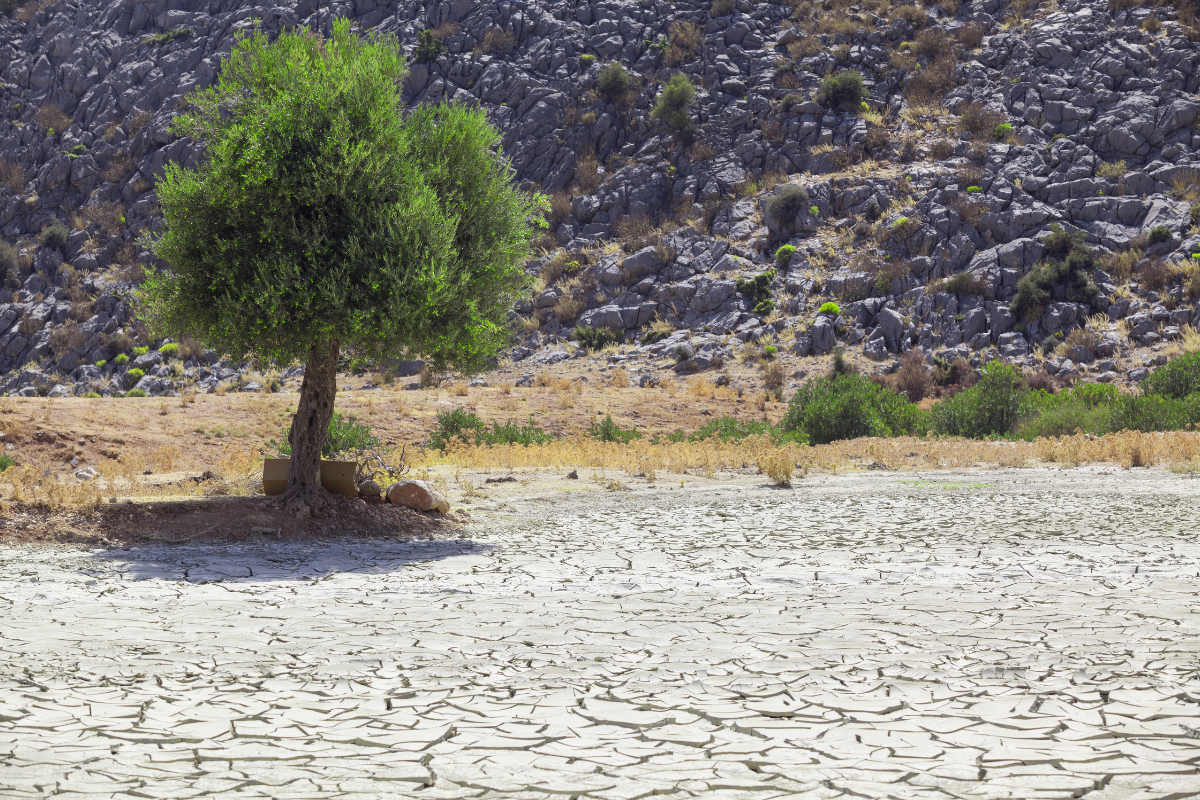
Olive leaves tolerate water potentials that would kill most annual and perennial crops, and the tree was domesticated on shallow, sloping soils with hot summers and little rain, where other crops could not grow. Greek olive varieties still differ considerably, and drought tolerance does not guarantee a good crop without water, because the tree survives easily, while flowering and fruit set are the first to pay for water shortage.
How the olive tree copes with water shortage
Olive stomata sit only on the underside of the leaf, shielded from excess radiation by hairs, and the leaf can turn to a more vertical angle to intercept less sun. When the water potential gap between leaf and soil exceeds a safe limit, the stomata close, keeping the tree hydrated enough to continue photosynthesis even in severe drought, a regulation that works well under mild to moderate stress and less effectively under severe stress.
The xylem vessels are narrow and interconnected, which makes embolism less likely and allows water to bypass a vessel that stops functioning. The roots spread through the upper soil layers to use light, infrequent rain and quickly redistribute active roots to wherever water is. After months of dry soil, they absorb water as soon as it rains.
Drought costs most at flowering and fruit set
Intense drought can cost most of the flowers or fruit, and water stress in summer and early autumn, when flower induction takes place, affects flowering the following year. The early stages of fruit growth, by contrast, tolerate moderate stress without reducing future oil accumulation, and autumn rains bring rapid recovery.
When heat is added to drought, pollen germination and fruit set decline above 30°C and flowers can die outright above 35°C, with Koroneiki and Kalamon relatively tolerant but still damaged beyond that limit. In a rainfed grove, a little water at the critical stages is worth more than the same water at another time of year, and the practical side of summer stress is covered in protecting olive trees from heat and drought.
Koroneiki and Chalkidikis stand out in the International Olive Council catalogue
In the International Olive Council catalogue, the only Greek cultivars rated tolerant to drought are Koroneiki and Chalkidikis, while Amfissis and Tsounati are classed as moderately tolerant. The catalogue also notes that cultivars from arid regions generally adapt better, but that the traits behind drought tolerance remain unclear because they depend on which cultivars each study compares.
In a Greek experiment with intermittent drought, Koroneiki and Mastoidis maintained cell turgor equally. Still, Koroneiki photosynthesised more with less open stomata, using water more efficiently, which the researchers attributed to differences in leaf anatomy.
Sources do not fully agree on Chalkidikis: while the International Olive Council rates it as tolerant, other descriptions, including the article on the Chalkidiki olive, call it moderately tolerant of drought.
Cultivars of the rainfed groves of the Peloponnese and Attica
The Agricultural University of Athens rates Kothreiki as tolerant of cold, wind and drought, and in Troizinia, where Manaki is the main cultivar, only 25% of groves are irrigated.
Megaritiki is often grown without irrigation in Attica and Corinthia, and the Greek agricultural press describes it as highly tolerant of drought. Neither cultivar appears in the International Olive Council table, so their reputation rests on the university description and a long tradition of rainfed growing rather than on comparative trials. In a rainfed grove, their yields follow each season's rainfall in any case.
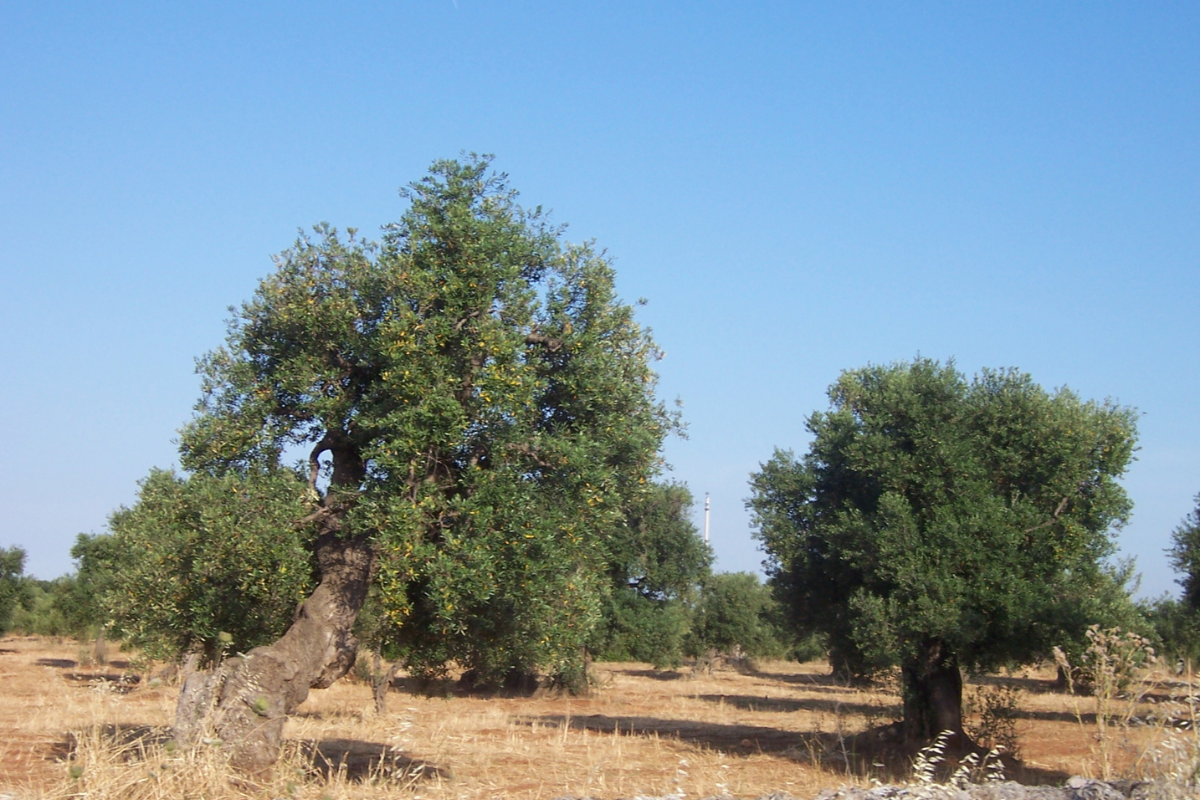
In a rainfed grove, yields follow each season's rainfall.
Three cultivars need soil moisture
Kalamon needs areas with high rainfall and humidity. It is often grown without irrigation in the Peloponnese. Still, because table olive prices follow fruit size, water shortage shows up on the scales and in the size grade, which is why growers often irrigate heavily.
Lianolia Kerkyras, which forms the tallest trees of the Ionian Islands, also needs soil moisture. Throumbolia does not fruit satisfactorily in hot, dry areas or in years of prolonged drought without irrigation, and it needs deep, fertile soils.
Drought tolerance and frost tolerance rarely go together
Picual and Leccino, which the International Olive Council lists as frost-tolerant, appear in the same catalogue as sensitive to drought, together with the Portuguese Cobrançosa and Cordovil de Serpa and the Tunisian Meski. Koroneiki sits at the opposite end, tolerant of drought but sensitive to cold.
The catalogue's drought-tolerant cultivars also include Arbequina, Cornicabra, and Hojiblanca from Spain; Chemlali Sfax from Tunisia; Souri from the eastern Mediterranean; Memecik from Türkiye; and Carolea from Italy. Arbequina and Cornicabra are among the few listed as tolerant of both drought and frost, although Arbequina's behaviour in cold varies greatly from site to site.
Saline water limits irrigation near the coast
Where drought is met with water from seaside boreholes, salinity becomes the second constraint. Olive is considered moderately salt-tolerant and grows with only a small yield loss in soils with a saturated-extract electrical conductivity of 4 to 6 dS/m. It can be irrigated with water of up to 5 dS/m, or up to 10 dS/m in tolerant cultivars. High-frequency drip irrigation, enough water to leach salts below the root zone and calcium added to the irrigation water allow saline water to be used without loss of growth or yield.
Among Greek cultivars, the same catalogue rates Kalamon as tolerant, Amfissis, Koroneiki, and Mastoidis as moderately tolerant, and Chalkidikis as sensitive. In a trial with six Greek cultivars irrigated with salt concentrations up to 200 mM sodium chloride, Kalamon showed no injury, Kothreiki and Megaritiki showed only a few symptoms at the highest level. At the same time, Koroneiki, Amfissis and Mastoidis developed leaf tip burn from 100 mM.
How Greek cultivars compare
| Cultivar | Drought | Salinity |
| Koroneiki | Tolerant | Moderately tolerant |
| Chalkidikis | Tolerant to moderate | Sensitive |
| Kothreiki or Manaki | Tolerant | Few symptoms |
| Megaritiki | Often rainfed | Few symptoms |
| Amfissis | Moderately tolerant | Moderately tolerant |
| Tsounati or Mastoidis | Moderately tolerant | Moderately tolerant |
| Kalamon | Needs moisture | Tolerant |
| Lianolia Kerkyras | Needs moisture | No data |
| Throumbolia | Needs moisture | No data |
Sources: International Olive Council, drought and salinity tolerance tables. Chartzoulakis et al., 2002, for salinity in Kothreiki and Megaritiki. Agricultural University of Athens and Wikifarmer articles on cultivar moisture requirements.
Important notes
The International Olive Council classifications are overall assessments drawn from many studies, and the catalogue itself notes that results depend on which cultivars are compared. How a grove behaves in drought also depends on soil depth and texture, tree age, crop load, and the distribution of rainfall throughout the year. Before planting or using saline water, soil and water analyses and advice from a local agronomist provide a safer picture than any general ranking.
Sources
- Agricultural University of Athens, Roussos, P. Classification of olive cultivars by fruit size. Laboratory notes (in Greek).
- Chartzoulakis, K., Loupassaki, M., Androulakis, I. (2002). Comparative study on NaCl salinity tolerance of six olive cultivars. Acta Horticulturae, 586, 497-502.
- Chartzoulakis, K., Patakas, A., Bosabalidis, A. M. (1999). Changes in water relations, photosynthesis and leaf anatomy induced by intermittent drought in two olive cultivars. Environmental and Experimental Botany, 42, 113-120.
- International Olive Council. Drought, World Catalogue of Olive Varieties.
- International Olive Council. High temperatures, World Catalogue of Olive Varieties.
- International Olive Council. Salinity, World Catalogue of Olive Varieties.
- Official Journal of the European Union (2006). Troizinia extra virgin olive oil PDO, summary of the registration application. C 128/11 (in Greek).
- Oikonomikos Tachydromos (2022). Olive cultivars with distinctive traits and their oil yields (in Greek).