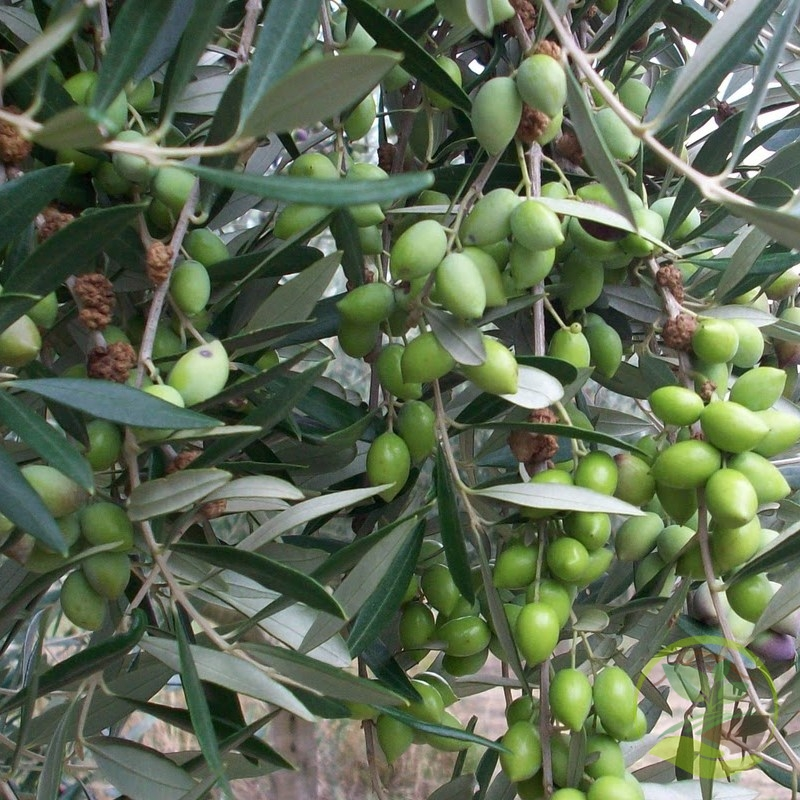
Megaritiki, Olea europaea var. argentata, is the dominant olive cultivar in Attica and is also widespread across the Peloponnese. It is a dual-purpose cultivar whose fruit is cured as cracked green olives or canned, and pressed for an oil with a fatty acid profile unlike that of the other major Greek cultivars.
Names and synonyms used for the cultivar
The OleaDB olive germplasm database records Megaritiki under the synonyms Ladolia, Perachoritiki, Megaron, and Vovoditiki, and notes that it is grown in Attica, Boeotia, Corinthia, Aigialeia, Kynouria, and around Nafplio. Greek agricultural press adds the local names Chourmadolia and Kalolia. In the nursery trade, the most common name is "Megara olive", after the town of Megara in West Attica. The spelling Megareitiki is also in use.
The name Ladolia points to three different cultivars.
In the laboratory notes of the Agricultural University of Athens, Ladolia appears as a synonym for three cultivars: Megaritiki, Koroneiki, and Lianolia Kerkyras. The three have little in common. Koroneiki is a small-fruited oil cultivar that suffers from frost; Lianolia Kerkyras grows into trees of 12 to 14 metres in the Ionian Islands; and Megaritiki is a medium-fruited dual-purpose tree. If you ordered young trees sold as Ladolia, please confirm the cultivar is Megaritiki or Megaron and check where the nursery sourced its material.
Fruit and tree characteristics
The Agricultural University of Athens places Megaritiki in its medium-fruited class (2.7 to 4.2 grams per fruit) and describes a cylindro-conical, curved fruit with a visible nipple. The flesh-to-pit ratio reaches 9 to 1, the highest among the medium-fruited cultivars in the same notes, and the pit is club-shaped, narrow at the base, curved and marked by ten grooves. That high share of flesh is why the cultivar is favoured for cracked green and crushed black olives, where the flesh is the product.
The tree reaches 5-8 metres.
How much oil does the fruit yield
The Agricultural University of Athens gives Megaritiki an oil content of 21% by weight, with good-quality oil, which works out to a little under five kilograms of olives per kilogram of oil in theory. Mill yields are usually lower because mechanical extraction does not recover all the oil, and oil content varies with ripeness.
Greek agricultural press and nursery catalogues quote higher figures, with oil content around 25% by weight that reaches 30% under more intensive management. These figures don't include a measurement method, a ripeness stage, or a statement about whether they refer to fresh fruit, so they cannot be directly compared with the university's 21%. Oil content rises as fruit ripens and loses water. It varies with irrigation and season, which makes the mill's own records across several harvests the most reliable guide for a given grove.
There is no official literature with per-tree yield measurements for Megaritiki. The figures in circulation come from the experience of growers in Attica and Corinthia and vary widely with tree age, irrigation and season, as they do for Koroneiki yield per tree.
What defines Megaritiki olive oil
In 199 virgin olive oil samples from four Greek cultivars, researchers at the Agricultural University of Athens measured the lowest oleic acid in Megaritiki oil, 65.81% on average, against 74.70% for Koroneiki and 75.36% for Amfissis. The gap is wide enough for the fatty acid profile to separate Megaritiki oil from the others, which helps authenticate the single-variety Megaritiki oils now on the market.
A comparison of Koroneiki and Megaritiki at different ripeness stages found that ripening lowered phenolic compounds and tocopherols in the oil of both cultivars, while milling pitted fruit raised phenolic content without materially changing the fatty acid profile. Harvesting earlier, therefore, gives an oil richer in phenolics, at the cost of less oil per kilogram of fruit.
When the fruit is harvested
Megaritiki has no PDO specification or other official text setting harvest dates, so timing follows the intended use. For cracked olives, the fruit is picked green, before it starts to change colour, and for crushed black olives, it is picked ripe. For oil, the grower chooses between the higher oil quantity of ripe fruit and the higher phenolic content of earlier fruit. Exact dates move with location, altitude and season, and across Greek olive groves the harvest runs from late September for early oil to as late as March. Fruit meant for the table needs careful handling at picking, since bruised olives lose value as cured product.
In Schimatari, growers of Megaritiki and Evias harvest in the second half of October, since even a two-week delay can raise acidity by 0.2%, and the indices that set the date, from skin colour to micro oil extractions, are covered in the guide to harvesting olives.
How Megaritiki compares with Koroneiki and Manaki
| Trait | Megaritiki | Koroneiki | Manaki |
| Use | Cracked and canned olives, oil | Oil | Oil, black canned olives |
| Fruit class | Medium | Small | Large, 4.7 grams |
| Oil content | 21% | 27% | 20% |
| Flesh to pit | 9 to 1 | 6.6 to 1 | 5.7 to 1 |
| Oleic acid | 65.81% | 74.70% | 70.15% |
| Cold | Tolerant | Sensitive | Tolerant |
| Mortality after artificial Verticillium inoculation | 80% | 0% | 100% |
Sources: Agricultural University of Athens, olive cultivar laboratory notes. Revelou et al., 2021. Markakis et al., 2022.
The three cultivars share groves in Attica, Corinthia and Argolis. Manaki, or Kothreiki, matches Megaritiki for cold tolerance, while Megaritiki stands apart for the flesh of its fruit and its suitability for cracked olives.
Growing conditions the cultivar tolerates
The Agricultural University of Athens rates Megaritiki as tolerant of cold, which lets it grow in the foothill zones of Attica, Boeotia and Corinthia where Koroneiki risks frost damage. Greek agricultural press also describes it as highly tolerant of drought and suited to unirrigated groves, and very productive with basic care, although yields in a dryland grove follow the season's rainfall.
Olive fly and Verticillium wilt are the main weaknesses
Wikifarmer's Greek-language cultivar overview describes Megaritiki as sensitive to olive fruit fly, a weakness that costs more for cracked olives, where each sting downgrades the fruit. Trap monitoring and treatments with approved insecticides belong in the grove's standing programme.
In an evaluation at the Institute of Olive Tree, Subtropical Crops and Viticulture of ELGO-DIMITRA, where young plants of ten cultivars were artificially inoculated with Verticillium dahliae, 80% of Megaritiki plants died within 140 days, compared with 100% for Kothreiki and none for Koroneiki. Symptoms in Megaritiki appeared later than in most cultivars, with the sharp rise recorded between days 90 and 130, and vascular colonisation by the fungus was intermediate, so on the cumulative stress index the cultivar ranked as intermediate, sixth of ten.
Artificial inoculation is harsher than field exposure. The result is still reason enough to keep Megaritiki off land with a history of Verticillium wilt or with a record of cotton, cucurbits, eggplant, peppers, potato or tomato.
Important notes
The figures on fruit, oil and tolerances come from specific studies, regions and seasons and are indications rather than guarantees. How the cultivar performs depends on soil, altitude, exposure, irrigation and tree age, so a new planting should be discussed with a local agronomist and started from certified nursery stock that guarantees varietal identity.
Where Verticillium wilt or another serious disease is suspected, an agronomist should confirm the diagnosis. Non-chemical methods come first, and any chemical treatment should use only products approved for olive, applied according to the label.
Sources
- Katsoyannos, E., Batrinou, A., Chatzilazarou, A., Bratakos, S. M., Stamatopoulos, K., Sinanoglou, V. J. (2015). Quality parameters of olive oil from stoned and nonstoned Koroneiki and Megaritiki Greek olive varieties at different maturity levels. Grasas y Aceites, 66(1), e067.
- Markakis, E. A., Krasagakis, N., Manolikaki, I., Papadaki, A. A., Kostelenos, G., Koubouris, G. (2022). Evaluation of olive varieties resistance for sustainable management of Verticillium wilt. Sustainability, 14(15), 9342.
- Revelou, P.-K., Xagoraris, M., Alexandropoulou, A., Kanakis, C. D., Papadopoulos, G. K., Pappas, C. S., Tarantilis, P. A. (2021). Chemometric study of fatty acid composition of virgin olive oil from four widespread Greek cultivars. Molecules, 26(14), 4151.
- Roussos, P. Classification of olive cultivars by fruit size. Laboratory notes, Agricultural University of Athens (in Greek).
- OleaDB. Cultivar Megaritiki, cultivation areas and synonyms.
- Oikonomikos Tachydromos (2022). Olive cultivars with distinctive traits and their oil yields (in Greek).
- UC Statewide IPM Program. Verticillium wilt, olive, pest management guidelines. University of California Agriculture and Natural Resources.