Manaki is the name growers in Corinthia, Argolis and Arcadia use for an olive cultivar that the scientific literature records as Kothreiki, Olea europaea var. minor rotunda, and that is widespread across the Peloponnese. It is a dual-purpose cultivar, pressed for oil and cured as black table olives. It tolerates cold better than Koroneiki, and it is the base cultivar of three Protected Designation of Origin (PDO) olive oils in Argolis and the Saronic Gulf.
Names and synonyms used for the cultivar
Laboratory teaching material from the Agricultural University of Athens lists Manaki, Glykomanako and Manakolia as synonyms of Kothreiki. In practice, Manaki is what farmers and mill operators in the eastern Peloponnese call the tree. At the same time, Kothreiki appears in research papers and in nursery catalogues, where the two names are often printed together as "Manaki-Kothreiki". Ordering young trees under both names reduces the chance of receiving the wrong material.
Agouromanako is a separate cultivar
Agouromanakolia, also sold as Agouromanako, grows in the same parts of Corinthia and Argolis, and the shared root of the name means the two are regularly treated as one, even in local press coverage. The Agricultural University of Athens describes it as a distinct medium-fruited, late-ripening cultivar with oil content of around 30% by weight and a flesh-to-pit ratio of 6 to 1, compared with 20% and 5.7 to 1 for Kothreiki. A 10-point gap in oil content changes the yield projection for an entire orchard, so buyers planning a new planting should ask the nursery for Kothreiki by name.
Where Manaki has grown
The cultivar is found throughout the Peloponnese, with the largest concentration in Corinthia, Argolis and Arcadia. In the Saronic Gulf, it is the main cultivar of Troizinia, the area covering Methana, Poros and Troizina, which is also the delimited zone of the Troizinia PDO oil.
Its cold tolerance lets it climb into foothill zones where Koroneiki struggles with frost, and Wikifarmer's Greek-language cultivar overview often places it above 700 metres. At even higher elevations, the usual choice is Tsounati, which is grown up to 1,000 metres.
Fruit and tree characteristics
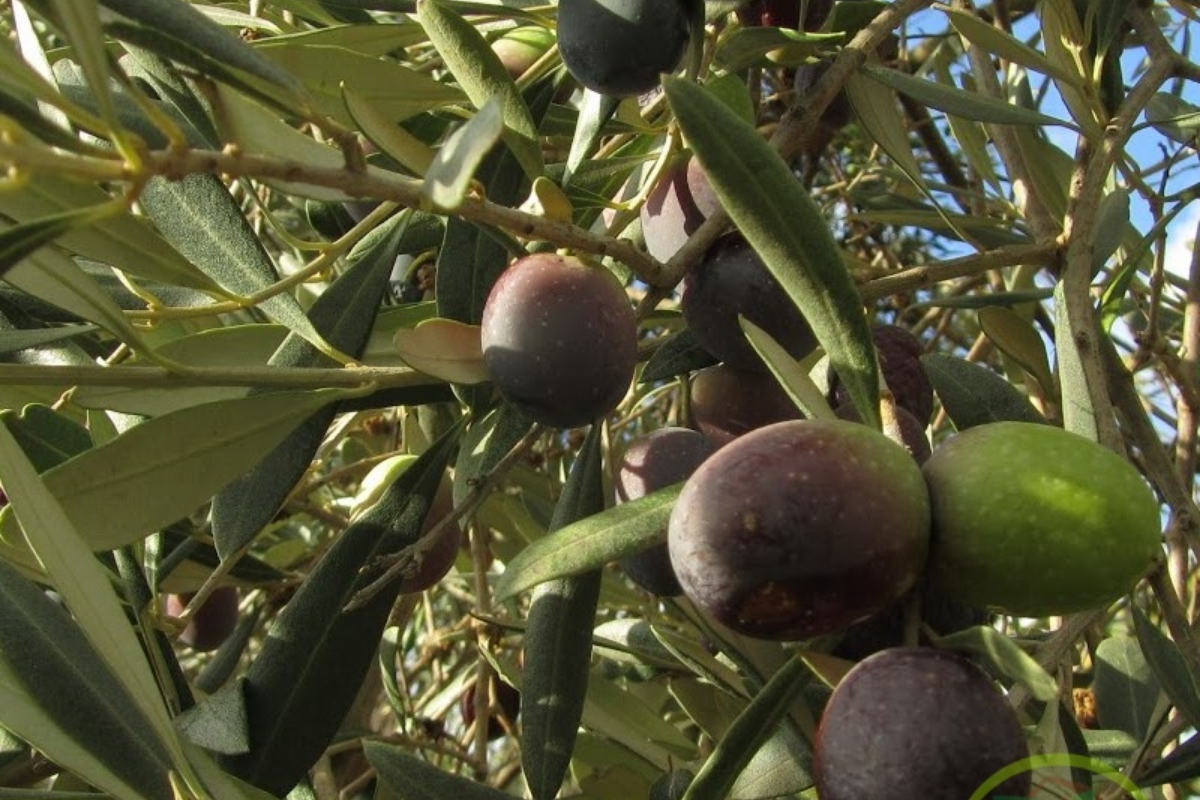
The fruit is ovoid to spherical, with an average weight of 4.7 grams and a flesh-to-pit ratio of 5.7 to 1, and the pit is cylindrical, pointed and marked by seven grooves. At that weight, the university places Kothreiki at the bottom of its large-fruited class, which starts at 4.3 grams. Other Greek sources call it medium-fruited, and a cooperative publication gives fruit of just 2.2 to 2.9 grams. With figures this far apart, describing the cultivar as dual-purpose is more useful than assigning it to a size class.
The tree reaches 5 to 7 metres and is self-fruitful, according to a comparison of flowering and self-pollination in twelve Greek cultivars. It therefore sets fruit in single-cultivar blocks without depending on a polliniser.
When the fruit is harvested
Kothreiki ripens slowly, and the Troizinia PDO specification sets harvest from November, when the fruit is still slightly unripe, through February, with the bulk picked in December and January. Most fruit is picked once the skin turns from green to violet-black, and it is not left to over-ripen on the tree, because overripe olives lose weight and volume, the oil loses aroma, and its acidity rises.
Koroneiki is picked from mid-October with a peak in November, so in groves with both cultivars, Manaki comes in one to two months later. Across Greek olive groves the season runs from late September for early-harvest oil to as late as March. Harvesting in Troizinia is traditionally done with hand-held combs and occasionally by hand, and the fruit reaches the mill on the day of picking in breathable jute sacks. For table use, the university classes Kothreiki among cultivars for black canned olives, which are picked fully ripe once the fruit has reached its final dark colour.
In Troizina, one grower who picks Manaki early, from 10 to 20 October, has to raise the vibration of his pneumatic harvesters because unripe fruit holds on strongly, and the indices that set the date, from skin colour to fruit detachment force, are covered in the guide to harvesting olives.
How much oil does the fruit yield
At 20% oil by fresh weight, five kilograms of olives would, in theory, give one kilogram of oil. Actual mill yields are usually lower because mechanical extraction does not recover all the oil in the fruit and because oil content shifts with ripeness. The same source gives 27% for Koroneiki, so an equal weight of Manaki fruit produces less oil.
There is no official literature with per-tree yield measurements for Kothreiki. The figures in circulation come from the experience of growers and nurseries in the eastern Peloponnese, who know from years of harvests what their trees produce, and they vary widely between groves with tree age, irrigation and alternate bearing, in the same way as for Koroneiki yield per tree.
What defines Manaki olive oil
In 199 virgin olive oil samples from four Greek cultivars, researchers at the Agricultural University of Athens measured an average of 70.15% oleic acid and 13.35% linoleic acid in Manaki oil, the highest linoleic acid value of the four, compared with 74.70% and 6.70% for Koroneiki. The study used the fatty acid profile to distinguish oils by cultivar, a useful approach for authenticating single-variety oils. Linoleic acid is polyunsaturated and oxidises more readily than oleic acid, so Manaki oil benefits from careful storage away from light, heat and air.
The Troizinia specification describes Manaki-based oil as yellow to greenish-yellow depending on fruit ripeness, with a taste built on sweetness or bitterness, a bitterness that fades over a few months, and a fresh-cut fruity aroma.
Three PDO olive oils rest on Manaki.
Lygourio Asklipiiou was recognised by ministerial decision in 1993 and registered in the EU as part of the first batch of Greek names in 1996. It covers extra-virgin olive oil from Manaki, grown within the former municipality of Asklipieio in Argolis.
Troizinia, registered in 2007, allows oil from Manaki alone, or with up to 50% Koroneiki. Kranidi Argolidas is produced in Ermionida, where a local packer reports the PDO oil at 80% Manaki and 20% Koroneiki.
For new plantings within these zones, the cultivar determines whether the oil can be sold under the PDO label, because each specification defines the varietal makeup. The Greek Ministry of Rural Development and Food keeps the full list of olive oil PDOs and their specifications.
How Manaki compares with Koroneiki
| Trait | Manaki (Kothreiki) | Koroneiki |
| Use | Oil and black table olives | Oil |
| Average fruit weight | 4.7 grams | Below 2.6 grams |
| Oil content | 20% | 27% |
| Flesh to pit | 5.7 to 1 | 6.6 to 1 |
| Oleic and linoleic acid | 70.15% and 13.35% | 74.70% and 6.70% |
| Cold | Tolerant | Sensitive |
| Main harvest | December and January | October and November |
| Mortality after artificial Verticillium inoculation | 100% | 0% |
Sources: Agricultural University of Athens, olive cultivar laboratory notes. Revelou et al., 2021. Markakis et al., 2022. Official Journal of the EU, C 128/2006.
Growing conditions the cultivar tolerates
The Agricultural University of Athens rates Kothreiki as tolerant of cold, wind and drought, and in Troizinia, the PDO specification records that only 25% of groves are irrigated by hose, drip or sprinkler.
Nutrition differs from Koroneiki. In a pot trial with young rooted cuttings on three contrasting soils, Kothreiki produced more biomass, took up more manganese, iron and zinc per plant, and held 74 to 80% of its manganese in the roots, against 44 to 56% for Koroneiki. The authors interpret root retention as a possible protective mechanism in manganese-rich soils, while the lower manganese and iron use efficiency they measured indicates that the plant needs more of both nutrients for the same growth. Because the results come from potted plants rather than bearing trees, orchard nutrition is best set by leaf analysis.
Verticillium wilt is the cultivar's main weakness
In an evaluation at the Institute of Olive Tree, Subtropical Crops and Viticulture of ELGO-DIMITRA in Chania, young plants of ten cultivars were inoculated by dipping their roots in a Verticillium dahliae conidial suspension and followed for 140 days. All 25 Kothreiki plants were infected and died, compared with 84% mortality in Amfissis and 96% in Chalkidikis, while Koroneiki lost none. On a cumulative stress index that combines plant height, weight, and survival, Kothreiki ranked intermediate, fifth among the ten cultivars.
Root-dip inoculation at high inoculum pressure is harsher than field exposure. The result is still reason enough to keep Manaki off land with a history of Verticillium wilt or with a record of susceptible crops such as cotton, cucurbits, eggplant, peppers, potato or tomato.
No comparative data from a research body were found for Kothreiki's response to olive fruit fly, peacock spot or olive knot, so the cultivar calls for the same routine monitoring as any grove.
Important notes
The figures on fruit, oil and tolerances come from specific studies, regions and seasons and are indications rather than guarantees. How the cultivar performs depends on soil, altitude, exposure, irrigation and tree age, so a new planting should be discussed with a local agronomist and started from certified nursery stock that guarantees varietal identity.
Where Verticillium wilt or another serious disease is suspected, an agronomist should confirm the diagnosis. Non-chemical methods come first, and any chemical treatment should use only products approved for olive, applied according to the label.
Sources
- Chatzistathis, T., Therios, I., Alifragis, D. (2009). Differential uptake, distribution within tissues, and use efficiency of manganese, iron, and zinc by olive cultivars Kothreiki and Koroneiki. HortScience, 44(7), 1994-1999.
- Dimassi, K., Therios, I., Balatsos, A. (1999). The blooming period and self-fruitfulness in twelve Greek and three foreign olive cultivars. Acta Horticulturae, 474, 275-278.
- Markakis, E. A., Krasagakis, N., Manolikaki, I., Papadaki, A. A., Kostelenos, G., Koubouris, G. (2022). Evaluation of olive varieties resistance for sustainable management of Verticillium wilt. Sustainability, 14(15), 9342.
- Revelou, P.-K., Xagoraris, M., Alexandropoulou, A., Kanakis, C. D., Papadopoulos, G. K., Pappas, C. S., Tarantilis, P. A. (2021). Chemometric study of fatty acid composition of virgin olive oil from four widespread Greek cultivars. Molecules, 26(14), 4151.
- Roussos, P. Classification of olive cultivars by fruit size. Laboratory notes, Agricultural University of Athens (in Greek).
- Official Journal of the European Union (2006). Troizinia extra virgin olive oil PDO, summary of the registration application. C 128/11 (in Greek).
- Greek Ministry of Rural Development and Food. Olive oil and table olive PDO and PGI names and specifications (in Greek).
- Greek Government Gazette 871/B/1993. Recognition of the designation of origin Lygourio Asklipiiou (in Greek).
- UC Statewide IPM Program. Verticillium wilt, olive, pest management guidelines. University of California Agriculture and Natural Resources.
- Ypaithros Chora (2021). Kranidi PDO olive oil holds its value (in Greek).
- Union of Agricultural Cooperatives of Agrinio (2022). Main Greek olive cultivars (in Greek).