
Where Koroneiki stops, Tsounati begins. Above 400 metres of altitude, where frost makes Greece's dominant variety unviable, Tsounati grows normally and reaches as high as 1,000 metres, an elevation at which no other Greek variety performs.
Before getting into how it manages that, a naming problem needs to be resolved, because it causes real confusion in the trade.
The same variety travels under seven names
This one variety circulates as Tsounati, Mastoidis, Athinolia, Matsolia, Mourtolia or Mouratolia, Matsa and Asprolia, depending on the region.
The identification comes from the work of agronomist and researcher Georgios Kostelenos, who has systematically catalogued the Greek varieties. The botanical name is Olea europaea var. mamillaris.
The practical problem arises in the nursery trade. A grower looking for "Athinolia" and a grower looking for "Tsounati" are asking for the same thing, often at different nurseries and different prices, without knowing it.
The second-oldest Greek variety
It ranks as the second-oldest olive variety in Greece, after Throumbolia of the Aegean, and the name Athinolia has its own origin. By tradition, this is the sacred cultivated olive that the goddess Athena gave to the Athenians, which they fenced, walled and protected.
Why does it withstand cold
Two characteristics work together to explain its performance at altitude.
The first is physiological tolerance of the tissues to low temperatures, which lets it survive winters that would destroy Koroneiki. The second, and the more interesting from an agronomic standpoint, is the timing of flowering. Tsounati flowers after mid-May, considerably later than most Greek varieties. That delay means the flowers, which are the most vulnerable organs, appear once the spring frost period has passed. In upland areas, where late frost regularly destroys the bloom of other varieties, this characteristic separates a crop from total loss.
The fruit and the oil
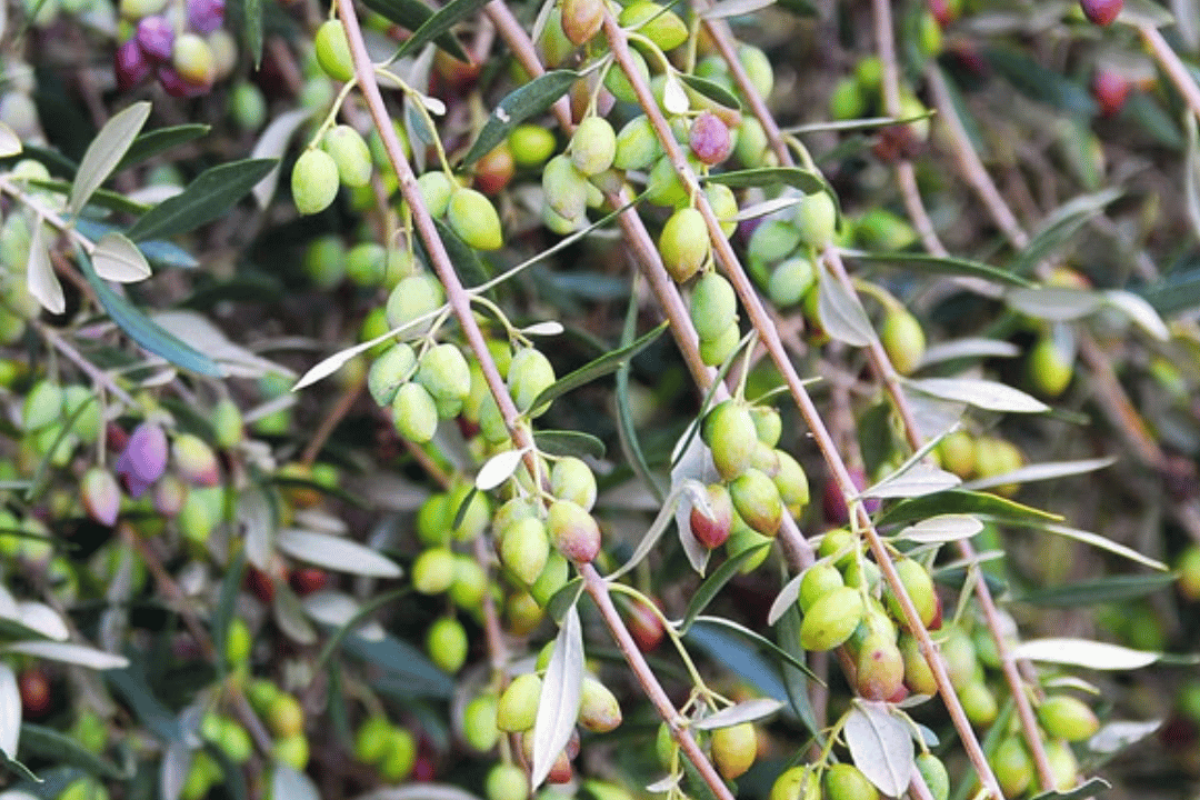
The fruit is small to medium, ovoid, somewhat lemon-shaped, and ending in a nipple-like protrusion, which is precisely where the name Mastoidis comes from. At full maturity, the colour turns black or purple-black.
Oil content is reported differently across sources, ranging from 20 to 35 per cent of fruit weight, a spread most likely attributable to differing measurement conditions and ripening stages. Even at the lower end, that represents a satisfactory yield.
Oil quality is where it excels. It is described as outstanding, with low acidity, a thin texture, and an amber colour, carrying a pronounced aromatic, fruity character. In practice, it is frequently used in blends with Koroneiki, at ratios ranging from 70 per cent Athinolia to 30 per cent Koroneiki. This combination yields high-quality oil with a distinctive fruity taste.
The tree and its requirements
The tree grows vigorously and reaches 10 metres in height, which directly bears on harvesting and pruning. The variety demands good soil and regular cultural care, fertilisation and weed control, unlike varieties that tolerate neglect. It is also susceptible to the olive fruit fly.
Alternate bearing runs strong
Its most serious drawback, and the reason average production is rated moderate, is the very pronounced alternate bearing. In practice, it is described as bearing fruit every second year, with the off year genuinely low rather than merely reduced.
Management rests on pruning, on fertilisation matched to the season's crop load, and on timely harvesting, since fruit left on the tree intensifies the effect for the following year.
When it is harvested
Ripening is rated late, with fruit reaching full maturity between December and January. In practice, however, harvest happens earlier for two distinct reasons.
In areas prone to early frost, picking starts from mid-November, so the fruit is not left exposed. The resulting oil is an outstanding early-harvest oil that keeps well enough to be consumed through the following April. For growers specifically targeting early-harvest oil, Tsounati ranks among the most suitable Greek varieties, as the quality of its early oil is typically high.
In a Chania grove at 500 to 700 metres, where centuries-old Tsounati trees grow alongside Koroneiki, harvest of both usually starts on 20 September, as the grower describes in when and how olives are harvested in Greece. How maturity indices set the date and how many kilograms of olives make a kilogram of oil is covered in harvesting olives.
Where it is grown
The variety concentrates in Crete and the Peloponnese. Specifically, it is recorded in the regional units of Rethymno and Chania on Crete, and in Laconia around Monemvasia, upper Messinia and Arcadia around Megalopoli.
What those areas share is altitude and a colder winter, which is to say precisely the conditions where Koroneiki struggles.
Notes
Oil content figures differ appreciably across sources and depend on the ripening stage, seasonal conditions, and measurement method. Altitude limits are a general framework and adjust to the microclimate of each site. Before establishing a new planting, consult a local agronomist and check how the variety performs in neighbouring groves under comparable conditions, since its requirement for good soil and regular care does not make it suitable for every position.
Sources
- Elaias Karpos. The ancient Tsounati variety.
- Gargalianoi Online. Mastoidis, the second oldest olive variety in Greece.
- National and Kapodistrian University of Athens. Olive varieties, Tsounati.