In late September, harvest begins in Chalkidiki that feeds the largest share of the Greek table olive industry. The Chalkidiki variety is picked green before the fruit ripens, and that early harvest is one of the traits that set it apart from other Greek varieties.
Half of Greek table olive production
Table olives of the Chalkidiki variety account for almost 50% of national production, around 116,300 tonnes a year, with a strong export orientation, since 92% is sold abroad. Greece is the second largest table olive producer in the European Union, with a 39% share of European production for the 2022 to 2023 period.
The overwhelming majority is processed as Spanish-style green olives, debittered in an alkaline solution and fermented in brine, while the registered specification also permits natural processing.
One PDO for two varieties
The name "Prasines Elies Chalkidikis" (Green Olives of Chalkidiki) was registered as a Protected Designation of Origin by Commission Implementing Regulation (EU) No 426/2012 of 22 May 2012, following an application submitted by Greece in 2006.
The PDO covers fruit from two varieties, Chondrolia Chalkidikis and Chalkidikis, both grown in Chalkidiki. The regulation describes large fruit with a high flesh-to-stone ratio, a bright green or greenish-yellow colour, a subtle fruity aroma, a somewhat bitter and spicy taste, and an absence of any oily sensation, traits it attributes to centuries of adaptation by the trees to the region's soil and climate.
Registration went through an intermediate stage. Belgium and a Canadian company lodged objections, and the agreement that followed added lactic and citric acid to the permitted preservatives and set a ceiling of 8.5% for the sodium chloride content of the brine. The same area also holds a separate PDO for olive oil, Agoureleo Chalkidikis.
The fruit and its flesh
The fruit usually weighs 6 to 10 grams, with an asymmetric ovoid shape, while the largest size grades exceed that range. Commercial grading is by number of fruit per kilo, from roughly 80 to 200 depending on the grade, with the largest usually destined for stuffing.
The stone separates easily from the flesh and stays slender relative to the mass of the fruit, which explains why the variety became established for pitting and stuffing rather than for oil. Oil content is rated medium. One further trait aids identification. At maturity the fruit does not turn fully black, unlike varieties such as Kalamon.
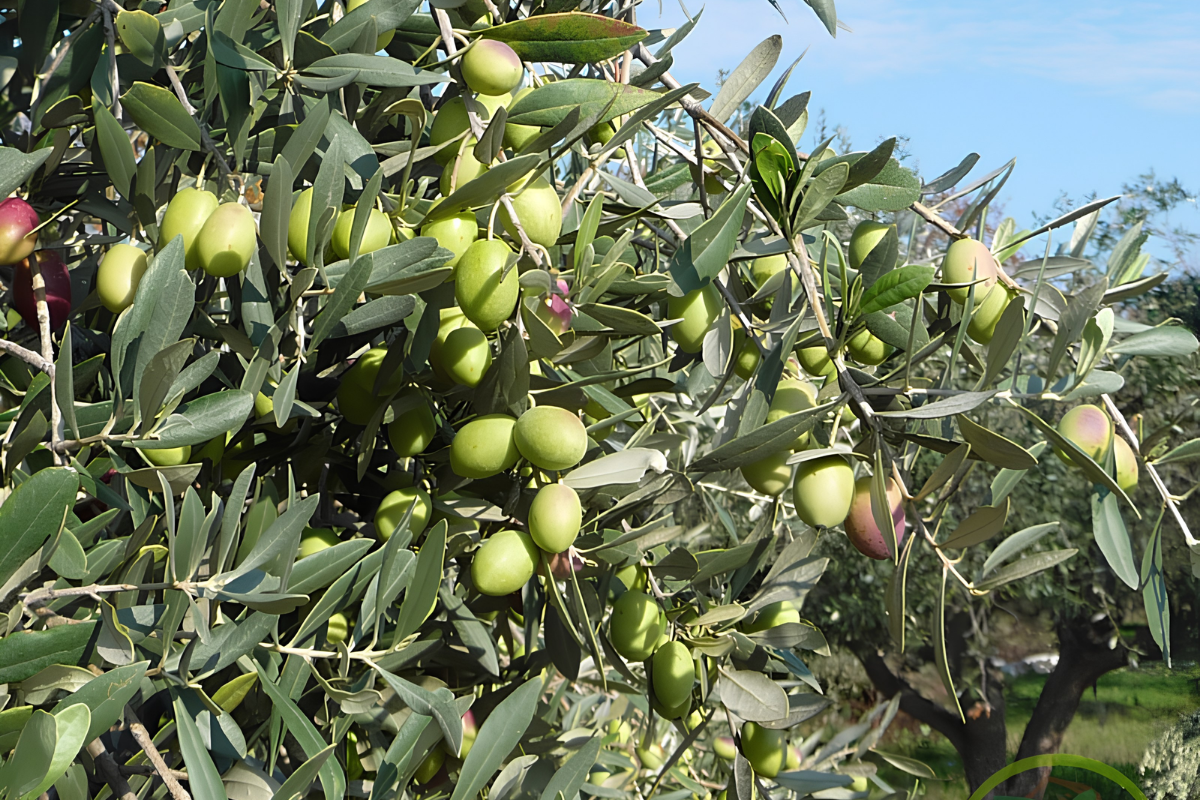
Olives on the tree at full size, still green, with only a few fruit beginning to change colour.
Harvest comes before the fruit ripens
For green table olives, fruit is picked once it has reached its final size while still holding its green or greenish-yellow colour, with harvest starting in late September and continuing through October. The International Olive Council catalogue classes the variety as early harvested, with medium fruit detachment resistance.
Picking for table use calls for more careful handling than harvesting for oil. Every knock or bruise shows in the final product, so harvest is largely done by hand and the fruit is placed in shallow crates.
In Ofrynio, Kavala, Chalkidikis olives are picked strictly by hand in late September and October, with workers wearing gloves or tape on their fingernails so as not to mark the fruit, as described in when and how olives are harvested in Greece. Maturity indices, yield per tree and the route to the mill are covered in the guide to harvesting olives.
Tolerances and susceptibilities
The variety is resistant to cold and moderately resistant to drought, traits that explain its dominance in northern Greece. Productivity is rated medium, with marked alternate bearing.
Its susceptibilities run opposite to those of Kalamon. The variety is sensitive to soil salinity, and according to the International Olive Council catalogue it is susceptible to Verticillium wilt, olive leaf spot, olive knot and the olive fruit fly. The large fruit is particularly attractive to the fly, so monitoring for the pest forms a standing part of cultivation.
The oil of the variety
Although the variety is intended mainly for table use, the olive oil it yields has been studied systematically. Research by Aristotle University of Thessaloniki on oils from 15 mills in Chalkidiki found that extra-virgin olive oil from Chondrolia Chalkidikis and Chalkidikis contains the required concentrations of bioactive compounds and can safely carry the health claim for oleic acid.
Where it is grown
The variety is grown mainly in Chalkidiki, as well as in Kavala, Serres and coastal zones of northern Greece. The PDO applies exclusively to fruit produced in Chalkidiki.
Notes
Production and export figures refer to the periods cited by the sources and change from year to year. The PDO specification is set by the registered regulation and any amendments to it, so the certification body is the correct source for its current form. Before establishing a new planting, consult a local agronomist, since the variety's sensitivity to salinity and Verticillium wilt limits where it performs well.
Sources
- European Union. Commission Implementing Regulation (EU) No 426/2012 registering Prasines Elies Chalkidikis (PDO).
- International Olive Council. Chalkidikis, World Catalogue of Olive Varieties.
- Mastralexi, A. & Tsimidou, M. Z. The Potential of Virgin Olive Oil from cv. Chondrolia Chalkidikis and Chalkidiki to Bear Health Claims. Molecules.
- Comparative study of Spanish-style and natural cv. Chalkidiki green olives throughout industrial-scale spontaneous fermentation. Food Research International.