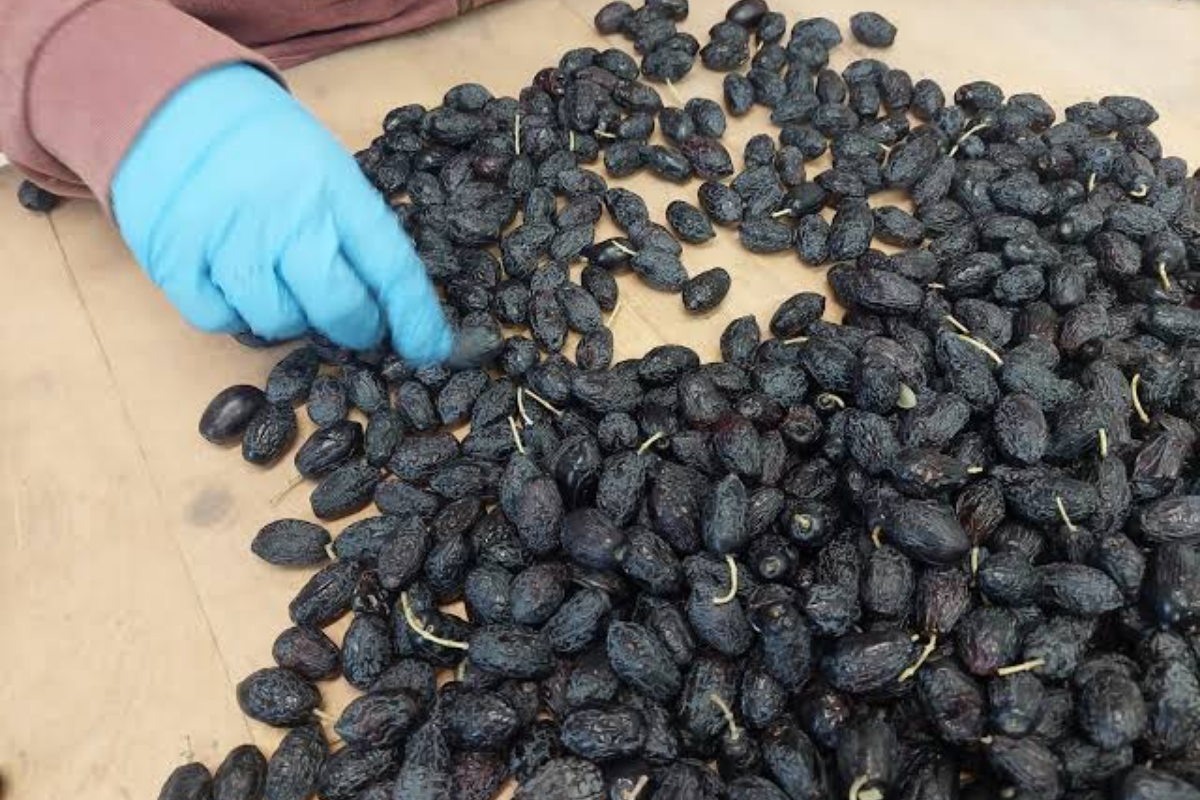
From early November, harvest begins on Thassos, Chios and Crete for an olive that behaves unlike any other Greek variety. Its fruit loses a large part of its bitterness while still on the tree, shrivels and turns black, so the processing that follows is simpler and shorter than for other table olives.
The variety is Throumbolia and the product is throumba
The variety is called Throumbolia, or Throumboelia, and is also known as Stafidolia, a name describing the raisin-like appearance of the ripe fruit. The word throumba refers mainly to the product, the black, wrinkled olive that the variety yields.
Thasitiki, according to the PDO specification published by the Greek Ministry of Rural Development and Food, is a variant of Throumbolia, inseparable from the island that gave it its name, and its fruit is described as an excellent raw material for dry-salted olives.
The fungus that removes the bitterness
The bitter taste of olives comes mainly from oleuropein, a phenolic compound that, in most varieties, is removed by an alkaline solution or a long soak in brine. With throumba, part of that work happens on the tree.
The description of the Throumba Thassou PDO attributes the loss of bitterness to the presence of the fungus Phoma oleae, which hydrolyses oleuropein. That explains why throumba is one of the few olives that can be eaten almost straight from the branch.
The process is still being studied. In a research project on Crete, the Institute of Technology of Agricultural Products of ELGO-DIMITRA, the national agricultural research organisation, at Lykovrysi, is isolating the fungus from naturally debittered fruit, so that debittering can be reproduced under controlled conditions off the tree.
Dry salting completes the processing
Natural debittering on the tree does not mean the fruit is ready. Under the PDO specification, fruit is picked at full ripeness or even later, since the black colour matters more than texture, the final product being sold is shrivelled.
It is then washed thoroughly with water under pressure to remove foreign matter, dust and leaves, and graded by size. The fruit is placed in tanks with coarse salt at 30 to 40% by volume, and after 30 to 40 days, maturation is complete. Before sale, the olives are exposed to air to promote oxidation and improve colour, then packed dry.
That dry processing has a nutritional consequence. In a study of nine commercial types of Greek table olive, Throumba Thassou showed a higher oleuropein content than the others, with values reaching 550 milligrams per kilo of flesh, since dry salting does not strip phenolic compounds the way alkaline processing does.
The fruit
The PDO specification describes the fruit as cylindro-conical, slightly curved on one side, ending in a small nipple, weighing 1.5 to 5 grams, and graded as Brilliant, meaning 290 to 320 fruit per kilo. The flesh accounts for 79 to 84% of fruit volume, the stone for 13 to 16% and the skin for 3 to 5%.
The variety is dual-purpose. Picked earlier, before shrivelling begins, it yields olive oil of very good quality, with an oil content reported at 28-30% of fruit weight.
What the variety requires
Throumbolia is demanding of soil moisture and does not bear satisfactorily in hot, dry areas or in years of prolonged drought without irrigation. It also needs winter chill for good flowering.
It thrives on deep, fertile, well-drained soils, and to perform it needs systematic cultural care, with fertilisation, pruning and weed control. The tree has an upright habit and reaches 5 to 10 metres in height.
Plant protection under the PDO specification
The Throumba Thassou PDO specification records which pests and diseases are controlled on the island, with olive leaf spot, the olive moth and black scale as the main targets.
For the olive fruit fly, the specification provides for bait sprays applied from the ground, biological methods, or no treatment at all, where none is needed. Sources differ on the variety's susceptibility to the fly: some describe it as susceptible, while others say it is rarely attacked, so the decision rests on monitoring the population in each grove.
Three throumba PDOs
The variety has given rise to three Protected Designations of Origin: Throumba Thassou, Throumba Chiou and Throumba Ampadias Rethymnis Kritis.
On Thassos, the zone of origin and processing is the entire island, with an annual production of 800 to 1,000 tonnes. Processing takes place exclusively on the island, with the plant of the Union of Agricultural Cooperatives handling around three-quarters of the production and small local units the rest.
When it is harvested
On Thassos, harvest starts in early November and continues to mid-January. It is done mainly by hand to avoid bruising the fruit, which is carried in perforated plastic crates holding 20 to 25 kilos.
Across Greece the season runs from mid-September for green table olives into March, as 22 growers from Crete to Thrace describe in when and how olives are harvested in Greece, and the guide to harvesting olives covers maturity indices, yield per tree and the route from tree to mill.
Where it is grown
Beyond the three PDO zones, Throumbolia is grown across the Aegean islands, including Samos, the Cyclades, Rhodes and Evia, as well as in Crete, Attica and Central Greece. That widespread rank it among the most widely distributed Greek varieties.
Notes
Figures on processing, fruit and Thassos production come from the Throumba Thassou PDO specification, which may be amended, so the certification body is the correct source for its current form. Oil content and susceptibility to the olive fruit fly are reported differently across sources. Before establishing a new planting, consult a local agronomist, since the variety's need for soil moisture and winter chill limits the sites where it performs well.
Sources
- Greek Ministry of Rural Development and Food. Product specification, Throumba Thassou PDO.
- Zoidou, E. et al. Identification of Throuba Thassos, a Traditional Greek Table Olive Variety, as a Nutritional Rich Source of Oleuropein. Journal of Agricultural and Food Chemistry.
- Thrubelia..
- Cookipedia. Throumpa Thassou, PDO description.