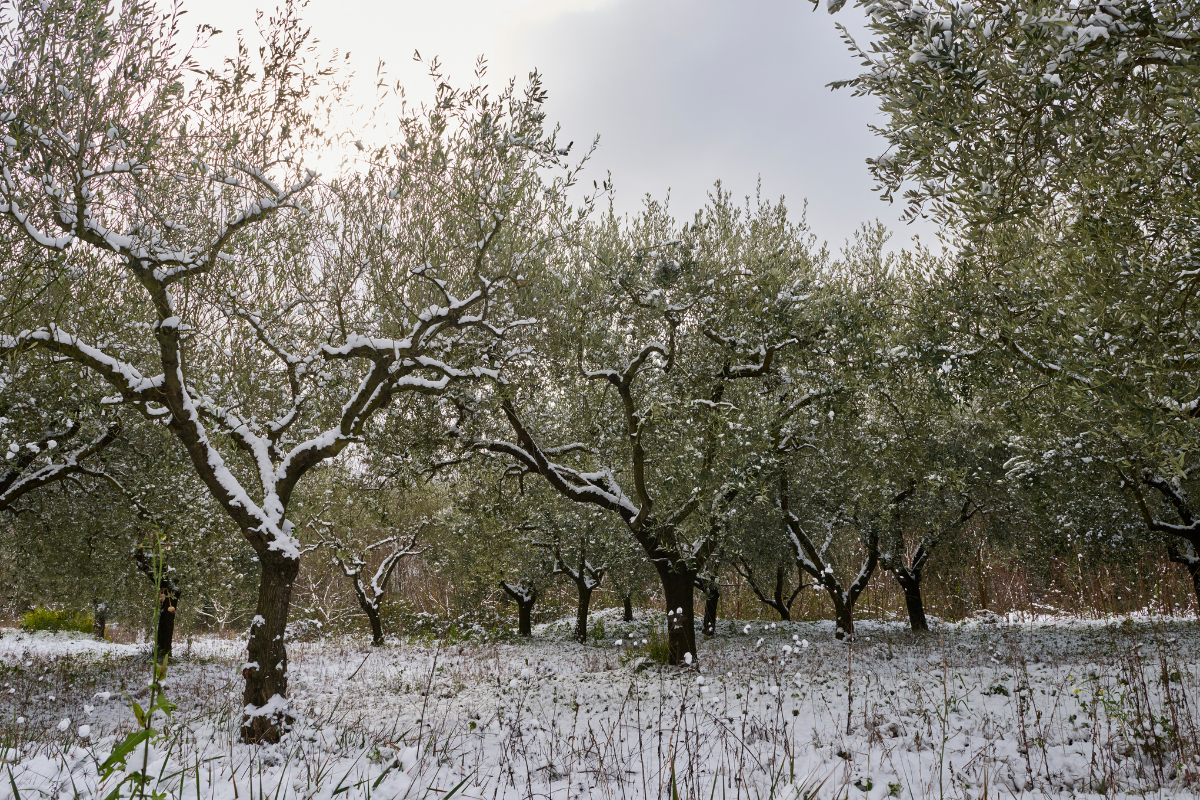
Olive trees start to suffer damage when temperatures fall below -7°C, and at -12°C or lower, the main branches and even the trunk are at risk, especially in November and December, before the trees have acclimatised to winter. Greek olive varieties differ widely in how much cold they take, and the most cold-hardy ones usually also need more winter chilling to flower. Hence, the toughest cultivar is not always the most productive choice for a given grove.
Olive trees are damaged below -7°C
The -7°C threshold is an approximation, because damage depends on how long the cold lasts, air and soil moisture, wind, the weather before the frost and the nutritional state of each tree, so trees in the same grove can suffer very different damage. When temperatures drop gradually, olive trees can withstand -12 °C without injury, while areas where the thermometer often falls below -4 to -5 °C are not suitable for olives.
Plants that have been exposed to cold gradually through autumn acclimatisation tolerate lower temperatures. In contrast, an early frost, or a warm spell that wakes the tree before a new cold snap, causes the heaviest damage, and young tissues are far more sensitive than old ones. That is why a November frost can do more harm than a colder one in January.
Fruit freezes before the tree does. An hour at -2 to -4°C shrivels olives permanently, green fruit being more sensitive than black, and frozen olives are no longer fit for canning, although they can still be milled for oil.
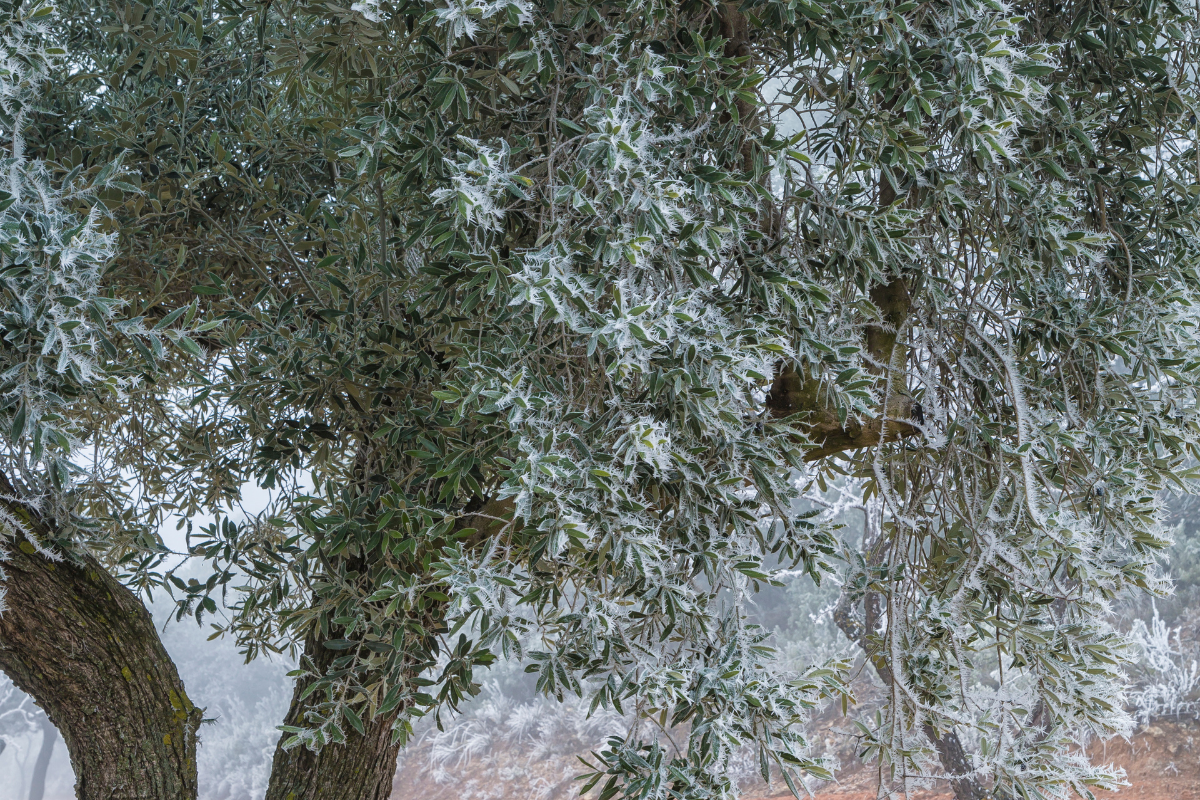
Young tissues are far more sensitive to frost than old ones, and an early frost before the trees acclimatise does the most damage.
Cold tolerance is not the same as chilling requirement.
Olive is one of the few evergreen fruit trees that need cold to flower. It requires at least 10 weeks at temperatures below 16°C for vegetative buds to differentiate into flower buds, and cultivars differ considerably in this requirement. Koroneiki, Megaritiki, Kolovi, Patrini and Lianolia Kerkyras form flowers at temperatures up to 16°C, while in Amfissis and Chondrolia Chalkidikis the limit drops to 12°C, so these two are not productive in areas with warm winters such as the coast of Crete.
According to the International Olive Council, chilling between 5 and 12°C is effective for flowering, and cultivars grown in cold climates and known for their hardiness need more chilling hours for decent flowering, while Koroneiki and Arbequina flower well even after mild winters.
ELGO-DIMITRA tested this with Greek cultivars in Chania, moving potted plants into a greenhouse for one, two or three months in winter. In the first year chilling deficit reduced inflorescences in all four cultivars, Mastoidis, Amfissis, Lefkolia Serron and Koroneiki, while in the second year Mastoidis lost inflorescences after three months in the greenhouse and Koroneiki did not. In practice, a northern cultivar planted in a warm southern grove risks poor flowering, and the risk grows as winters get warmer.
How Greek cultivars score for cold tolerance
The cultivar guide of the Kostelenos nursery, which has evaluated Greek and foreign cultivars in Troizinia since 1991, rates cold tolerance on a scale from 1 (sensitive) to 4 (very tolerant). It is the most complete comparative record of Greek cultivars, but it is based on observations at a single site rather than a controlled trial.
| Cultivar | Region | Use | Cold tolerance (1 to 4) |
| Dopia Veroias | Imathia | Oil | 3.5 |
| Chondrolia Chalkidikis | Chalkidiki | Dual-purpose | 3 |
| Dopia Pierias | Pieria | Oil | 3 |
| Mavrolia Serron | Serres | Dual-purpose | 3 |
| Maroneias or Makris | Thrace | Dual-purpose | 3 |
| Throumba Thassou | Thassos | Dual-purpose | 3 |
| Mastoidis or Tsounati | Crete, Peloponnese | Oil | 3 |
| Petrolia Serron | Serres | Dual-purpose | 2.5 |
| Kothreiki or Manaki | Peloponnese | Dual-purpose | 2.5 |
| Megaritiki | Attica, Corinthia | Dual-purpose | 2.5 |
| Lianolia Kerkyras | Ionian, Epirus | Oil | 2.5 |
| Amfissis or Konservolia | Central Greece, Thessaly | Table | 2 |
| Kalamon | Peloponnese, Crete | Table | 2 |
| Koroneiki | Peloponnese, Crete | Oil | 2 |
Source: Kostelenos and Vlasaki, Guide to olive cultivars and nursery trees (in Greek). Cold tolerance scale: 1 sensitive, 2 normal, 3 tolerant, 4 very tolerant.
Cultivars of the mountain groves of southern Greece
Tsounati, or Mastoidis, replaces Koroneiki where Koroneiki's zone ends, in the colder groves of Crete and the Peloponnese, and is grown up to 1,000 metres above sea level. In the ELGO-DIMITRA experiment, however, it proved to need adequate chilling to flower, which Koroneiki did not.
Manaki, or Kothreiki, is often found above 700 metres in Corinthia, Argolis and Arcadia, and Megaritiki is rated cold-tolerant in the foothills of Attica, Boeotia and Corinthia. Both score 2.5 on the Kostelenos scale, between normal and tolerant.
Amfissis, or Konservolia, is the cultivar on which sources disagree most. The Kostelenos guide gives it 2, normal tolerance, while an Iranian study of seven cultivars found Amphisis to have the highest freezing tolerance, with Koroneiki among the sensitive ones. On Mount Pelion, the trees survive even when covered in snow. Either way, it needs a lot of chilling to flower, so it belongs in cold sites rather than warm coasts.
Local cultivars of northern Greece
Winters in northern Greece are harsh enough to kill olive trees, which is why olive growing there is largely confined to coastal zones. Local cultivars adapted to the cold have survived there, most of them with only local distribution.
Chondrolia Chalkidikis is the most widespread, with the Chalkidiki cultivar covering 27% of Greece's table olive area, and it combines good cold tolerance with a high chilling requirement. Around Serres, growers keep Mavrolia, Petrolia and Lefkolia Serron, the last classified by ELGO-DIMITRA among cultivars originating from mountainous, colder areas. On the Kostelenos scale, the highest score among the Greek cultivars in the table goes to Dopia Veroias, at 3.5, while Dopia Pierias and Maroneias from Thrace score 3.
These cultivars have been studied far less than the main commercial ones, and not every nursery stocks their propagation material. For a new grove in the north, trees that have survived for decades in the surrounding villages are the most reliable guide to the right cultivar.
Koroneiki is the most sensitive of the main cultivars
The International Olive Council lists Koroneiki among cultivars sensitive to frost, together with the Italian Frantoio and Coratina, and above roughly 400 metres, hardier cultivars usually replace it. When a group of growers planted it near Trikala, the trees came into bearing early until a severe frost caused cankers on the trunks and almost halted further growth.
The same trait that makes it vulnerable to cold suits it to the warm south. Because Koroneiki needs little winter chilling, it flowers even after mild winters, an advantage that grows as climate change brings warmer winters.
Three Spanish cultivars and one Italian stand out for hardiness
The International Olive Council lists Picual and Cornicabra from Spain, Leccino from Italy, Zard from Iran and Sourani from Lebanon as frost-tolerant. In a study of eight Spanish cultivars that combined laboratory measurements with damage from a natural frost in the field, Cornicabra, Arbequina and Picual suffered least, while Empeltre had frost damage on every shoot, with a leaf lethal temperature of -9.5°C.
Results for Arbequina vary sharply from place to place. In an evaluation of 24 cultivars in Italy, it was among those with the heaviest damage. After the late frost of April 2022 on the Adriatic coast, it lost 6% of its inflorescences in one grove and 95% in another in the same area. A cultivar's reputation for hardiness, therefore, guarantees little for a particular grove, and the same caution applies to foreign cultivars promoted for high-density planting.
Grove position matters as much as the cultivar
On a north-facing, cold and windy slope olives are not grown above 300 metres, while on a warm east- or south-facing site sheltered from cold winds they can reach 1,000 metres. Cold air is heavier and drains into low ground, so valleys and hollows often freeze harder than the slopes above them.
Cultivars and trees with a moderately dense canopy that lets light into the interior tolerate frost better, and pruning dense canopies improves cold tolerance. Because frost damage also varies with the tree's nutritional state, fertilisation based on soil and leaf analyses is part of frost protection.
Important notes
Scores and temperature thresholds are indications. Frost damage depends on how long the cold lasts, acclimatisation, the tree's age and nutrition, soil moisture, and the grove's position, and studies of the same cultivar often disagree depending on the method and site. Before planting in a cold area, recent weather records, the behaviour of neighbouring groves and the advice of a local agronomist are more reliable guides than any general ranking.
Sources
- Barranco, D., Ruiz, N., Gómez-del Campo, M. (2005). Frost tolerance of eight olive cultivars. HortScience, 40(3), 558-560.
- Bartzokas, N. (2023). The role of chilling in olive fruiting. Association of Olive-Growing Municipalities of Crete (in Greek).
- Frontiers in Plant Science (2024). An easy methodology for frost tolerance assessment in olive cultivars. Review and experimental results, citing the 24-cultivar evaluation by Lodolini et al. (2016).
- International Olive Council. Chalkidikis, World Catalogue of Olive Varieties.
- International Olive Council. Frost, World Catalogue of Olive Varieties.
- International Olive Council. High temperatures, World Catalogue of Olive Varieties.
- Kostelenos, G. D., Vlasaki, E. K. Guide to olive cultivars and nursery trees. ISBN 978-618-84882-1-2 (in Greek).
- Koubouris, G., Limperaki, I., Darioti, M., Sergentani, C. (2019). Effects of various winter chilling regimes on flowering quality indicators of Greek olive cultivars. Biologia Plantarum, 63, 504-510.
- Saadati, S., Baninasab, B., Mobli, M., Gholami, M. (2019). Measurements of freezing tolerance and their relationship with some biochemical and physiological parameters in seven olive cultivars. Acta Physiologiae Plantarum, 41(4).
- Zucchini, M., Lodolini, E. M., Giorgi, V., Neri, D. (2026). Response of different olive cultivars to late frosts in the Marche region. Università Politecnica delle Marche.