From 10 September, the harvest of green Amfissa olives began in some areas, while the black crop will follow in winter, from the same fruit and the same trees. The variety yields different products depending on when it is picked, from green olives through to natural black, ripe, or shrivelled, and that flexibility goes some way to explaining why it has historically been the most widespread table olive in Greece.
The variety is called Konservolia
The variety's name is Konservolia, from its main use in canning, and it also goes by the name Amfissa olive, after the area that made it famous. Its black olives are traded as konservoelies and are the country's main black table olive.
In some areas, Konservolia is also referred to as Chondrolia, a name that warrants caution. Chondrolia Chalkidikis is a different variety, one of the two covered by the Prasines Elies Chalkidikis PDO, so the bare word "chondrolia" is not enough to identify planting material.
Six PDOs and one PGI for one variety
Konservolia is linked to six Protected Designations of Origin, each for its own zone: Konservolia Amfissis, Konservolia Artas, Konservolia Atalantis, Konservolia Rovion, Konservolia Stylidas and Konservolia Piliou Volou. To these is added one Protected Geographical Indication, Konservolia Agriniou.
The Konservolia Amfissis PDO covers the variety in the prefecture of Phocis, in municipalities including Amfissa, Itea and Delphi. The Konservolia Agriniou PGI covers the provinces of Trichonida, Messolonghi, Nafpaktia, Xiromero and Valtos, and the relevant decision describes a large fruit, ovoid to near-round without a nipple, with particularly firm flesh and good resistance to processing.
The olive grove of Amfissa
The zone that gave the variety its name is home to one of the country's oldest olive groves, with a history of around 3,000 years. It covers 55,000 stremmata, about 5,500 hectares, of alluvial soils, with some 1,100,000 trees, 70% of which are more than 150 years old.
This is a pure, non-hedgerow planting, with deeply furrowed trunks and trees that in many cases reach 10 metres. The basic plot is called a lachidi, and plots are divided by earth banks known as trafia that hold back rainwater, while terraces have been built on the sloping ground.
The fruit
The fruit is large, round and slightly asymmetric, with an average weight of 6 to 10 grams, corresponding to roughly 100 to 165 fruit per kilo. The flesh-to-stone ratio reaches 10:1, with rich, crisp flesh.
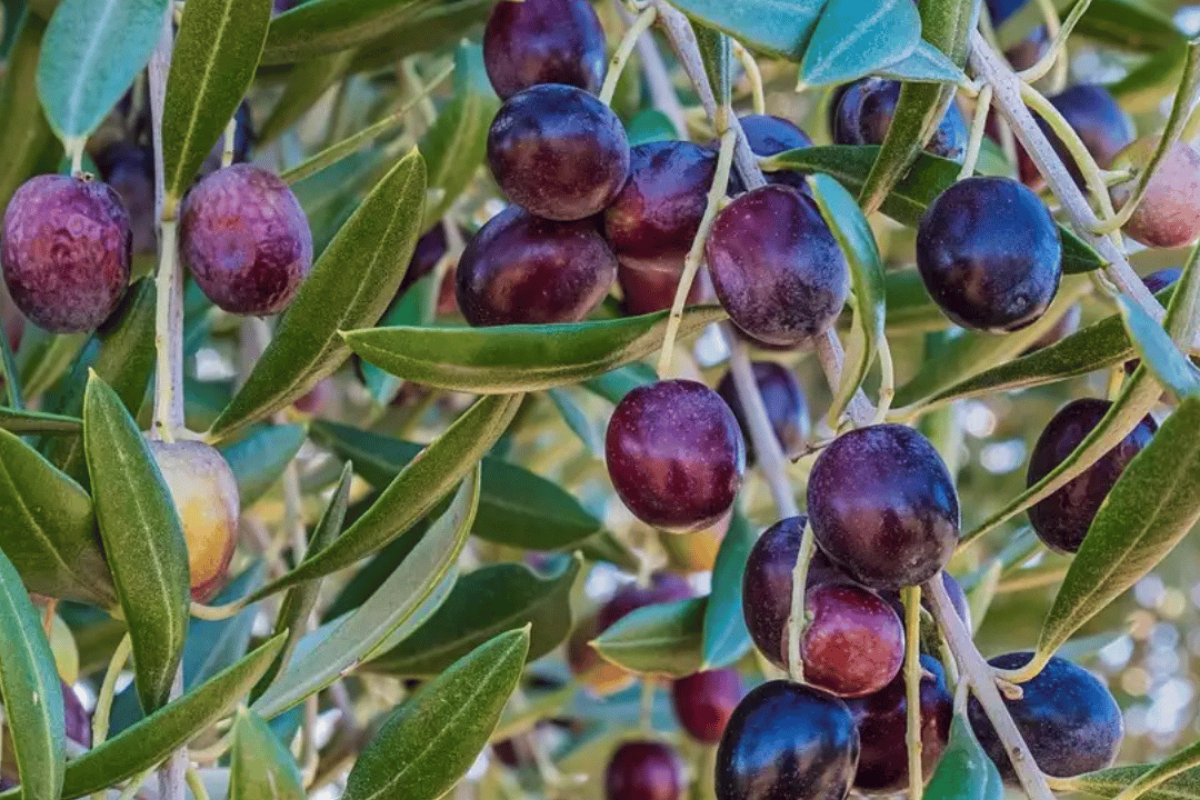
Colour changes clearly with ripening, from deep green through greenish-yellow, reddish and violet, ending at full maturity as violet-black. Oil content is low, at around 16%, so the variety is used mainly for table olives.
Green and black from the same tree
Konservolia yields both main table olive products, with the difference decided by harvest timing.
For green olives, harvest starts in mid-September, once the fruit has reached size while keeping its green colour, and it calls for especially careful handling, since green fruit bruises more easily than ripe fruit. For black olives, the fruit is left to ripen on the tree. Ripening is rated late, from mid-November to January or February, and in years of heavy crop it extends into the first months of spring.
In Stylida, the cooperative's members pick green Konservolia after the first September rains and the more sensitive black fruit later, only by hand, while in Itea one grower picks Amfissis at the end of September for a premium oil, as described in when and how olives are harvested in Greece. How maturity is judged and how many kilograms of olives give a kilogram of oil is covered in the guide to harvesting olives.
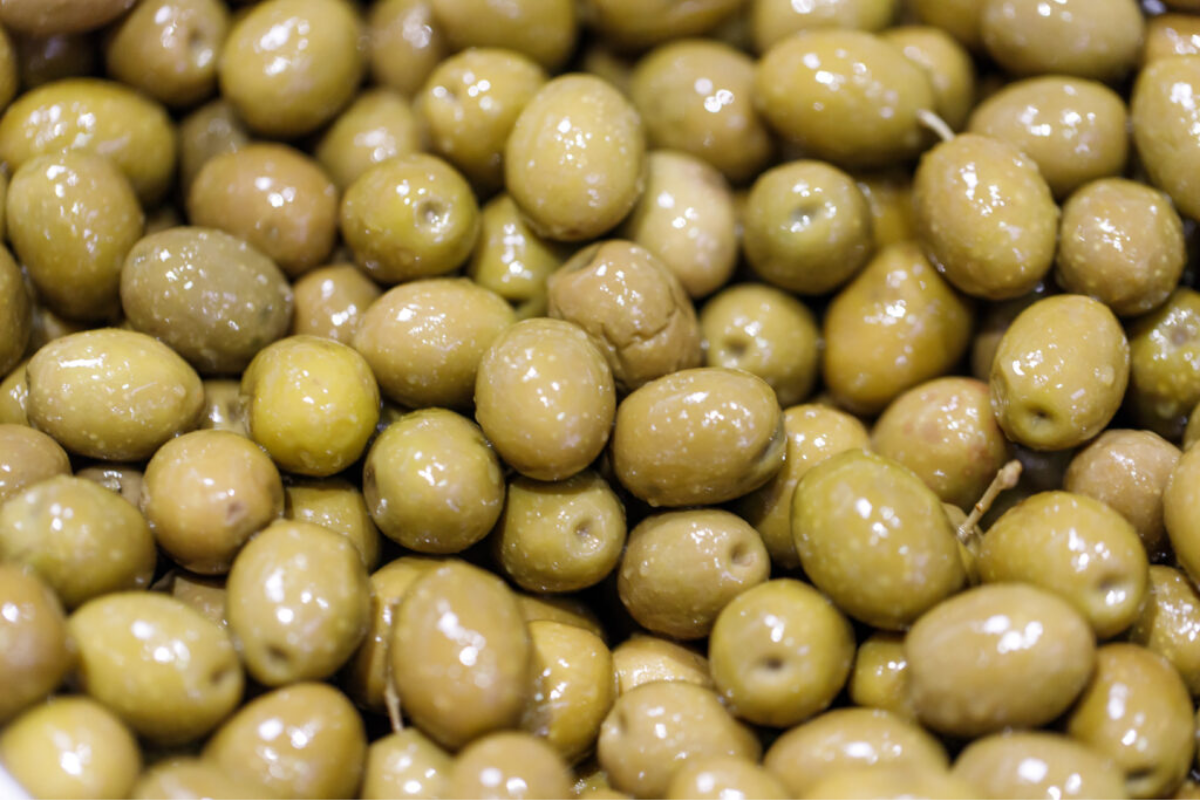
Green table olives come from fruit picked at full size, before it changes colour.
The tree
The tree has an upright habit and grows to 6 to 10 metres, with a crown 5 to 8 metres across, though it can be held at 4 to 5 metres with frequent pruning. Leaves are medium-sized and elongated, with a distinct tip that bends downward, a trait useful for identifying the variety.
It is considered a productive variety, with a cultivated tree yielding 15 to 100 kilos of fruit depending on the season, pruning, fertilisation and irrigation. Older descriptions record century-old trees in the Chrisso area of Amfissa, yielding 250 to 380 kilos each.
Tolerances and susceptibilities
The variety shows good cold tolerance. A classic description of the variety, quoted in the specialist press, states that it thrives up to 600 metres above sea level and that the trees withstand being completely covered in snow, as often happens on Pelion.
It thrives on clay and loam soils with good drainage, while heavy soils that hold water are avoided. It grows even on poor, stony soils, but performs far better on fertile soils that hold enough moisture, and watering in spring and summer noticeably improves fruit size and flesh.
Its most significant susceptibility concerns Verticillium wilt. In an ELGO-DIMITRA study evaluating the resistance of Greek varieties, Amfissis was used as a reference variety of known susceptibility, with Koroneiki as the resistant counterpart, so plots with a history of the disease are avoided for new plantings.
Where it is grown
Cultivation spreads along two arcs. The first runs from northern Evia through Magnesia, Phthiotis and Thessaly to Pieria, and the second from Phocis and Aetolia-Acarnania to Arta.
According to the Registers Directorate of the Greek Ministry of Rural Development and Food, some 13.3 million Konservolia trees are grown on 847,000 stremmata (about 84,700 hectares), compared with around 6.5 million trees of the Kalamon variety.
Notes
Figures for the fruit, the tree and yield come from various sources and represent ranges, since the variety behaves differently by zone and management. The respective decisions and registered files set the specifications of each PDO and of the PGI, so the certification body is the correct source for their current form. Before establishing a new planting, consult a local agronomist, particularly on the plot's history of Verticillium wilt.
Sources
- Markakis, E. A. et al. Evaluation of Olive Varieties Resistance for Sustainable Management of Verticillium Wilt. Sustainability.
- Olivenews. Konservolia has a past, a present and a future.
- Ellinas Agrotis. Konservolia, a centuries-old tradition from Amfissa.
- WIPO Lex. Decision recognising the Konservolia Amfissis PDO.
- WIPO Lex. Decision recognising the Konservolia Agriniou PGI.