From September to November, the planting window for autumn bulbs opens, and one afternoon's work is enough to keep a garden or balcony in flower from midwinter to early summer. Freesias, crocuses, daffodils, hyacinths, tulips and irises all go into the ground in the same season, under the same basic rules, and then bloom in relay, one after another. This guide covers which bulbs to plant in autumn and when, the rules that apply to all of them, a plan for continuous colour from January to June, and which bulbs stay in the ground or get lifted after flowering.
What autumn bulbs are
Autumn bulbs are the bulbs planted from September to December that spend winter in the soil, where the cold triggers flowering, and bloom from midwinter to early summer. It is the big family of tulips, daffodils, hyacinths, freesias, crocuses and bulbous irises, along with anemones and amaryllis. The other major group, the spring-planted bulbs such as dahlias, gladioli, lilies and cannas, runs the opposite calendar, planted from February to May for summer flowers.
The planting table
| Bulb | Planting | Depth | Bloom |
|---|---|---|---|
| Freesia | Early September to early December, mild climates | 5 to 8 cm | February to April |
| Crocus | September to November | 5 to 10 cm | Late winter to early spring |
| Daffodil | September to December | 10 to 15 cm | Late winter to spring |
| Hyacinth | September to November | About 10 cm | Mid-January to early spring |
| Tulip | Mid-September to early December | 10 to 15 cm | March to May |
| Bulbous iris | September onward | 5 to 10 cm | Late February to June |
The five rules that apply to every bulb
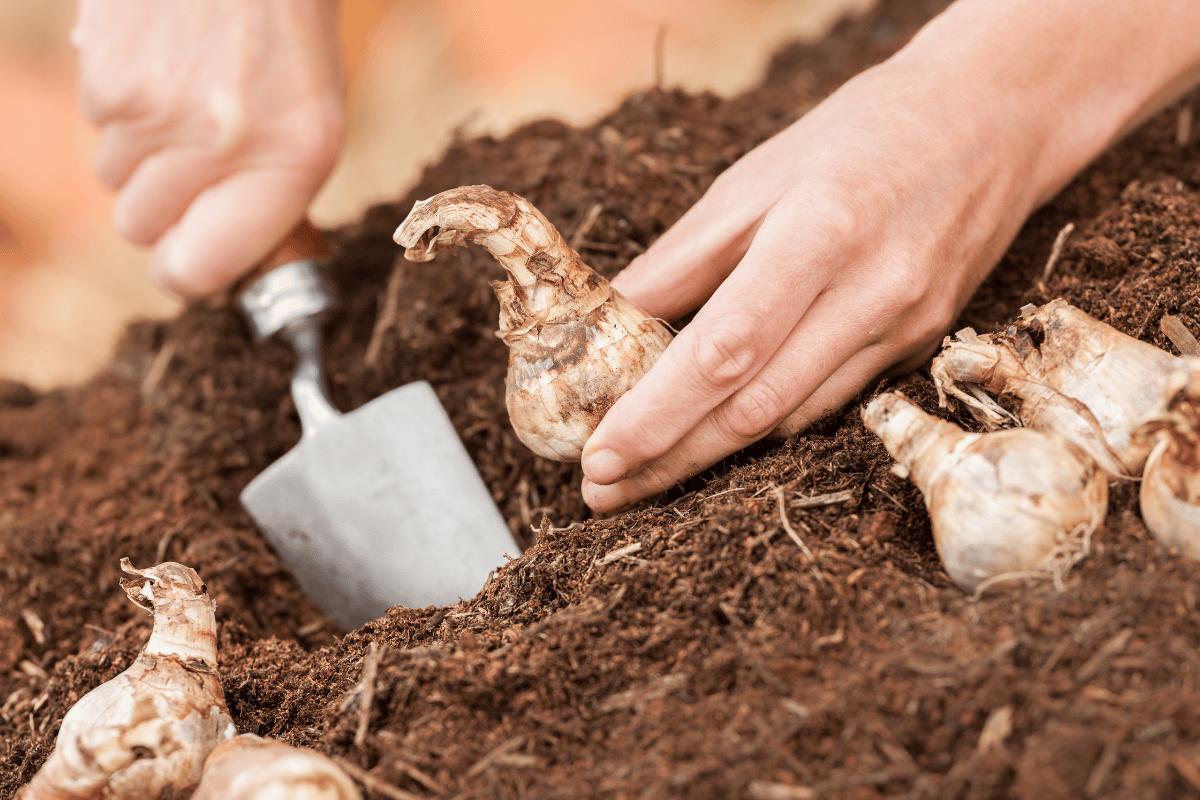
- Drainage above all: standing water is the one true enemy of a bulb, rotting it before it roots. Improve heavy, permanently damp ground with organic matter and grit, or switch to pots
- Depth of two to three times the bulb's height: always with the pointed tip up. Go deeper in light soils and hard-frost regions
- Large, firm bulbs: free of mould and soft spots, because the size of the bulb decides the size of the display
- Water with restraint: one thorough watering straight after planting to start the roots, then hold back until shoots appear
- Never cut the leaves after flowering: while green, they refill the bulb with next year's reserves. Only the spent flower stem is removed
The six autumn bulbs
Freesia
The freesia traditionally opens the planting season and flowers 12 to 13 weeks later, with the most penetrating fragrance of any bulb. A 15 cm pot takes 10 to 15 corms for a ready-made bouquet.
Crocus
The crocus is among the first flowers of the year and the only one of the group with an edible relative, the saffron crocus, which runs its own calendar, planted from July and flowering in autumn.
Daffodil
The daffodil is the least demanding bulb of all. It needs no chilling help, stays permanently in the ground and thickens into larger clumps on its own, naturalising happily in lawns and under deciduous trees.
Hyacinth
The hyacinth flowers just two to two and a half months after planting, with the strongest scent of the winter garden, and grows in plain water on a windowsill. Its bulbs are always handled with gloves, because they irritate the skin.
Tulip
The tulip needs 12 to 14 weeks of winter cold, which is why in mild climates the bulbs are pre-chilled in the refrigerator before planting, in a paper bag away from fruit. Species tulips are the only ones that return reliably every spring.
Iris
The bulbous iris is planted like the other autumn bulbs, with slightly deeper planting helping it reflower in later years. Rhizomatous irises, led by the bearded iris, are a different story altogether, planted with the rhizome half-exposed.
The autumn group also includes the dramatic amaryllis and the anemone, whose hard, dried corms are soaked in water for a few hours before planting.
Colour from January to June
One autumn planting keeps the garden in flower for nearly six months, as the six bulbs bloom in relay. Hyacinths start from mid-January, crocuses, dwarf irises and the first daffodils follow from late February, freesias and early tulips peak in March, mid and late tulips with bearded irises fill April and May, and Dutch irises close the season in June. Mixing early and late varieties within each kind stretches the display even further.
Bulb lasagne and pansies on top
In containers, autumn bulbs are combined in layers, the so-called bulb lasagne. Tulips take the deepest layer, daffodils and hyacinths the middle, and crocuses the top at 7 to 12 cm, so a single pot flowers in waves for months. On the surface, low winter bedding such as pansies or cyclamen keeps the pot in colour all winter while the bulbs work underneath.
Which bulbs stay in the ground and which are lifted
Daffodils, crocuses, irises, hyacinths and species tulips stay permanently in place, rest dry through summer and return thicker every year. The big hybrid tulips are lifted in warm climates once the foliage has died down, because they weaken after their first spring and damp summer soil rots them, while freesias are lifted only in wet-summer regions, or simply left in a pot kept dry and out of the rain. The rule of lifting is a single one. Bulbs come out only after the leaves have withered completely, then get cleaned, dried for a few days and stored somewhere dry, shaded and airy until the next autumn.
Frequently asked questions
When should autumn bulbs be planted
From September to November, and into December in mild climates. Late planting, even in January, gives a thinner first display but beats letting the bulbs dry out unplanted.
How deep do you plant bulbs
At two to three times each bulb's height, pointed tip up. In practice, 5 to 10 cm for small bulbs such as crocuses and freesias, and 10 to 15 cm for tulips, daffodils and hyacinths.
Do autumn bulbs come back every year
Most do. Daffodils, crocuses, irises and hyacinths return each spring and multiply, while the big hybrid tulips weaken and are usually replaced with fresh bulbs.
Can autumn bulbs grow in pots
Yes, all of them, as long as the pot has drainage holes, a gritty layer at the base and a light, free-draining mix. In containers, bulbs are planted closer together than in the ground for a fuller display.
Which bulbs grow in water
Hyacinths and tulips, using pre-chilled bulbs in a forcing vase where the water just touches their base. It is the simplest way to have flowers indoors in the middle of winter.
When do you dig up bulbs
Only after the foliage has withered completely, in early summer. In warm climates that mainly means hybrid tulips, while daffodils, crocuses, irises and hyacinths stay in the ground.
Important notes
Every garden is different, and planting dates shift with your climate, so treat the guidance above as a general starting point. The best varieties sell out early, and ordering bulbs in late summer, with the rest of the August garden jobs, secures the pick of the catalogue.
References
- Royal Horticultural Society, Bulbs.
- The Old Farmer's Almanac, Growing crocuses.