

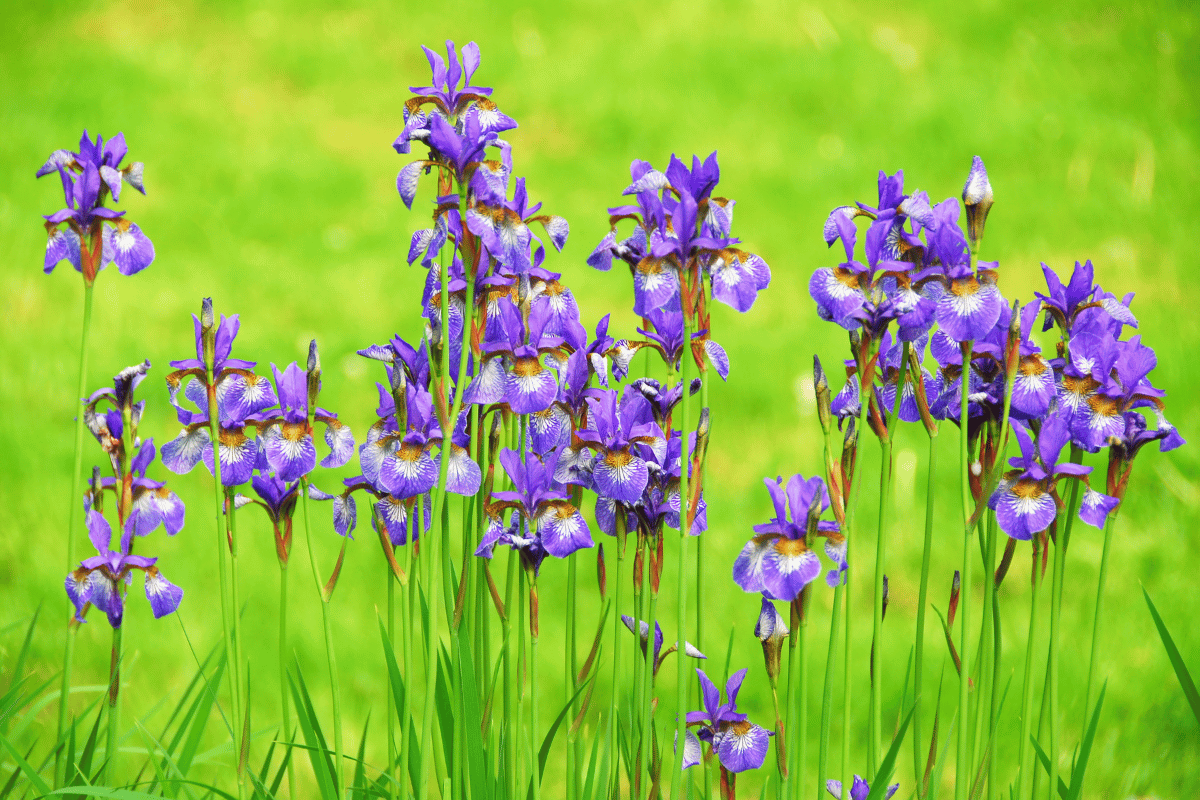
Irises fall into two groups that are planted in completely different ways. Bulbous irises go into the ground in autumn like tulips, 5 to 10 cm deep, while rhizomatous irises, led by the bearded iris, are planted from late summer with the rhizome half-buried, its back exposed to the sun. Mixing up the two systems produces plants that refuse to flower, and that confusion sits behind most disappointments with the rainbow flower. This guide covers the types of iris, when and how to plant each group, care in beds and containers, dividing the clumps, and the reasons an iris stops blooming.
What is an iris
The iris (Iris) is a genus of around 310 perennial herbaceous species in the family Iridaceae, spread across the northern hemisphere. It takes its name from Iris, the Greek goddess of the rainbow and messenger of the gods, thanks to a colour range that runs from white and yellow through every blue and purple to near black. The leaves are narrow and sword-shaped, held in upright fans, and the flowers combine three upright petals, the standards, with three arching sepals, the falls, a shape no other flower repeats. The dried rhizomes of certain species yield orris, a violet-scented raw material of fine perfumery.
Rhizome irises and bulb irises
| Group | Examples | When and how to plant |
|---|---|---|
| Rhizomatous | Bearded (germanica) iris, Siberian iris, Japanese iris | Late summer to early autumn, with the rhizome half-buried and its top exposed to the sun |
| Bulbous | Dutch iris (hollandica), dwarf reticulata and danfordiae | Autumn, from September onward, 5 to 10 cm deep like the other autumn bulbs |
When do irises bloom
Irises flower from late winter to early summer, depending on the group. The dwarf bulbous kinds, such as reticulata, open first, from late February into March. Bearded irises follow from April, with the tall varieties peaking in May, and Dutch and Siberian irises close the season through May and June. Some modern bearded varieties are remontant and flower again in late summer. Each bloom lasts 3 to 7 days and each plant stays in flower for two to three weeks, so combining dwarf, bearded and Dutch irises keeps colour in the garden from February to June.
Planting rhizomatous irises
Plant rhizomatous irises from late summer to early autumn, so they root before winter. Depth decides everything. Dig a shallow hole, form a small mound of soil in the centre, sit the rhizome on the mound and spread the roots down the sides. Cover only the roots and the lower half of the rhizome, leaving its back exposed to air and sun. A deeply buried rhizome rots or refuses to flower, and this is the single most common mistake made with irises. Keep spacing generous, 30 to 60 cm, because the clumps thicken fast.
Planting bulbous irises
Plant bulbous irises in autumn, alongside tulips and freesias, 5 to 10 cm deep with the pointed tip up and 5 to 10 cm apart. Planting slightly deeper, down to 15 cm, helps the bulbs reflower more reliably in later years, a tip that comes straight from the RHS. Choose large, firm bulbs and water once thoroughly after planting.
Position and soil
Irises need sun, at least 6 hours of direct light a day, because shade multiplies leaves at the expense of flowers. The soil should be fertile, neutral to slightly acidic and above all well drained, since standing water rots rhizomes and bulbs alike. Beyond that, the iris ranks among the least demanding and toughest garden plants, with excellent tolerance of drought and cold, which is why bearded irises persist for generations around old farmhouses with no care at all.
Growing irises in pots
Irises grow well in containers on a sunny balcony or terrace. Use a pot at least 30 cm across with drainage holes, a layer of grit or pumice at the base, and a light, fast-draining potting mix opened up with extra perlite or coarse sand. Terracotta suits them, because it lets the mix dry properly. The half-buried rule applies in pots exactly as in the ground for rhizomatous kinds, with one to three rhizomes per pot, while bulbous irises go in at their normal depth. Clumps congest faster in containers than in beds, so divide potted irises every two to three years.
Watering and feeding
The iris is one of the most forgiving plants in the garden, and a forgotten, unwatered iris rarely suffers. Water once or twice a week from growth through flowering, letting the soil dry between waterings, and barely at all in summer. The only real mistake is overwatering, which rots rhizomes and roots.
Feeding stays light. Work a complete granular fertilizer into the soil at planting and repeat in early spring, applied around the clumps rather than over the rhizomes. Avoid high-nitrogen feeds, which produce soft foliage and rot-prone rhizomes instead of flowers.
After flowering and division
After the blooms fade, cut only the flower stems and leave the foliage to feed the rhizome, removing leaves only as they brown. Every three to five years, when the clumps congest and flowering thins out, lift the rhizomes five to six weeks after blooming ends, cut them apart with a clean knife into sections carrying one fan of leaves each, and replant the younger, outer pieces half-buried in refreshed soil. Division is also the main way irises are propagated, while the bulbous kinds multiply through offsets around the mother bulb.
Why irises stop flowering
The causes are almost always one of four. The rhizome was planted too deep and fully covered, the position gets less than 6 hours of sun, the clumps have congested and need dividing, or the feeding carries too much nitrogen. With bulbous irises, shallow planting joins the list, exhausting the bulbs after their first spring.
Irises also call for a little handling care, because all parts of the plant, and the rhizome most of all, are toxic if eaten, and the sap can irritate skin. Wear gloves when dividing, and keep plants and rhizomes away from pets that dig or chew.
Frequently asked questions
When should irises be planted
Rhizomatous irises from late summer to early autumn, with the rhizome half-buried, and bulbous irises in autumn from September onward, 5 to 10 cm deep.
When do irises bloom
From late February for the dwarf bulbous kinds, and from April to June for bearded and Dutch irises, with each plant in flower for two to three weeks.
Do irises come back every year
Yes, irises are long-lived perennials. Rhizomatous clumps persist for decades with a division every three to five years, and bulbous irises return more reliably when planted slightly deeper.
Why does my iris have leaves but no flowers
Usually because the rhizome was buried completely, the spot is too shady, the clump has congested, or the feeding is nitrogen-heavy. Dividing and replanting shallowly in full sun solves most cases.
Can irises grow in pots
Yes, in a container at least 30 cm across with fast drainage on a sunny balcony, with rhizomes half-buried just as in the ground and division every two to three years.
Are irises toxic to pets
Yes, all parts and especially the rhizome are toxic to cats and dogs if eaten, and the sap can irritate skin. Wear gloves when dividing and keep rhizomes out of reach.
Important notes
Every garden is different, and results depend on your climate, soil and the type of iris, so treat the guidance above as a general starting point. Ordering rhizomes and bulbs in late summer, with the rest of the August garden jobs, secures the best varieties before they sell out.
References
- Royal Horticultural Society, How to grow bulb irises.
- Utah State University Extension, Growing iris.