
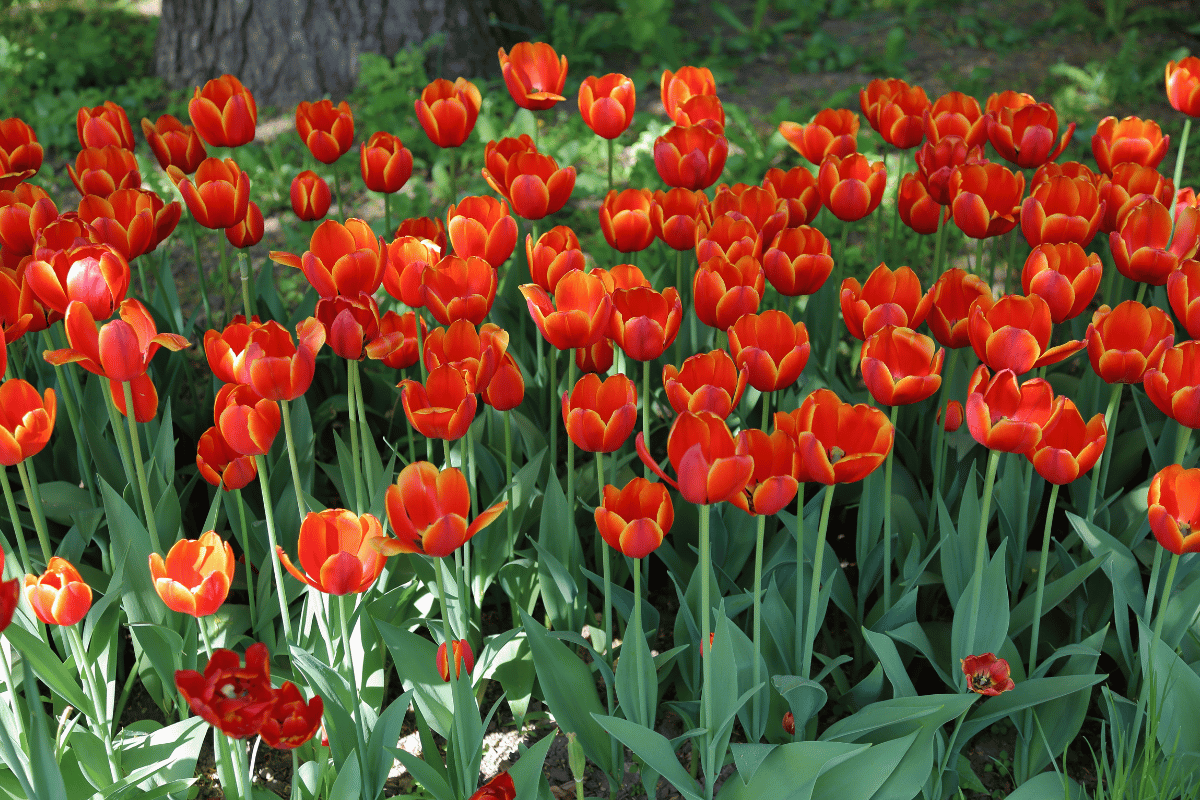
Tulips are planted in autumn and flower in spring, from March to May, roughly three months after the bulbs go into the ground. That timeline has no shortcuts, because the bulb needs a period of winter cold to trigger flowering, and a bulb that misses its chill produces leaves but no bloom. Beyond that one rule, tulips are among the easiest bulbs to grow, provided they are planted at the right depth in well-draining soil and watered with restraint. This guide covers when and how to plant tulip bulbs; growing them in pots and in water; feeding and aftercare; whether they come back every year; and the reasons tulips fail to flower.
What is a tulip
The tulip (Tulipa) is a bulbous perennial native to Central Asia, now inseparable from the Netherlands, the world's largest producer of bulbs. The bulb is egg-shaped and wrapped in papery brown skins, called tunics, and inside it the next spring's flower already exists fully formed, built from the energy the plant stored the previous season. The cup-shaped flowers come in nearly every colour, from pure white to the deep purple of 'Queen of Night', the variety sold as a black tulip. Because the flower is pre-formed in the bulb, tulips cannot be propagated from cuttings, and everything about growing them revolves around treating that bulb well.
When do tulips bloom
Tulips flower in spring, and the variety determines exactly when.
| Group | Flowering period |
|---|---|
| Early varieties | Late February or early March to early April |
| Mid-season varieties, the largest group | Early April to mid-May |
| Late varieties | Mid to late May |
Each flower lasts one to two weeks on the plant, depending on the weather, and cut tulips hold in a vase for up to 10 days. Mixing early, mid and late varieties keeps the same bed in flower from March until the end of May, one of the building blocks of a garden with flowers in bloom all year.
When and how to plant tulip bulbs
Plant tulip bulbs in autumn, from mid-September to early December, ideally in October and November once the soil has cooled below about 15°C. The winter chill is not optional, since the bulb needs roughly 12 to 14 weeks of cold, around 4 to 5°C, before it will flower.
Buy firm, heavy bulbs with no mould, soft spots or wounds, and favour the largest ones, because big bulbs produce stronger plants and larger flowers. The best varieties sell out early, so ordering starts in late summer, as noted in the guide on what to plant in August. Leave the papery brown tunic in place.
Planting comes down to a few simple rules:
- Depth: 10 to 15 cm, or about three times the height of the bulb. Go to the deeper end in light, sandy soils and in regions with hard frosts
- Orientation: the pointed end faces up, and the rounded base sits down
- Spacing: 10 to 15 cm apart in the ground, and closer together in containers
- Watering: water thoroughly straight after planting to start the roots
In mild-winter regions, bulbs benefit from pre-chilling before planting. Keep them in a paper bag in the refrigerator for 12 to 16 weeks, away from apples and pears, because the ethylene the fruit releases destroys the flower inside the bulb. Pre-chilled bulbs are also sold ready to plant.
Position and soil
Tulips need full sun or light shade, and the further south they are grown, the more welcome a little afternoon shade becomes. Deep shade produces weak, leaning stems. In the soil, drainage decides everything, because standing moisture rots the bulb faster than any pest. Aim for a loose, fertile soil with a pH of 6.0 to 6.5. In sandy ground, work in organic matter such as compost at roughly 1:1 with soil, and in heavy clay, a 5 cm layer of grit at the bottom of the planting hole keeps water away from the bulb.
Growing tulips in pots
Tulips do well in containers, where drainage is fully under your control. Choose a pot at least 30 cm wide and deep with drainage holes, use a quality free-draining potting mix, and set the bulbs closer than in the ground, about a finger's width apart without touching, at the same three-times-their-height depth. A trick worth stealing is the bulb lasagne, planting in layers with late varieties deepest and early ones above them, so a single pot flowers in waves for two months or more.
Over winter the pot stays outdoors in a cold, sheltered spot with the compost barely moist, and once shoots appear in spring it moves into the sun. In cold regions an unheated shed or garage protects the pot from freezing solid. Tulips are planted at the same time as the autumn container plants, and pairing them under cyclamen in the same pot gives colour from autumn, with the tulips taking over in spring.
Growing tulips in water
Tulip bulbs can be grown in plain water, in a forcing vase with a narrow neck or in a glass jar with pebbles or expanded clay in the base. The rule for success is the water level: it should just touch the base of the bulb, no more, because a submerged bulb rots. Change the water every 5 to 7 days to keep it fresh.
The bulb must already have had its cold period, so use pre-chilled bulbs or chill them in the refrigerator as described above. Keep the vase in a cool, dark place for one to two weeks while roots develop, then move it somewhere bright and turn it regularly, since the stem leans towards the light. Flowers appear in three to four weeks, which makes forced tulips one of the easiest ways to have spring flowers indoors in the middle of winter.
Watering and feeding
Watering follows the plant's phase. After the initial soak at planting, water sparingly, about once a week, until the flower stem emerges, because more than that invites rot. Increase watering while the plant grows and blooms, and stop completely once the foliage starts to yellow after flowering. At every stage, tulips prefer slightly dry conditions over wet ones.
No feeding is needed at planting, since the bulb carries its own reserves. Once the buds form, a liquid or water-soluble fertiliser for flowering plants supports the bloom and helps the bulb refill for next year.
After flowering
When a flower fades, cut off only the flower stem and leave the foliage alone, because the leaves keep photosynthesising and loading the bulb with the reserves that decide next spring's display. Let the leaves die back on their own, which finishes in early summer, and stop watering as they do.
The bulbs can then be lifted, cleaned, washed, dried for a few days and stored somewhere cool, shaded and airy until autumn planting. Lifting is worth the effort in warm climates, where damp summer soil encourages rot. The large hybrid varieties rarely repeat their first-year display, which is why many gardeners replace them each autumn. At the same time, species tulips, the small botanical kinds, are the genuinely perennial choice, staying in the ground and multiplying on their own year after year.
Propagation
Tulips are propagated from offsets, the small daughter bulbs that form around the mother bulb, which are separated at summer lifting and then planted in autumn. Offsets need a year or two of growing before they are large enough to flower. Cuttings are impossible because the flower is pre-formed inside the bulb, and raising tulips from seed takes several years to produce a flowering-size bulb, which makes it a breeder's job rather than a gardener's.
Why tulips fail to flower
Four causes cover almost every case. Insufficient chilling, the classic problem in mild climates, is solved by pre-chilling in the refrigerator. Shallow planting produces weak plants with small flowers or none. Overwatering before the stem emerges rots the bulb. And small or exhausted bulbs, whether bought that way or drained because last year's foliage was cut too early, lack the reserves to bloom.
Tulips are also toxic to cats and dogs, with the bulb the most dangerous part, so store lifted bulbs well out of reach of pets that dig or chew, and keep an eye on animals around freshly planted beds.
Frequently asked questions
When should tulip bulbs be planted
From mid-September to early December, ideally in October and November once the soil has cooled. Autumn planting is the precondition for spring flowering.
How deep do you plant tulip bulbs
10 to 15 cm deep, about three times the height of the bulb, with the pointed end up. Go deeper in light soils and in regions with hard frosts.
Do tulips come back every year
Species tulips do, and they multiply on their own. The big hybrid varieties weaken after their first spring, especially in warm climates, so they are often replaced with fresh bulbs each autumn.
Do tulips grow better in pots or in the ground
Both work well. Pots offer full control over drainage and suit mild climates and small spaces, while the ground suits large displays and lets species tulips naturalise permanently.
Can tulips grow in water
Yes, using pre-chilled bulbs in a vase where the water just touches the base of the bulb. Change the water every 5 to 7 days, give the bulb one to two weeks in a cool, dark spot to root, then move it into the light.
Why did my tulips produce leaves but no flowers
Usually because the bulb did not get enough winter cold or was too small and exhausted. In mild climates, pre-chilling the bulbs in the refrigerator for 12 to 16 weeks solves it.
Important notes
Every garden is different, and results depend on your climate, soil and the quality of the bulbs. The guidance above is a general starting point.
Because tulip bulbs are toxic to pets and repeated handling can irritate sensitive skin, store bulbs out of reach, wear gloves for large plantings, and contact a vet if an animal eats any part of the plant.
References
- Royal Horticultural Society, How to grow tulips.
- Iowa State University Extension, How do you force tulip bulbs indoors.