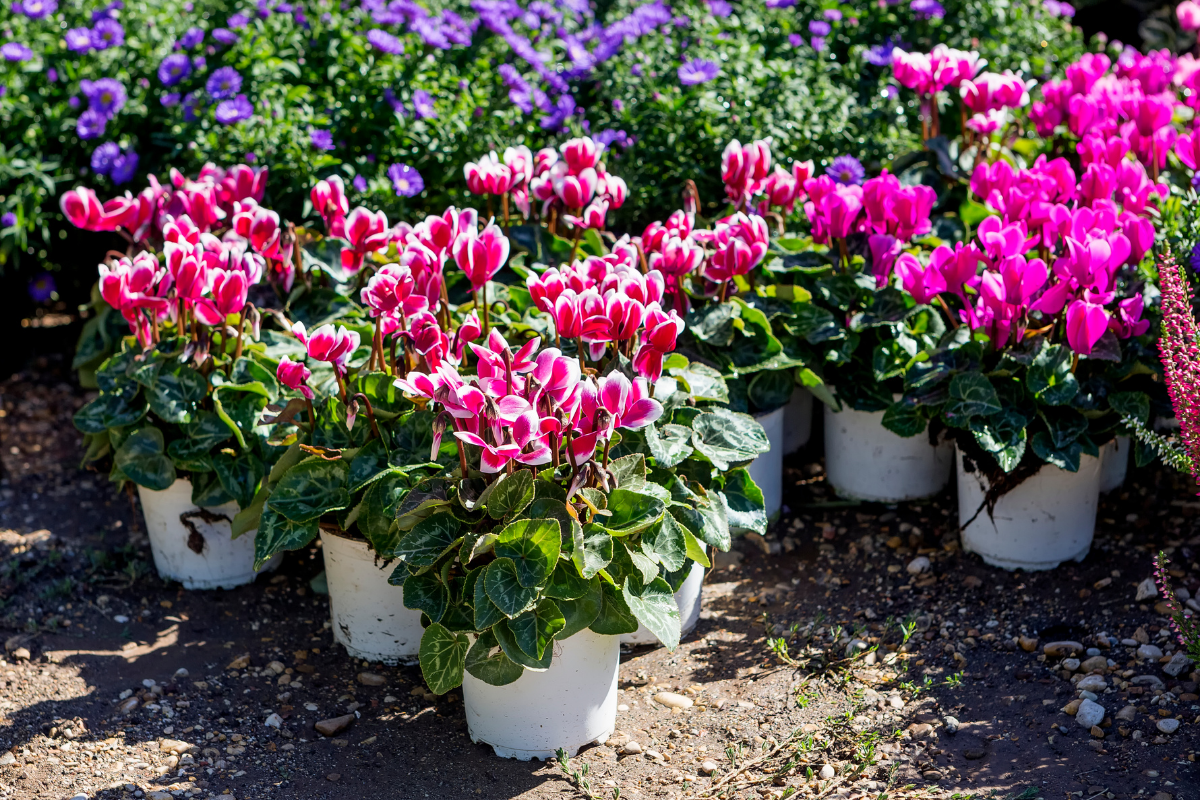
Cyclamen flowers when almost everything else is resting, carrying its swept-back blooms from autumn through to spring over marbled, heart-shaped leaves. It is one of the most popular winter pot plants and, in its hardy forms, a woodland garden plant that spreads happily under trees. It is also one of the most commonly killed houseplants, almost always for the same two reasons, too much warmth and water poured into its centre. This guide covers how to grow and care for cyclamen in pots and in the garden, how to water it properly, what to do in its summer dormancy and how to bring the same plant back into flower year after year.
What is cyclamen
Cyclamen is a Mediterranean perennial in the primrose family (Primulaceae) that grows from a flattened underground tuber, often sold as a bulb although botanically it is a corm-like tuber. The leaves are heart-shaped, dark green with silvery marbling, and the flowers are held upside down on slim stems, with reflexed petals in white, pink, red and purple. The name comes from the Greek word for circle, a reference to the rounded tuber. In Greece and around the Aegean, wild cyclamen such as Cyclamen graecum flower every autumn from rock crevices and beneath trees, which says a lot about the conditions the plant prefers.
Types of cyclamen
The key distinction is between the florist's cyclamen sold in pots and the hardy species grown outdoors, because they are treated differently.
| Type | Where it fits | Flowering |
|---|---|---|
| Florist's cyclamen (C. persicum) | The classic potted cyclamen, for a cool, bright room or a sheltered balcony, not frost-hardy | Autumn to spring |
| Ivy-leaved cyclamen (C. hederifolium) | The toughest garden species, for dry shade under trees and shrubs, where it self-seeds and spreads | September to November |
| Round-leaved cyclamen (C. coum) | Hardy and winter-flowering, for colour in the coldest months of the garden | Winter to early spring |
| Greek cyclamen (C. graecum) | The common wild cyclamen of Greece, for rock gardens and Mediterranean plantings | Autumn |
Position and temperature
Cyclamen is a plant of cool shade. It grows best in partial or dappled shade, in a sheltered spot outdoors or the coolest bright room indoors, and it performs best between 10 and 18°C. Heat is its enemy. A warm, centrally heated living room sends a florist's cyclamen into early dormancy within weeks, with yellowing leaves and collapsing flowers, so keep it well away from radiators and fireplaces and give it the coolest position you have. Hardy species tolerate frost without protection, while the florist's cyclamen needs shelter from freezing.
Planting the tuber
Plant cyclamen tubers from September to November, shallowly, about 3 to 5 cm deep. The rounded side faces down and the flatter or slightly concave side, where the shoots emerge, faces up. In the ground, space tubers 15 to 20 cm apart, and in a pot leave the top of the tuber sitting just proud of the compost surface, which protects the crown from rot.
The growing medium matters more than feeding. Cyclamen needs a light, humus-rich mix with excellent drainage, such as compost opened up with grit or perlite, because standing moisture rots the tuber faster than anything else. Heavy clay is the one soil to avoid, and pots must have drainage holes.
Because the root system is shallow, cyclamen suits wide, relatively shallow containers around 20 to 25 cm deep, and early autumn is the right moment to repot, just before the new season's growth begins.
Watering, the job that decides everything
Most cyclamen are lost to watering mistakes rather than neglect. Water moderately, once or twice a week during the growing season, and only when the surface of the compost has dried. Pour the water around the plant, never into its centre, onto the tuber, the leaves or the stems, because moisture sitting there causes rot and fungal disease.
The safest method for pots is watering from below. Stand the pot in a basin of water for 10 to 30 minutes so the compost draws moisture up from the base, then let it drain fully. The tuber and foliage stay completely dry. Never leave the pot standing in a saucer of water.
Feeding and grooming
Through the flowering season, feed with a water-soluble fertiliser for flowering plants every three to four weeks at half the stated strength. Overfeeding produces lush leaves at the expense of flowers.
Weekly grooming keeps a cyclamen flowering all winter. Remove yellowing leaves and spent flowers by twisting or pulling the whole stem cleanly from the base rather than cutting it halfway, since stubs left behind rot on the tuber and invite grey mould.
Summer dormancy and reblooming
In spring the leaves yellow and die back, and this is not a sign of failure but the natural end of the cycle, as the tuber enters summer dormancy to sit out the heat. Once the foliage has dried, cut it away, stop watering completely and move the pot to a shaded, cool, dry place for the whole summer.
In early autumn, as temperatures fall, the tuber wakes. Resume careful watering around the start of September, and once new growth shows, return to the normal routine. Managed this way, the same cyclamen flowers for many years instead of being thrown away every spring, and old tubers only get bigger and more generous with time.
Propagation
Cyclamen is propagated from seed, since dividing the tuber rarely succeeds and usually destroys it. Soak the seed in tepid water for a few hours, sow it in a light mix and cover it lightly, because it germinates in darkness, then be patient, as germination takes one to three months. In the garden, hardy species self-seed steadily, with ants carrying the sticky seeds away and gradually extending the colony.
Is cyclamen poisonous to cats and dogs
Yes. According to the ASPCA, cyclamen is toxic to cats and dogs, with the highest concentration of its irritant saponins in the tuber. Chewing the plant causes drooling, vomiting and diarrhoea, and eating a quantity of tuber can cause more serious effects, so keep pots out of reach of pets that dig or chew, and contact a vet promptly if any part is eaten.
Frequently asked questions
When does cyclamen flower
From autumn to spring, depending on the type. Florist's cyclamen flowers from roughly October to April, ivy-leaved and Greek cyclamen in autumn, and Cyclamen coum in the middle of winter.
Why are my cyclamen's leaves turning yellow
In spring it is simply dormancy beginning, which is normal. During the growing season, yellowing usually means the plant is too warm, sitting near a radiator, or being overwatered.
How do I get a cyclamen to flower again next year
Respect its dormancy. When the leaves die back in spring, stop watering and keep the pot dry and shaded all summer, then start watering again in early autumn and the tuber will regrow and rebloom.
Can cyclamen grow indoors
Only somewhere cool. It needs a bright room at around 10 to 18°C, away from radiators, and in a warm living room it fades within weeks, while on a cool porch or balcony it flowers all winter.
How should I water a cyclamen
Once or twice a week when the compost surface is dry, from below if possible, by standing the pot in water for 10 to 30 minutes. Never pour water into the centre of the plant or over the tuber.
Do cyclamen come back every year
Yes, if the tuber is kept dry and shaded through its summer dormancy. Hardy garden species return and even spread by self-seeding, while florist's cyclamen rebloom indoors for years with the same treatment.
Important notes
Every home and garden is different, and how a cyclamen performs depends most on temperature, light and drainage. The guidance above is a general starting point.
Because the plant, and especially the tuber, is toxic to pets, keep it out of reach of cats and dogs, and seek veterinary help if any part is eaten. Old folk uses of the tuber are unsafe for the same reason and should not be attempted.
References
- Royal Horticultural Society, Hardy cyclamen.
- ASPCA Animal Poison Control, Cyclamen.
- Cyclamen Society, Cultivation.