
Freesias open the autumn bulb season, going into the ground from early September to early December in mild climates and flowering 12 to 13 weeks after planting, from late winter into spring. Their sweet, penetrating fragrance keeps them near the top of every list of scented flowers, in the garden and in the vase alike. This guide covers when and how to plant freesia corms, growing freesias in pots, watering and feeding, what to do with the corms after flowering, why freesias sometimes disappoint, and how to cut them for the vase.
What is a freesia
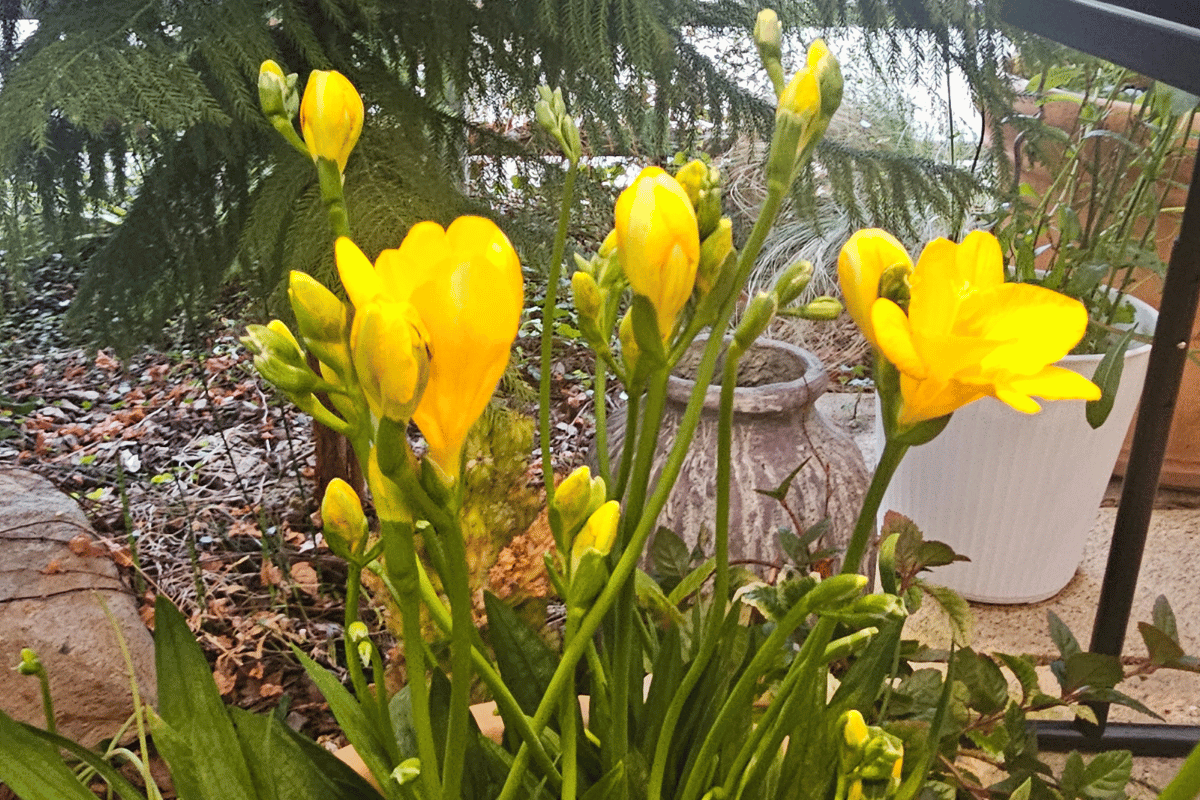
The freesia (Freesia) is a herbaceous perennial in the iris family (Iridaceae), native to South Africa's Cape region, where it grows on sunny plains. The genus was described in 1866 and named after the German botanist and physician Friedrich Freese. The plant grows from a small conical corm, 1 to 2.5 cm across, and produces narrow, sword-shaped leaves and thin flowering stems with a signature bend near the top, so that the tubular blooms line up along one side of the spike, all facing upward.
Garden freesias are hybrids of the wild African species, with single or double flowers in white, yellow, orange, pink, red, purple and bicolour combinations. Botanically the corm renews itself every season, with the old corm withering as a new one forms above it, which is why lifting and storing works so smoothly.
When do freesias bloom
Autumn-planted freesias flower from late winter into spring, roughly 12 to 13 weeks after planting, and a well-planted pot stays in bloom for around a month as the spikes open in succession. Flowering ends with the first real heat, because above roughly 21°C the plant stops blooming and heads into dormancy. Freesias are strictly cool-season flowers, which is exactly why they suit Mediterranean winters and cool greenhouses so well.
When and how to plant freesia corms
In mild-winter climates, plant freesia corms from early September to early December, traditionally the first bulbs of the autumn season, ahead of tulips and hyacinths. In cold-winter regions, where young plants would be lost to frost, plant in spring after the last frost for summer flowering, or grow them in pots under cover. Choose large, firm corms without soft spots, since bigger corms carry more flower spikes. Planting comes down to four moves:
- Depth: 5 to 8 cm, with the pointed tip facing up
- Spacing: 8 to 10 cm apart in the ground, closer in containers
- Position: sunny, cool and sheltered from strong wind
- Watering: one thorough watering after planting, then restraint until shoots appear
Position and soil
Freesias need full sun or the lightest shade and a cool position to flower well. The soil should be light, free-draining and only moderately fertile, without heavy doses of organic matter, because nitrogen-rich ground pushes leaves at the expense of flowers and standing water rots the corms. The thin stems lean under the weight of the blooms, so in beds it pays to push a few twiggy sticks in among the corms at planting time as discreet support, a trick the RHS recommends for exactly this plant.
Growing freesias in pots
Pots are the natural home of the freesia, offering full control over drainage and easy shelter from heavy rain and frost. Choose a relatively tall container, since the plant makes a long tap root, with drainage holes and a layer of grit or pumice at the base, filled with a light, free-draining potting mix. Plant the corms densely, and a 15 cm pot comfortably takes 10 to 15 corms for a genuinely full display, with 5 to 7 corms the standard for a smaller pot.
After planting, keep the pot in a cool spot at around 5°C for three to four weeks until shoots emerge, then move it into good light at 10 to 15°C. This cool start, straight from the RHS playbook, produces sturdy, compact plants that stand up instead of flopping.
Watering and feeding
Water with restraint at first, because corms rot easily in wet compost before they root. Once shoots appear, water once or twice a week to keep the mix moist but never soggy, stepping up slightly through flowering. After the blooms fade and the foliage starts to yellow, reduce watering gradually and then stop, letting the corms dry off for dormancy.
Feeding stays light. A water-soluble fertilizer high in potassium and phosphorus, applied every two to three weeks during growth and early flowering, is all freesias need. Avoid nitrogen-heavy feeds, which produce foliage instead of flowers.
After flowering
Cut the spent spikes and leave the leaves to yellow and die back on their own, because they recharge the new corm forming for next year. In mild-winter regions the corms can stay in the ground, or the pot can simply move to an out-of-the-way corner protected from summer and autumn rain, so the corms rest dry. Otherwise, lift the corms once the foliage has withered, clean them and store them in a dry, shaded, airy place until autumn. Lifting is also the moment to separate the small cormlets that form around the parent, which flower from their second year onward.
Why freesias fail to flower
The reputation for being tricky comes down to two mistakes. The first is heat, since freesias stop flowering above roughly 21°C, so late planting in a warm spot produces plants that summer overtakes before they bloom. The second is water, because corms rot in heavy, soggy soil before they even sprout. Planted early in autumn in light soil, watered with restraint and given a cool start, freesias rank among the easiest bulbs, and ordering the corms in late summer, alongside the other August garden jobs, secures the best varieties.
Freesias as cut flowers
Freesias are among the finest scented cut flowers and a staple of spring bouquets. Cut the stems early in the morning, when the first bloom on the spike has just opened and the rest are still in bud, and they last one to two weeks in the vase with regular water changes, opening every bud along the spike in turn.
Frequently asked questions
When should freesias be planted
From early September to early December in mild-winter climates, 5 to 8 cm deep with the pointed tip up. In cold regions, plant in spring after the last frost or grow them in pots under cover.
How long do freesias take to bloom
About 12 to 13 weeks from planting, with autumn-planted corms flowering from late winter into spring.
Do freesias come back every year
Yes. In mild climates the corms stay in the ground and return each year, while in cold or wet-summer regions they are lifted after the foliage dies back and stored dry until autumn.
How many freesia corms fit in a pot
A 15 cm pot takes 10 to 15 corms planted densely at 5 to 8 cm deep, and a smaller pot takes 5 to 7. Dense planting is what produces the full, bouquet-like effect.
Why are my freesias not flowering
The usual causes are heat above roughly 21°C, too much shade, overwatering or waterlogged soil, nitrogen-rich ground that favours leaves, and small or exhausted corms.
Do freesia corms multiply
Yes, each corm renews itself annually and produces small cormlets around its base. Separated at lifting and grown on, the cormlets reach flowering size from their second year.
Important notes
Every garden is different, and results depend on your climate, soil and the quality of the corms, so treat the guidance above as a general starting point. Freesias are not reliably hardy in cold-winter regions, where pot culture under cover is the safer route.
References
- Royal Horticultural Society, How to grow freesias.
- BBC Gardeners' World Magazine, Growing freesias.