
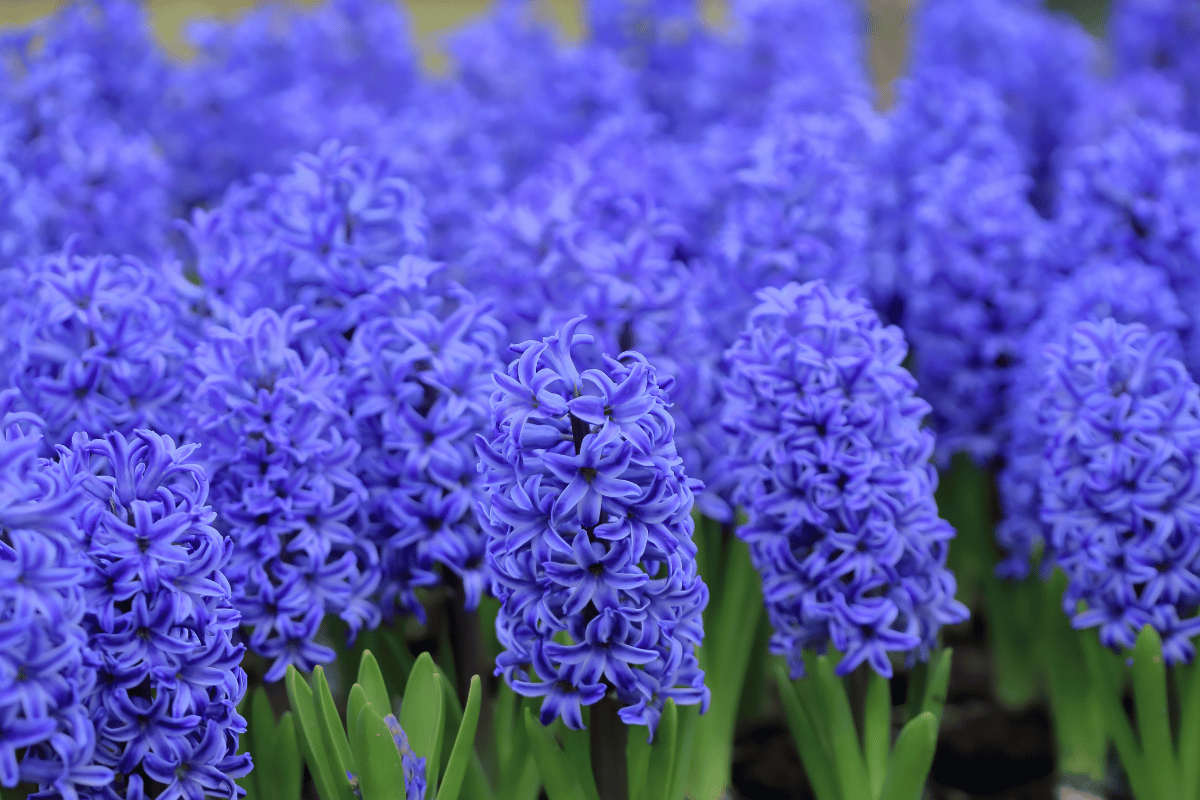
Hyacinths are planted from September to November and flower just two to two and a half months later, filling gardens, pots and windowsills with the strongest fragrance of any spring bulb. They grow as happily in plain water as in soil, which makes them the most indoor-friendly of the autumn-planted bulbs, and a single packet of bulbs can supply both the border and a vase on the kitchen table. This guide covers when and how to plant hyacinth bulbs, why they are handled with gloves, growing them in pots and in water, forcing them for winter bloom, watering and feeding, and what to do after flowering.
What is a hyacinth
The hyacinth (Hyacinthus orientalis) is a perennial bulb in the family Asparagaceae, native to Iran and the wider Middle East, with most commercial bulbs now produced in the Netherlands. Each bulb sends up one dense, upright spike packed with small, waxy, intensely fragrant flowers, reaching about 30 cm tall. The classic colour is blue or violet, and modern varieties add white, pink, magenta, yellow and deep purple, in single or double forms. The name comes from Greek mythology and Hyacinthus, the youth loved by Apollo, from whose blood the flower was said to have sprung.
When do hyacinths bloom
In the garden, hyacinths flower from late winter to early spring, roughly two to two and a half months after planting, noticeably faster than tulips. Each spike stays in bloom for two to three weeks, and cool weather stretches the display. Indoors, pre-chilled bulbs forced in water or compost can flower from late December, which is why hyacinths are the classic Christmas bulb.
When and how to plant hyacinth bulbs
Plant hyacinth bulbs in autumn, from September to November, once the soil has cooled, and order the bulbs early for the best choice of varieties. Choose large, firm bulbs with no mould or soft spots, because the bigger the bulb, the fuller the flower spike.
Gloves are the one rule that sets hyacinths apart from other bulbs. The bulb's surface contains irritant substances that can cause itching and an allergic skin reaction, so wear gloves for every handling step, from opening the bag to planting. The planting itself is simple:
- Depth: about 10 cm deep, pointed tip facing up
- Spacing: 13 to 15 cm apart in the ground, in groups of five or more for impact
- Soil: well-drained and moderately fertile, in full sun to light shade
- Watering: water thoroughly once after planting, then let winter rain take over
Hyacinths need a cold period of 10 to 12 weeks to develop good roots and shoots, which an outdoor winter provides on its own.
Growing hyacinths in pots
Hyacinths grow particularly well in containers. Choose a pot at least 15 cm deep with drainage holes, use peat-free multipurpose compost, and set the bulbs close together without letting them touch each other or the pot walls, with their tips level with or just below the surface. Stick to one variety per pot, because different varieties grow at different rates and a mixed pot flowers unevenly. For bowls without drainage holes, use bulb fibre instead of compost, as it holds moisture without turning soggy. Keep the potted bulbs cool, dark and barely moist for their chilling period, then bring them into the light once the shoots are 5 to 8 cm tall, and rotate the pot every few days so the top-heavy spikes grow straight instead of leaning toward the window.
Growing hyacinths in water
Growing a hyacinth in plain water is the plant's best-known trick. Use a hyacinth glass, the hourglass-shaped vase that holds the bulb above the water, or a bowl of pebbles with the bulb resting on top. The steps are the same either way:
- Fill the vessel so the water just touches the base of the bulb, never covering it
- Keep it in a cool, dark place at 4 to 8°C for around 10 weeks, until roots fill the glass and a shoot emerges
- Lower the water level so only the roots sit in water, and refresh it every 10 to 15 days
- Move the glass to a bright spot out of direct sun and let it flower
Forcing hyacinths for Christmas
For flowers in December, buy bulbs sold as "prepared", which have already received part of their cold treatment. Pot them in early autumn, or chill ordinary bulbs yourself in a paper bag in the refrigerator for 12 to 14 weeks at 4 to 7°C, kept away from ripening fruit such as apples, whose ethylene damages the flower bud. After chilling, keep the potted bulbs in a cool, dark spot at around 10°C for one to two weeks to build a strong stem, then bring them into indirect light at normal room temperature and the spikes will open within weeks.
Watering and feeding
Water sparingly at first, because a bulb without roots rots easily in wet compost. Once growth is under way, water once or twice a week whenever the surface of the compost dries out, keeping it slightly moist and never waterlogged. Feeding is equally restrained. A liquid fertilizer for flowering plants applied once when the flower spike appears, and once more two weeks later, is enough. Overfeeding does not add flowers and is one of the common causes of a poor spike.
What to do after flowering
When the spike fades, cut it off at its base and leave the leaves untouched to yellow and die back naturally, because they recharge the bulb for next year. Garden hyacinths are perennial and can stay in the ground, going dormant over summer and returning each spring, though the spikes of later years come back looser and more informal than the tightly packed spike of the first season. Bulbs forced indoors in water or bowls are more depleted, so plant them out in the garden after flowering, where they usually recover and bloom again within two to three years, in step with daffodils and the other naturalised spring bulbs.
Why a hyacinth produces few flowers
A thin or stunted spike usually comes down to three causes: a winter too warm to give the bulb its full cold period, overwatering that damages the roots, and overfeeding. Small or exhausted bulbs also throw small spikes, which is why large top-size bulbs are worth the small extra cost.
Frequently asked questions
Are hyacinths better in pots or in the ground
Both work well. The ground suits a permanent display that returns each spring, while pots suit balconies and indoor forcing, provided the container is at least 15 cm deep and holds one variety only so the bulbs flower together.
What is the best month to plant hyacinths
September to November, once the soil has cooled. For Christmas flowers indoors, pot prepared bulbs in early autumn.
Do hyacinths come back every year
Yes, garden hyacinths are perennial and rebloom each spring if the foliage is left to die back naturally, though the spikes become looser over the years. Forced indoor bulbs should be planted out in the garden to recover.
How many times a year does a hyacinth bloom
Once. Each bulb produces one flowering spike per season, lasting two to three weeks, and then rests until the following spring.
What do I do with a potted hyacinth after it blooms
Cut off the spent spike, keep watering until the leaves die back, then plant the bulb out in the garden. It is too depleted to force again indoors, but outdoors it usually flowers again within two to three years.
Important notes
- Wear gloves whenever you handle hyacinth bulbs, as their surface irritates the skin and can trigger an allergic reaction.
- Hyacinth bulbs are toxic if eaten, and the ASPCA lists hyacinths as toxic to both cats and dogs, so keep bulbs and plants away from pets that dig or chew.
- Keep bulbs chilling in the refrigerator away from ripening fruit, as ethylene damages the developing flower bud.
References
- Royal Horticultural Society, How to grow hyacinths.
- ASPCA Animal Poison Control, Hyacinth.