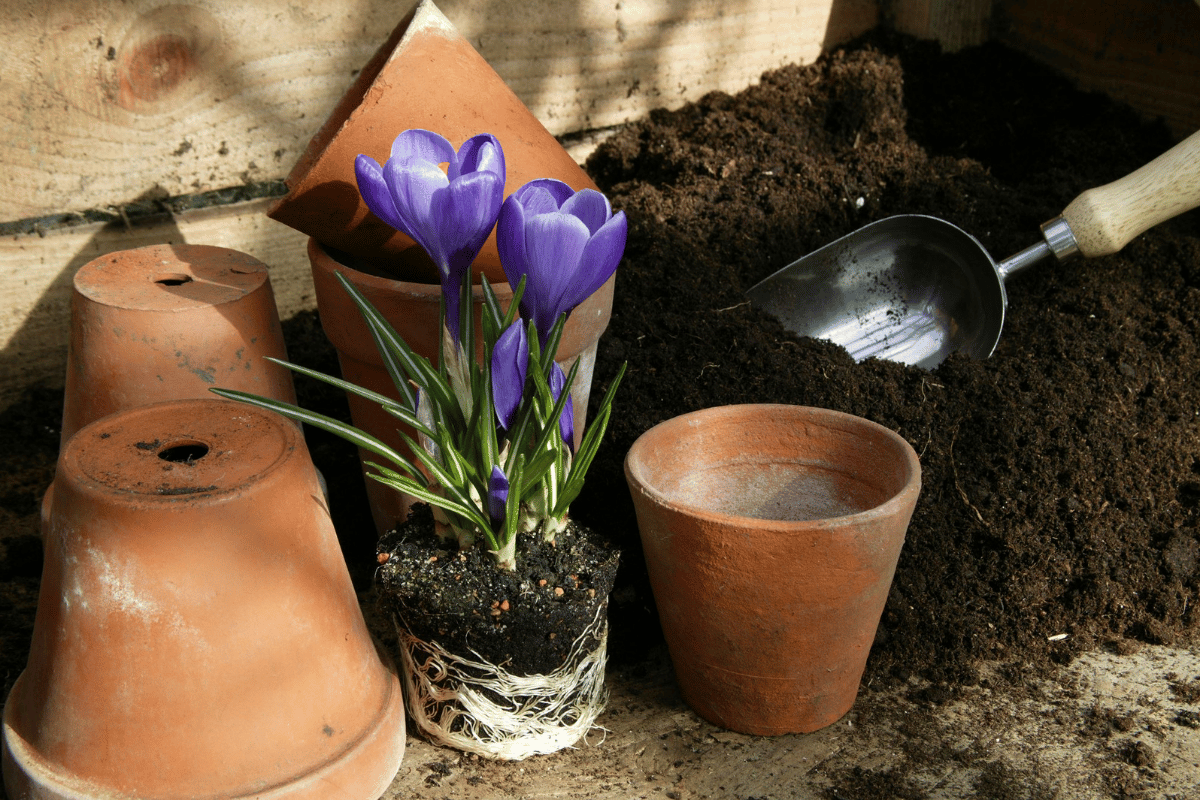
Crocuses are planted from September to November and flower in late winter, among the very first blooms of the year, often pushing through the last of the cold. The same genus also holds the saffron crocus, which runs the calendar in reverse, planted in summer, flowering in October and November, and yielding saffron, the most expensive spice in the world, from its red stigmas. This guide covers the types of crocus, when and how to plant the corms, care in beds, lawns and pots, growing your own saffron, and a critical warning about the poisonous lookalike the crocus must never be confused with.
What is a crocus
The crocus (Crocus) is a genus of about 100 species of low bulbous plants in the iris family (Iridaceae). It reaches just 10 to 20 cm tall, with narrow, grass-like leaves marked by a white central stripe, and because the flowering stem stays underground, the cup-shaped blooms in white, yellow, orange and purple appear to sit directly on the soil. Greece ranks among the richest countries in wild crocus species, and the wild Crocus cartwrightianus of Attica, the Cyclades and Crete is considered the ancestor of the cultivated saffron crocus.
Ornamental and edible crocuses
| Group | When to plant | When it blooms |
|---|---|---|
| Spring-flowering ornamentals (vernus, chrysanthus, Dutch hybrids) | September to November | Late winter to early spring, among the first flowers of the year |
| Autumn-flowering ornamentals (speciosus and others) | Late summer | October to November |
| Saffron crocus (Crocus sativus), the edible one | July to early October | October to November, with the stigmas harvested by hand |
When and how to plant crocus corms
Plant spring-flowering crocuses from September to November, alongside tulips and the other autumn bulbs, so they receive the 10 to 12 weeks of cold they need. Choose firm, plump corms and plant them in groups, because the crocus is a small plant and only dense clusters make a show. The basics of planting:
- Depth: 5 to 10 cm, pointed tip facing up
- Spacing: 5 to 8 cm apart in the ground, even closer in pots
- Groups: at least 10 to 15 corms together for visible impact
- Watering: one light watering straight after planting
Late planting, even into December or January, is not ideal but beats leaving the corms to dry out in the bag. Late-planted crocuses flower later and more thinly in their first year and return to normal the next.
Position and soil
Crocuses need a sunny spot with at least 6 hours of direct light and a light, airy soil of moderate fertility with excellent drainage. Compacted, clayey, permanently damp ground is where corms rot. The plant itself is extremely cold-hardy, down to about −15°C, though frost during flowering spoils the open blooms. Crocuses also excel naturalised in lawns, spreading on their own year after year like daffodils, as long as the first mowing waits until the foliage has died down.
Growing crocuses in pots
In containers, crocuses perform beautifully in a pot at least 20 cm wide and deep with drainage holes, filled with a light potting mix opened up with a handful of perlite or coarse sand. Plant the corms densely, 2 to 5 cm apart without touching, at 5 to 10 cm deep. In a bulb lasagne, the layered pots of mixed bulbs, the crocus always takes the top layer at 7 to 12 cm, above tulips and hyacinths, and opens the season before everything else. Pots can also be forced for late-winter flowers indoors, kept cold and dark until the shoots show and then brought into a bright, cool room.
Watering and feeding
The crocus is among the most drought-tolerant bulbs. After the light watering at planting, keep the soil moderately moist through growth and flowering, and completely dry through the summer dormancy, because damp summer soil is the most common way corms are lost. Feeding amounts to a little compost or well-rotted manure at planting and a small dose of granular fertilizer when the flower shoots start to develop.
Growing your own saffron
The saffron crocus (Crocus sativus) is the edible crocus whose dried red stigmas are the spice saffron. Its harvest appears in Minoan frescoes painted three and a half millennia ago, and Greece's Kozani saffron holds PDO status among the world's finest. The plant is sterile and sets no seed, so it multiplies only vegetatively, through cormlets.
In practice, the saffron crocus grows easily in a garden bed or a large pot. Plant the corms from July to early October, deeper than the ornamentals at 10 to 15 cm and about 10 to 15 cm apart, in full sun and perfectly drained soil, and the flowers arrive in October and November. Pick the stigmas by hand early in the morning from fully open flowers, then dry them. The numbers explain the price of the spice, since a full 1,000 m² field yields on average only about 800 grams of saffron a year. For a few homegrown pinches, 20 to 30 corms in a sunny corner or two large pots are enough.
After flowering
Once the blooms fade, let the foliage yellow and die back on its own, because it recharges the corm for next year. The corms are not lifted. They stay in place, rest dry through summer and return every year, producing cormlets and steadily thicker clumps. When after 4 to 5 years the clumps congest and flowering thins out, lift the corms in summer, separate them and replant.
Beware the toxic lookalike
The crocus has a double that everyone growing it should know. The autumn crocus or meadow saffron (Colchicum autumnale) flowers at the same time as the saffron crocus, with similar mauve blooms, yet it is no crocus at all. It belongs to a different family and every part of it is severely poisonous, with a toxin that cooking does not destroy. No "saffron" should ever be picked from a plant that has not been positively identified as Crocus sativus. Colchicum gives itself away by the 6 stamens in its flower, against the crocus's 3, and by its broad leaves, nothing like the crocus's grassy ones. As for ornamental crocuses, they are mildly toxic to cats and dogs if eaten, so keep corms and plants away from pets that dig.
Frequently asked questions
When should crocus corms be planted
Spring-flowering ornamentals from September to November, 5 to 10 cm deep. The edible saffron crocus goes in earlier, from July to early October, and deeper, at 10 to 15 cm.
When do crocuses bloom
Spring crocuses flower in late winter and early spring, among the first blooms of the year. The saffron crocus and the autumn-flowering ornamentals bloom in October and November.
Do crocuses come back every year
Yes, crocuses are reliable perennials. The corms stay in the ground, multiply through cormlets and thicken into larger clumps on their own year after year.
Can I plant crocus bulbs in January
Yes, if the ground can still be worked, though the first year's flowering will be late and thin. It is still better than letting the corms dry out in their bag.
Can I grow my own saffron
Yes, with saffron crocus (Crocus sativus) corms planted in summer in full sun and sharply drained soil. Twenty to thirty corms yield a few pinches of saffron a year, with the stigmas picked by hand early in the morning.
Are crocuses toxic
Ornamental crocuses are mildly toxic to cats and dogs. The real danger is colchicum, the poisonous "autumn crocus" of a different family, which resembles the crocus but carries 6 stamens instead of 3 and must never be picked for saffron.
Important notes
Every garden is different, and results depend on your climate, soil and the corms you start with, so treat the guidance above as a general starting point.
Never harvest or consume any part of a plant resembling a crocus unless it has been positively identified as Crocus sativus, since the lookalike colchicum is severely poisonous. Ordering corms in late summer, with the other August garden jobs, secures the best varieties.
References
- Royal Horticultural Society, How to grow crocuses.
- ASPCA Animal Poison Control, Crocus.