

Italy's national average price for extra virgin olive oil was €4.75 per kilo in the week of 12 October 2026, 48.0% lower than in the same week of 2025, according to a Wikifarmer analysis of the weekly prices that member states report to the European Commission. In the same week the Spanish price was €3.26 and the Greek price €3.45 per kilo, both about 23% lower than a year earlier. These prices are the starting point of the 2026/27 season, as the new olive harvest begins.
Italy was 45.5% dearer than Spain
Every member state that produces more than 20,000 tonnes of olive oil reports a weekly national average price per olive oil category to the European Commission, for bulk oil at the mill exit (Commission Implementing Regulation (EU) 2017/1185). In the week of 12 October, Italy's extra virgin price was 45.5% above Spain's. The gap had been 31.7% the week before and 115.5% a year earlier. In the same week Italy's price was 37.5% above Greece's, and Portugal stood at €3.52 per kilo (Agri-food Data Portal).
These comparisons are producer prices within each country. For trade between countries, export data show that Italy pays less per kilo for Spanish extra virgin olive oil than most buyers.
| Country | Week of 12 October 2026 (€/kg) | Week of 5 October 2026 (€/kg) | Change in one week | Week of 13 October 2025 (€/kg) | Change in one year |
| Italy | 4.75 | 4.37 | +8.7% | 9.14 | −48.0% |
| Greece | 3.45 | 3.64 | −5.2% | 4.51 | −23.5% |
| Spain | 3.26 | 3.32 | −1.7% | 4.24 | −23.0% |
| Portugal | 3.52 | 3.46 | +1.7% | 4.30 | −18.1% |
Source: Wikifarmer analysis of European Commission weekly olive oil prices (Agri-food Data Portal), national average prices of extra virgin olive oil, bulk at the mill exit. Changes were calculated from prices in euros per 100 kg.
Italy's price fell in early October to its lowest since July 2022
In the week of 5 October, Italy's national price reached €4.37 per kilo, the lowest of all weeks with a reported price since the week of 18 July 2022, when it was €4.35. In September 2025 the same price was above €9 per kilo. From €9.14 in the week of 13 October 2025 it had already fallen to €6.78 by the end of 2025, so more than half of the fall over the year came in the last three months of 2025.
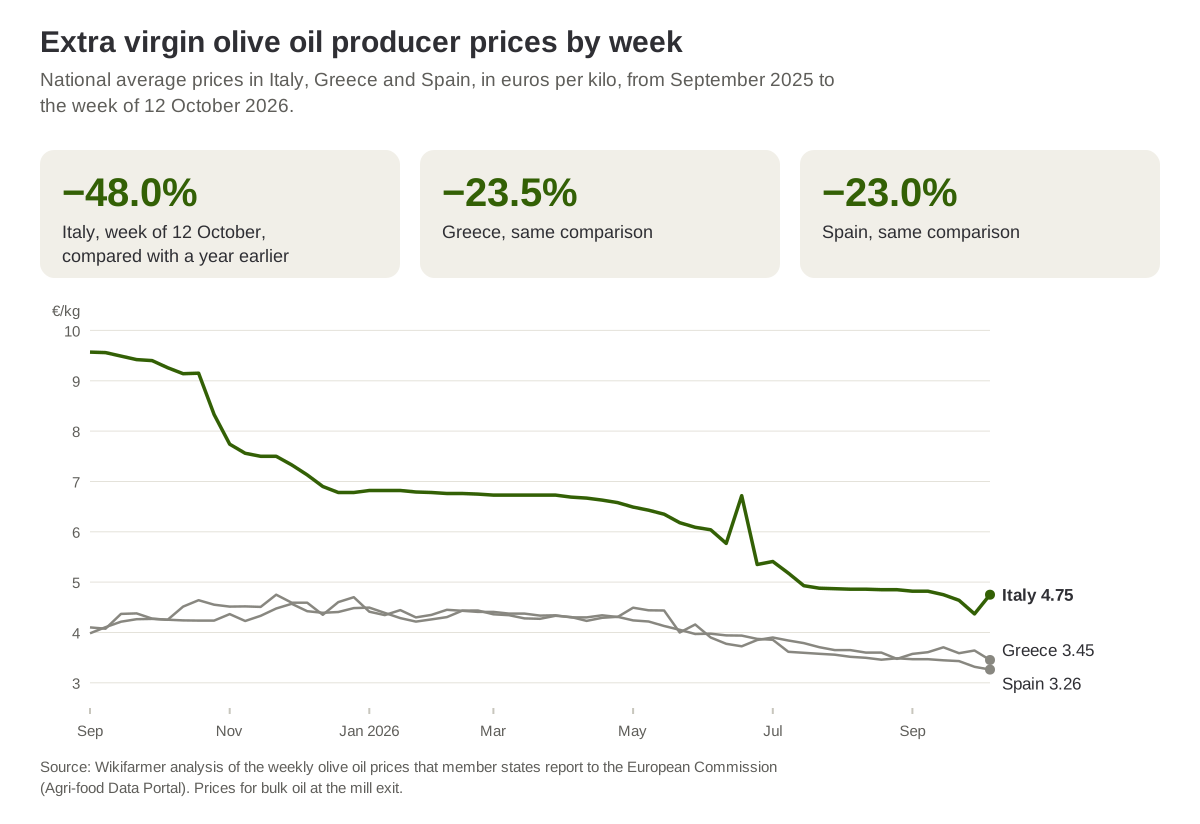
Source: Wikifarmer analysis of European Commission weekly olive oil prices (Agri-food Data Portal).
Italy's average rose while most Italian markets did not
The 8.7% rise in Italy's national price in the week of 12 October does not show up in most of the Italian local markets that report an extra virgin price. Of the seven markets with a price in both weeks, Foggia rose from €4.00 to €4.65 per kilo, while Catanzaro fell from €4.00 to €3.70, Cosenza from €4.05 to €3.70 and Taranto from €4.20 to €4.00. Bari stayed at €4.30, and Palermo and Trapani in Sicily at €6.70. The Commission's data do not show how the markets are weighted in the national average, so a one-week rise is not enough to speak of a recovery in the Italian price.
ISMEA reports the same price for Italy
ISMEA, Italy's public agency for agricultural markets, publishes its own weekly producer price. On its page, as we read it on 21 and 22 October, the latest week carries the label "2026-10-3", and the extra virgin price was also €4.75 per kilo, 48.0% lower than in the same week of the previous year and 8.6% higher than the week before (ISMEA Mercati). ISMEA's page gives no dates for the week, so the match with the Commission's figure covers the price level and the change over the year, while the weekly change differs by 0.1 percentage point.
The Greek price fell 5.2% the week after Spain's fall
The Spanish price fell 3.3% in the week of 5 October, and the following week the Greek price fell 5.2%, from €3.64 to €3.45 per kilo. In Crete, Chania fell from €3.70 to €3.45 and Heraklion from €3.725 to €3.525 per kilo, while Messinia fell from €3.50 to €3.40. In Spain, the price in Jaén, the Spanish province with the largest olive oil output, was €3.29 per kilo in the week of 12 October, from €3.31 the week before.
Since 2005, in weeks when the Spanish price fell by 3% or more on a log basis, the Greek price was lower three weeks later in 31 of the 44 cases with complete data, as our analysis of Greek prices after large Spanish falls shows. For the current Spanish fall, the three-week window closes with the prices of the week of 26 October, so the first week's fall is not enough to say that the Greek price moved the same way.
What the prices mean for producers and buyers
Producers start the new season with producer prices about 23% lower than a year earlier in Greece and Spain and close to half of last year's price in Italy, while bottlers and buyers of bulk oil see a 45.5% gap between Italy and Spain. The data cover one or two weeks and do not show where prices will go during the harvest. In Wikifarmer's assessment, which does not come from the prices themselves, the first prices for new oil and the production estimates will shape the picture in the coming weeks. On production, Greece's 2026/27 crop is estimated at 280,000 to 300,000 tonnes.
On the supply side, our weekly olive oil report showed that Italy ended the 2025/26 season with olive oil stocks of 195,044 tonnes.
One or two weeks of prices are a short record
The prices are national averages and market prices of extra virgin olive oil that member states report to the European Commission in euros per 100 kg, for bulk oil at the mill exit, given here in euros per kilo. Changes are simple percentage changes calculated from prices in euros per 100 kg. The price for the week of 19 October was not yet available on 23 October. Ten weeks are missing from the Italian series since July 2022, so the comparison with July 2022 covers the weeks with a reported price. The "31 of 44" figure comes from the weekly national prices of Spain and Greece since 2005: 49 weeks had a Spanish log fall of 3% or more, 44 of them with complete data, and the Greek price three weeks later was compared with the price in the week of the fall. It describes what happened in the past and is not a forecast. All numbers were recomputed independently from the source files. The data are not advice to buy or sell.
Sources
- European Commission. (2026). Agri-food Data Portal, API guide and weekly olive oil prices. Directorate-General for Agriculture and Rural Development.
- European Commission. (2017). Commission Implementing Regulation (EU) 2017/1185 on the notification of information and documents to the Commission. EUR-Lex.
- ISMEA Mercati. (2026). Olio d'oliva, prezzi medi all'origine, settimanali per prodotto. ISMEA.